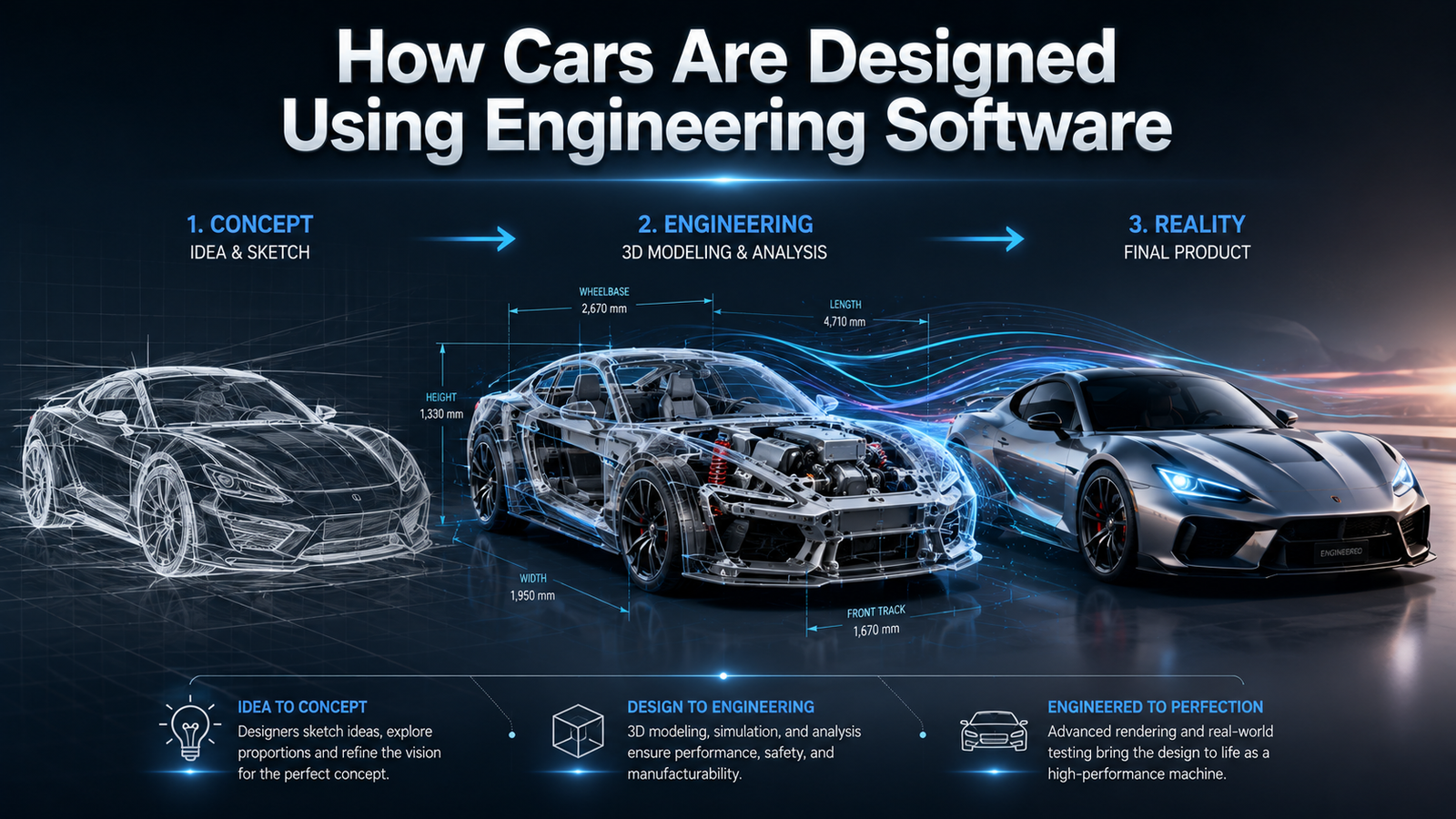
Today, engineers no longer design cars on paper.
Instead, they use advanced tools to create, test, and improve every part digitally. Therefore, understanding
car design using engineering software helps you see how modern vehicles are developed in real industries.
From the first idea to final production, software drives every step of the process.
From Concept to Digital Design
First, engineers start with an idea or concept.
They create rough sketches and then convert them into digital models using CAD software. As a result, they can visualize the car in 3D and make quick changes whenever needed.
In addition, digital design allows better accuracy and faster decision-making.
This process is part of
real CAD workflows in industry, where engineers replace manual drafting with modern tools.
3D Modeling of Car Components
Next, engineers design individual components.
They create parts such as the body structure, engine elements, chassis, and interior systems. Moreover, they define precise dimensions for each component to ensure a proper fit.
Because of this, every part works correctly within the overall system.
This directly connects with
dimension accuracy in mechanical design.
Assembly and System Integration
After designing the parts, engineers assemble them digitally.
They check how components fit and interact with each other. As a result, they identify problems early and fix them before production.
Furthermore, this step improves overall product quality and reduces costly errors.
This step is closely related to
assembly design in CAD.
Simulation and Testing
Before building a physical prototype, engineers test the design using simulation tools.
They analyze strength, safety, aerodynamics, and performance. Therefore, they can improve the design without spending extra time and cost on physical testing.
In addition, simulation helps engineers make better design decisions.
This approach is part of
CAE-based engineering analysis.
Role of Advanced Software in Automotive Design
Engineers use high-end tools like CATIA and UG NX in automotive design.
These tools help them manage complex designs and large assemblies efficiently. Moreover, they allow teams to collaborate and work on different parts of the project at the same time.
As a result, companies complete projects faster and with better accuracy.
This is also seen in
real-world CAD applications.
From Digital Model to Production
Finally, the design moves to manufacturing.
Engineers prepare the model for production using CAM tools and manufacturing software. Therefore, they ensure a smooth transition from design to production.
In addition, this process reduces errors and improves efficiency in manufacturing.
This connects with
industrial design and manufacturing workflows.
Conclusion
Car design depends heavily on engineering software today.
It allows engineers to design, test, and improve vehicles efficiently. Therefore, learning these tools is essential for anyone interested in automotive engineering.
Start Your Journey in Automotive Design
To work in the automotive industry, you need practical knowledge of design software.
At
4Dimensions Infotech, students learn how cars are designed using real engineering tools and workflows.
As a result, you gain the skills required for automotive design careers.
👉
Start learning automotive design and build your engineering career.
Frequently Asked Questions (FAQ)
1. How are cars designed today?
Engineers design cars using CAD, CAE, and simulation software.
2. Which software is used in car design?
Engineers commonly use CATIA, UG NX, and similar tools.
3. What is the role of simulation in car design?
Simulation helps engineers test performance and safety before manufacturing.
4. Do engineers still use manual drawings?
No, most engineers now use digital tools instead of manual drawings.
5. How important is CAD in automotive engineering?
CAD plays a key role in design, modeling, and development.
6. How can I learn car design?
You can learn by practicing CAD tools and working on real design projects.