
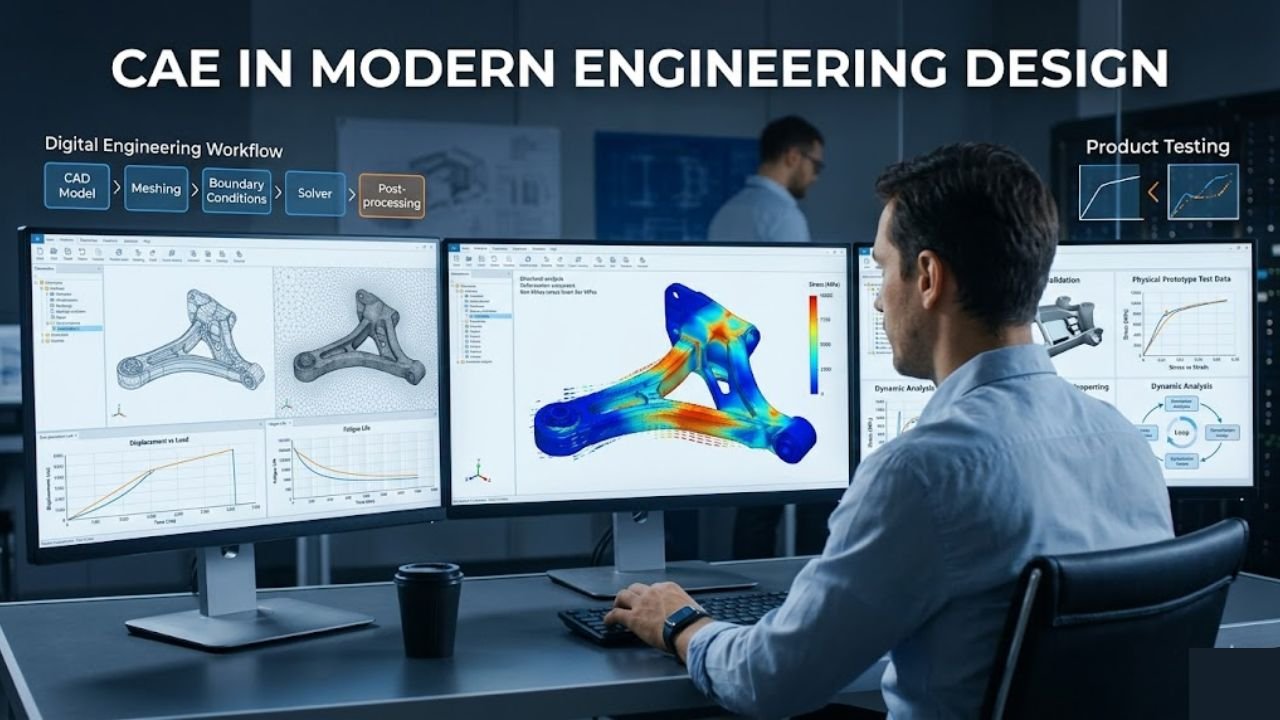
Modern engineering has evolved far beyond traditional drafting and manual calculations. Today, engineers rely heavily on digital tools to design, test, and optimize products before they are manufactured.
One of the most important technologies in this process is CAE (Computer-Aided Engineering). It plays a major role in improving design accuracy, reducing development costs, and speeding up product innovation.
As industries become more competitive, companies expect engineers to understand both CAD modeling and simulation-based engineering workflows.
Because of this, CAE has become an essential part of every modern engineering software course, cad design course, and advanced product development workflow.
Students learning through practical CAD training programs are now expected to understand how products behave under real-world conditions, not just how to create 3D models.
CAE stands for Computer-Aided Engineering.
It refers to the use of engineering software tools to simulate, analyze, and test product performance digitally before manufacturing begins.
Instead of building multiple physical prototypes, engineers now create virtual models and test them using simulation tools.
These simulations help engineers study:
Therefore, CAE helps companies reduce risk, improve safety, and optimize designs much earlier in the development process.
This is one of the biggest reasons why CAE is becoming increasingly important in mechanical engineering, automotive design, aerospace engineering, and industrial product development.
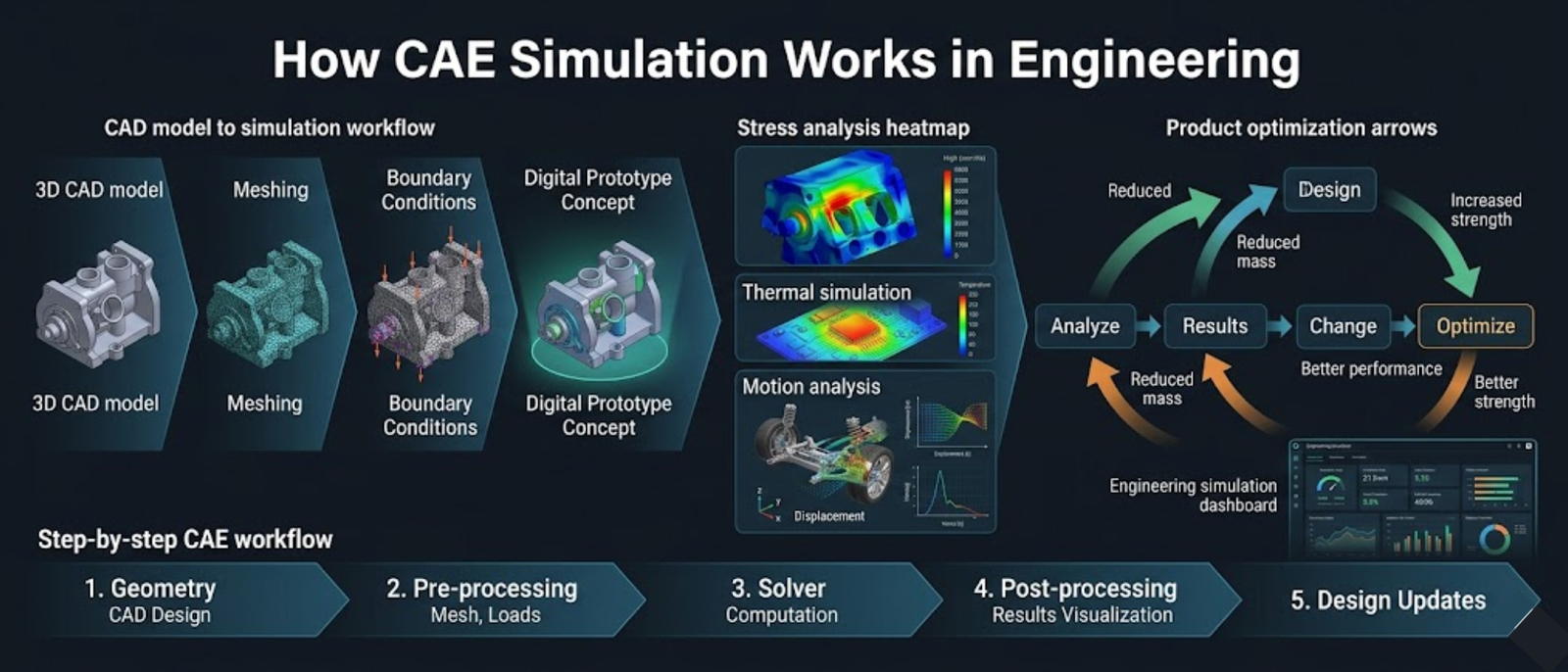
CAE plays a major role in reducing design errors early in the development process.
Because engineers can test products virtually, companies avoid expensive manufacturing mistakes and reduce development time significantly.
In addition, CAE allows engineers to run multiple design iterations quickly.
Instead of redesigning products after physical testing failures, engineers can optimize designs digitally before production begins.
For example, engineers working with SolidWorks course tools or CATIA training workflows can simulate stress, deformation, vibration, and performance behavior directly inside engineering software.
As a result, engineers can improve:
Modern industries no longer rely only on physical testing because simulation-driven engineering is faster, smarter, and more cost-effective.
This is why CAE knowledge is becoming a highly valuable skill for students pursuing careers in product design, mechanical engineering, and CAD-based industries in Pune.

CAE is used across almost every major engineering industry today.
In mechanical engineering, CAE helps engineers analyze stress concentration, structural strength, deformation, and machine performance.
In automotive industries, engineers use CAE for:
Similarly, aerospace engineers use CAE to simulate airflow, thermal conditions, vibration behavior, and structural loads on aircraft components.
Industries such as manufacturing, robotics, industrial automation, and consumer electronics also depend heavily on CAE-driven workflows.
As engineering products become more complex, simulation-based design is becoming a standard part of modern product development systems.
This shift is also closely connected with the rise of automation in design engineering jobs, where engineers are expected to combine CAD modeling with intelligent simulation and optimization workflows.
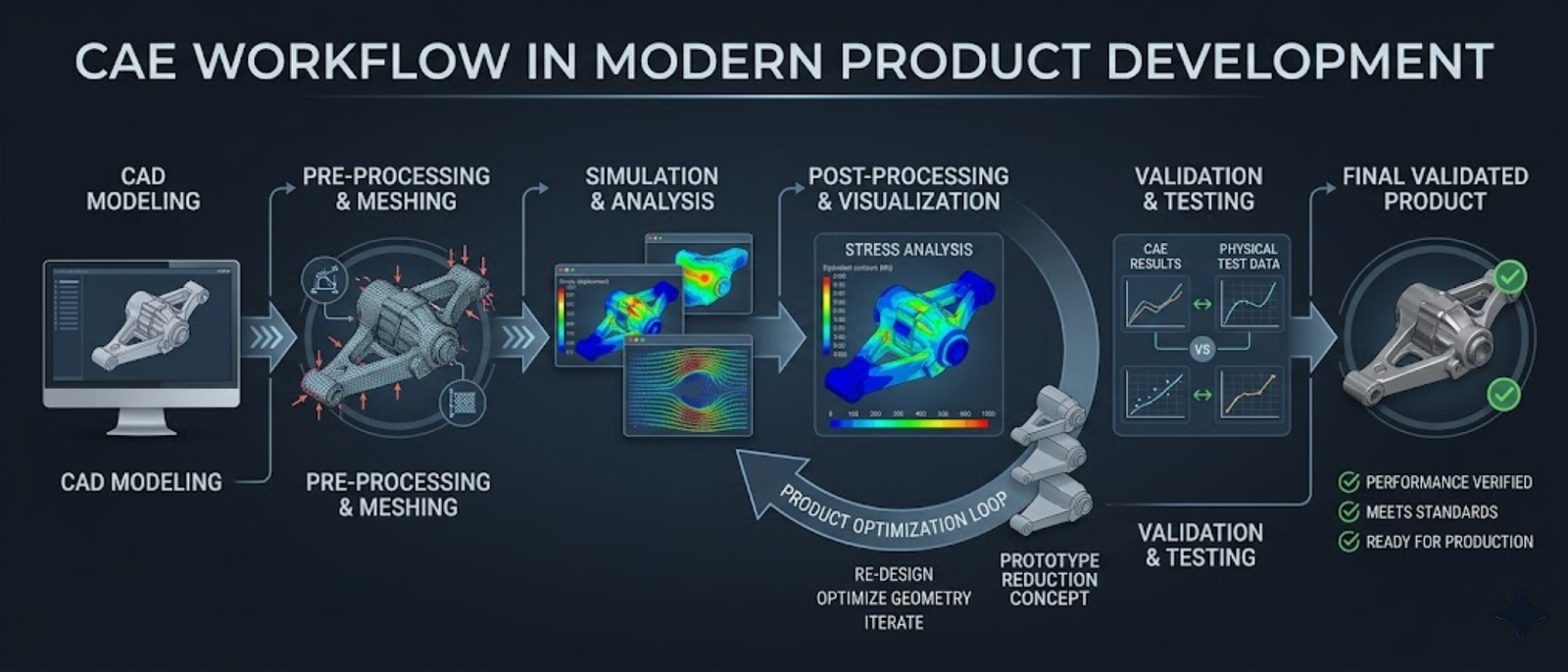
CAD and CAE work together throughout the product development cycle.
First, engineers create a 3D model using CAD software such as AutoCAD, SolidWorks, CATIA, or Creo.
Next, the same model is tested using CAE simulation tools.
If simulation results show stress concentration, deformation, overheating, or design weaknesses, engineers modify the CAD model and test it again.
This continuous loop of design and simulation helps engineers optimize products before physical manufacturing begins.
This is also why engineers who understand both CAD and CAE gain a strong advantage in modern engineering careers in Pune.
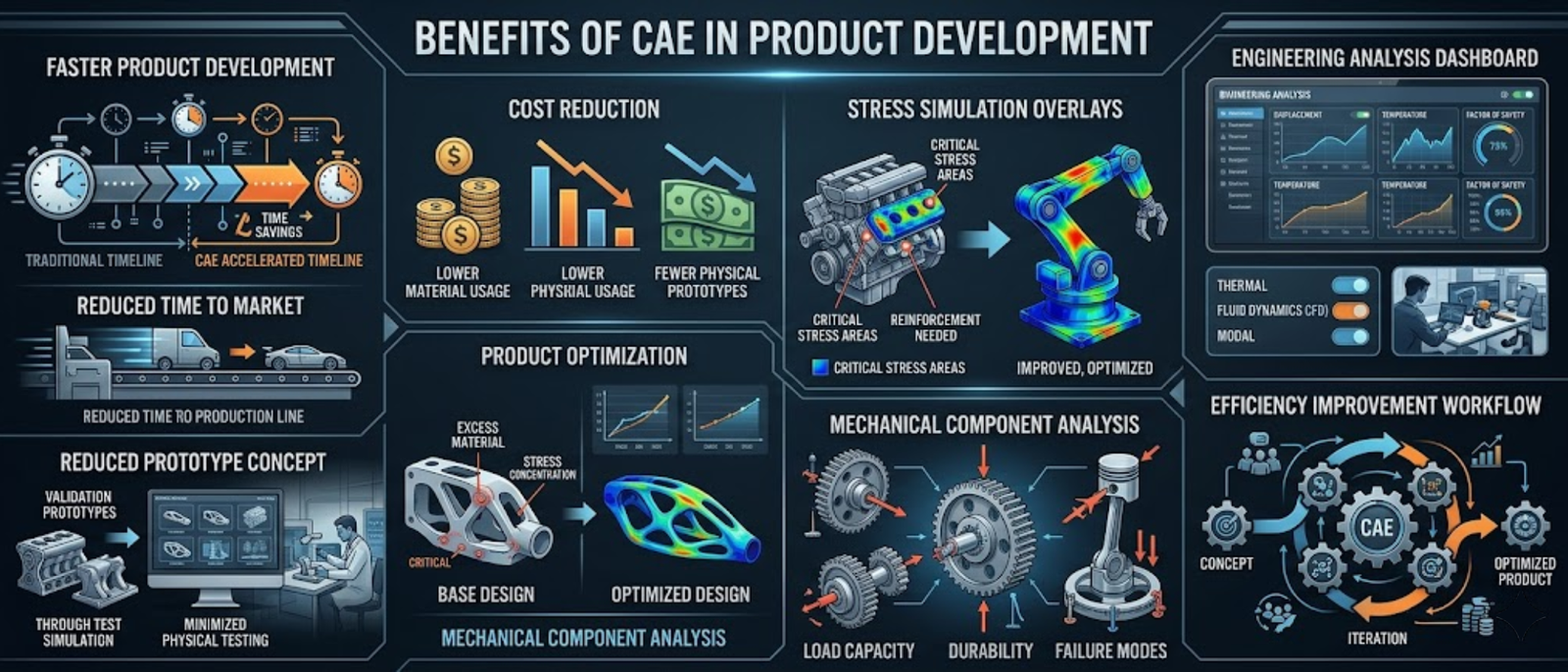
One of the biggest advantages of CAE is reducing development cost.
Since engineers can test products digitally, companies require fewer physical prototypes, reducing manufacturing expenses significantly.
In addition, CAE saves time because engineers can perform multiple simulations quickly without waiting for physical production.
Another major benefit is improved safety and reliability.
Simulation tools help engineers identify weak points, stress failures, and performance issues early in the design process.
Students learning through cad design course in Pune, engineering software course, or solidworks course programs now gain practical exposure to these modern engineering workflows.
This practical knowledge helps students understand how products behave in real-world environments instead of focusing only on software operations.
Consider the design of a car suspension system.
Engineers use CAE simulation tools to analyze how the suspension responds under different road conditions and load scenarios.
The software helps engineers visualize stress distribution, vibration behavior, and deformation patterns.
Based on these simulation results, engineers optimize the suspension design to improve comfort, durability, and safety.
Without CAE, companies would need multiple expensive physical prototypes to achieve the same level of optimization.
CAE has become one of the most important technologies in modern engineering design and product development.
It helps engineers simulate, analyze, and optimize products digitally before manufacturing begins.
As industries move toward smarter and faster development systems, CAE skills are becoming increasingly valuable for engineers.
Therefore, understanding simulation-driven engineering is essential for students pursuing careers in CAD design, mechanical engineering, automotive industries, and advanced product development.
To succeed in modern engineering careers, students must understand both design and simulation workflows.
Focus on learning how products perform, not just how they look.
1. What is CAE in engineering?
CAE stands for Computer-Aided Engineering and is used for simulation and analysis of engineering designs.
2. Why is CAE important?
CAE helps reduce design errors, lower development cost, improve safety, and optimize product performance.
3. Which software is used for CAE?
Software like SolidWorks, CATIA, ANSYS, and Creo are commonly used for engineering simulations.
4. How is CAE different from CAD?
CAD is used for creating designs, while CAE is used for testing and analyzing those designs.
5. Can students learn CAE easily?
Yes, with proper CAD and engineering software training, students can learn CAE and simulation workflows effectively.
© 2025 4Dimensions Infotech. All rights reserved. | Best Design Engineering Training Institute in Pune
Start your journey with the best design engineering training institute in Pune.