
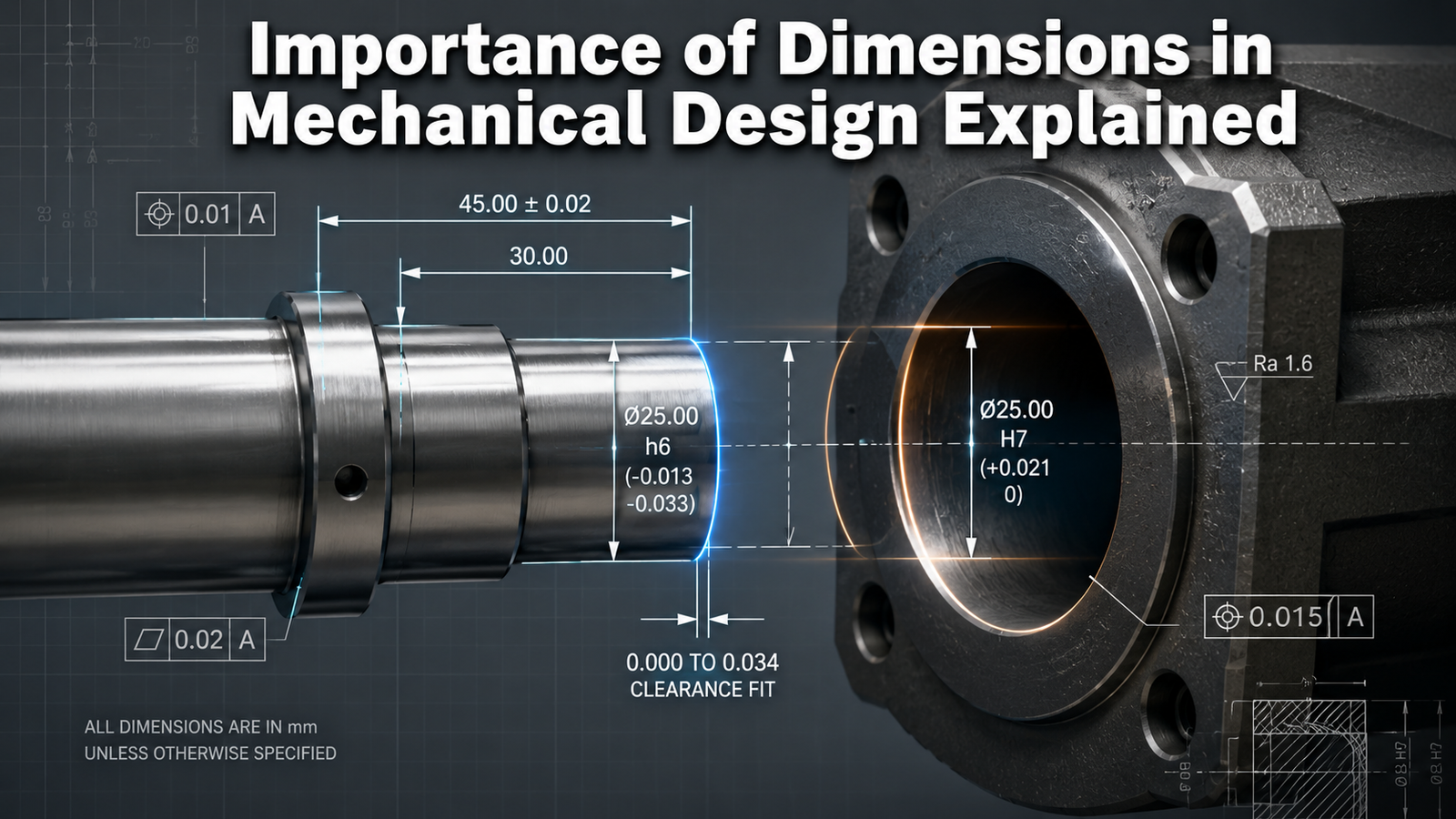
Imagine building a machine where parts do not fit together.
Even a small mismatch in size can lead to failure. This is why understanding the importance of dimensions in mechanical design is essential for every engineer.
Dimensions are not just numbers on a drawing they define how a product is created, assembled, and functions in real life.
Every mechanical component must follow precise measurements.
If a dimension is incorrect, the part may not fit, move properly, or perform its function. Therefore, engineers must define dimensions clearly and accurately.
In real projects, even a minor error can lead to major issues such as misalignment, vibration, or system failure.
Because of this, dimensions form the foundation of reliable engineering design.
Manufacturing depends completely on dimensions.
Machines, tools, and processes use these measurements to produce parts. If the dimensions are unclear or incorrect, manufacturers cannot produce the part correctly.
As a result, errors in dimensions can lead to material waste, increased cost, and delays.
This is closely connected to errors in engineering drawings, where small mistakes create large problems on-site.
Mechanical systems often involve multiple parts working together.
For these parts to function properly, they must fit with precision. Engineers use dimensions to control clearances, tolerances, and alignment.
For example, if a shaft is slightly larger than its hole, it will not fit. On the other hand, if it is too small, it may cause looseness or vibration.
Therefore, correct dimensioning ensures proper assembly and performance.
In modern design, engineers define dimensions directly within CAD software.
This allows them to create accurate models and make quick adjustments when needed. As a result, designs become more flexible and easier to modify.
This process is part of clean CAD modeling practices, where proper dimensioning ensures better control over the design.
Many beginners underestimate the importance of dimensioning.
They may place dimensions incorrectly, miss important measurements, or create unclear drawings. Because of this, the design becomes difficult to understand and manufacture.
To avoid these issues, engineers should:
Over time, developing good dimensioning habits improves both design quality and communication.
Accurate dimensions do more than just define size—they ensure that the entire system works smoothly.
They help reduce errors, improve product quality, and ensure efficient manufacturing.
In addition, proper dimensioning supports better decision-making during design and production.
Dimensions are a fundamental part of mechanical design.
They control how parts are created, assembled, and function in real-world conditions. Therefore, engineers must treat dimensioning as a critical skill, not just a basic step.
To become a skilled engineer, you must understand how to create accurate and clear designs.
At 4Dimensions Infotech, students learn how to apply dimensioning techniques in real engineering projects using industry-standard tools.
You gain practical knowledge that prepares you for real-world challenges.
👉 Learn mechanical design the right way and build industry-ready skills.
1. Why are dimensions important in mechanical design?
They ensure that parts fit correctly and function properly.
2. What happens if dimensions are incorrect?
Parts may not fit, leading to failure, waste, and delays.
3. What is tolerance in dimensioning?
It is the allowable variation in a dimension.
4. How do dimensions affect manufacturing?
They guide machines and processes to produce accurate parts.
5. What tools are used for dimensioning?
CAD software like AutoCAD, SolidWorks, and CATIA.
6. How can I improve my dimensioning skills?
By practicing with real designs and understanding engineering standards.
© 2025 4Dimensions Infotech. All rights reserved. | Best Design Engineering Training Institute in Pune
Start your journey with the best design engineering training institute in Pune.