
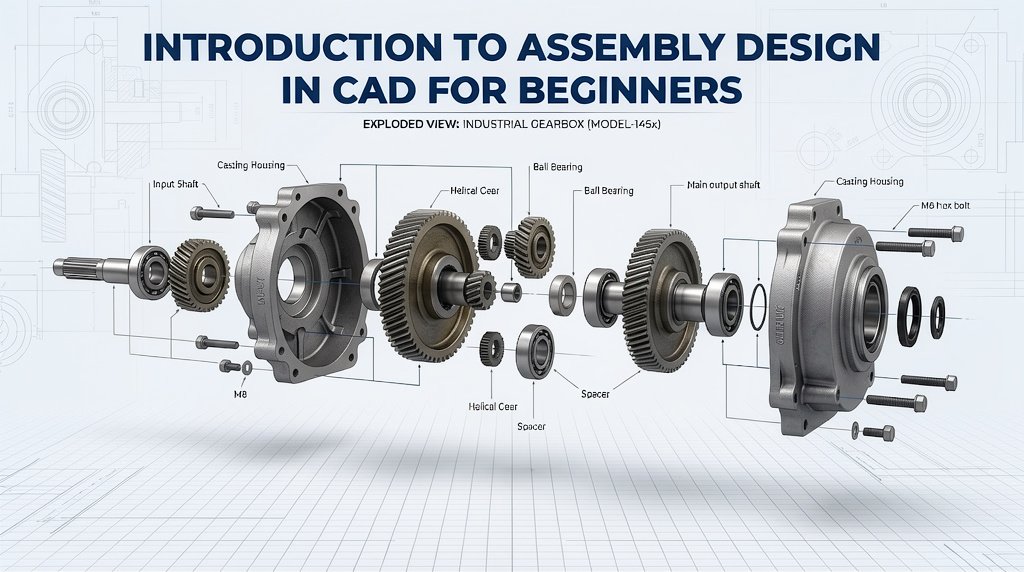
In real engineering projects, products are rarely made from a single part.
Instead, they consist of multiple components that fit and work together. This is where assembly design in CAD becomes important.
Understanding how individual parts come together is a key step in moving from simple modeling to real-world engineering design.
Assembly design is the process of combining multiple individual parts into a complete system.
Each part is created separately, and then assembled using constraints that define how they connect and move relative to each other.
This approach reflects how products are actually built in manufacturing environments, as seen in complete product design workflows.
When engineers design parts individually, they may not always understand how those parts interact in real conditions.
However, assembly design allows them to test fit, alignment, and movement before production.
As a result, engineers can detect issues early and avoid costly mistakes later.
This becomes especially important in projects where accuracy and coordination matter, similar to avoiding errors during execution.
The process usually begins by creating individual parts using CAD software.
After that, these parts are brought together in an assembly environment. Engineers then apply constraints such as alignment, distance, or rotation to define relationships between components.
Because of this, the assembly behaves like a real product, allowing engineers to understand how it will function.
Constraints control how parts connect and move.
For example, engineers may fix one part in place while allowing another part to rotate or slide.
Although the concept may seem simple, proper constraint application is essential for creating stable and functional assemblies.
This connects closely with structured modeling practices explained in clean CAD modeling techniques.
Beginners often face difficulties when working with assemblies.
Sometimes parts do not align correctly, or constraints conflict with each other. In other cases, models become too complex and difficult to manage.
However, with proper understanding and practice, these challenges can be reduced significantly.
In real-world engineering, assembly design plays a major role in product development.
It helps engineers:
Because of this, assembly design is widely used in industries such as automotive, machinery, and product design.
Assembly design in CAD is a critical skill for engineers who want to work on real products.
It goes beyond individual part modeling and focuses on how components interact in a complete system.
By learning assembly design, engineers can create more accurate, functional, and practical designs.
To master assembly design, you need hands-on practice with real components and workflows.
At 4Dimensions Infotech, students learn how to create and manage assemblies used in real engineering projects.
You gain practical experience that prepares you for industry-level design work.
👉 Start learning assembly design and build real engineering skills.
1. What is assembly design in CAD?
It is the process of combining multiple parts into a complete product using constraints.
2. Why is assembly design important?
It helps check fit, function, and alignment before manufacturing.
3. What are constraints in CAD assemblies?
They define how parts connect and move relative to each other.
4. Which software is used for assembly design?
Software like SolidWorks, CATIA, and Creo are commonly used.
5. What problems can occur in assembly design?
Misalignment, constraint conflicts, and complex models.
6. How can I improve my assembly design skills?
By practicing real projects and understanding part relationships.
© 2025 4Dimensions Infotech. All rights reserved. | Best Design Engineering Training Institute in Pune
Start your journey with the best design engineering training institute in Pune.