
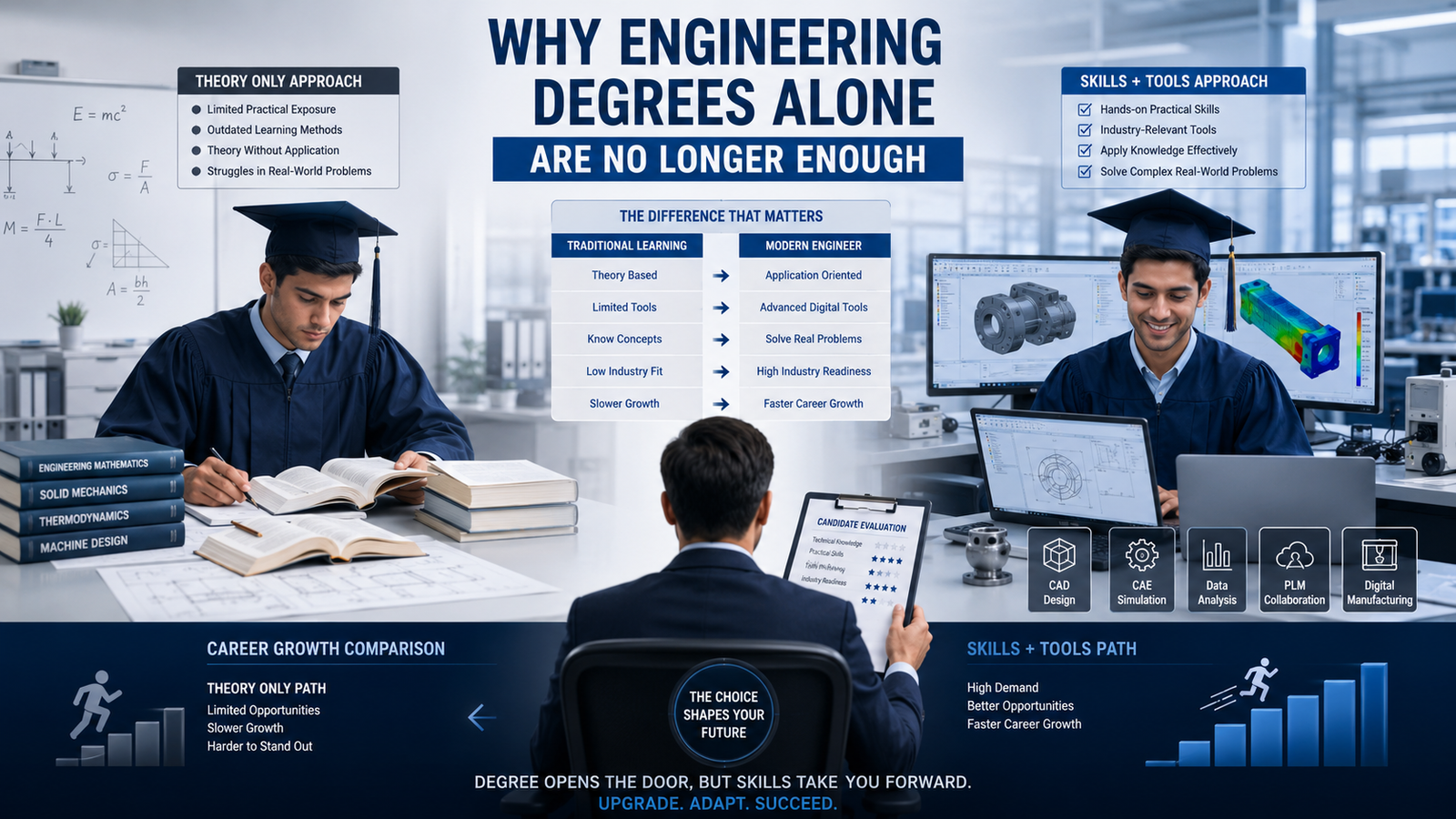
An engineering degree can help you get an interview. However, in today’s job market, digital skills often determine whether you actually get hired.
Engineering is no longer limited to calculations, theory, and manual drafting. Modern companies rely heavily on software, automation, simulation, and digital workflows to design, analyze, and manufacture products.
As industries continue to adopt advanced technologies, engineers who lack digital skills often struggle to compete with candidates who can immediately contribute using industry-standard tools.
This is why the Importance of Digital Skills in Engineering Careers continues to grow across mechanical, civil, electrical, manufacturing, and construction industries.
Whether you want to become a CAD Engineer, Mechanical Design Engineer, BIM Engineer, Product Designer, or Simulation Engineer, digital skills have become a fundamental requirement.

Digital skills refer to the ability to use modern engineering software, digital tools, and technology-driven workflows to solve engineering problems more efficiently.
Today’s engineers work with CAD software, simulation platforms, BIM tools, digital manufacturing systems, and cloud-based collaboration technologies throughout the product development process.
These tools help engineers design faster, analyze performance more accurately, and improve communication across teams.
Engineers who understand digital workflows can adapt more quickly to changing industry requirements and contribute more effectively to projects.
As a result, digital competency has become one of the most important career-building skills for engineering professionals.
While specific software requirements vary between industries, several digital skills remain valuable across most engineering careers.
Students searching for a CAD Course in Pune, Mechanical Design Course, SolidWorks Course, or CATIA Course are often preparing themselves for these industry requirements.
These skills are closely related to Modern Engineering Design Processes, where digital tools support almost every stage of development.
Digital transformation is changing every engineering industry.
Manufacturing companies use smart factories. Construction firms rely on BIM. Product development teams use advanced CAD and simulation software. Engineers are increasingly expected to work within digital ecosystems.
This trend is part of Industry 4.0 and the Role of Design Engineers.
As a result, engineers with strong digital skills often enjoy better job opportunities, faster career growth, and greater flexibility across industries.
Companies are not simply hiring engineers anymore. They are hiring digitally capable engineers.
Many students focus entirely on theory while ignoring practical digital tools.
Others learn software commands but never apply them to real engineering projects.
Some avoid simulation, project work, and industry-standard workflows altogether.
These mistakes often become visible during technical interviews when recruiters evaluate practical engineering skills.
Digital skills are no longer optional in engineering careers. They are now a core requirement across almost every engineering discipline.
Engineers who combine strong fundamentals with practical digital expertise are better prepared for modern industry challenges and future career growth.
The sooner students begin developing these skills, the stronger their competitive advantage becomes.
At 4Dimensions Infotech Pune, students learn industry-standard software, real engineering workflows, and project-based problem-solving techniques.
Our training covers AutoCAD, SolidWorks, CATIA, Creo, Revit, Civil 3D, and modern engineering tools used by companies worldwide.
Whether you are searching for CAD Courses in Pune, a CAD Training Institute, a SolidWorks Course, a CATIA Course, or a complete Mechanical Design Course, building digital skills is one of the smartest investments you can make in your engineering career.
👉 Start building digital skills that make you job-ready and future-proof your engineering career.
1. Why are digital skills important in engineering?
They help engineers design, analyze, collaborate, and solve problems using modern tools.
2. What are the most important digital skills for engineers?
CAD modeling, CAE simulation, BIM workflows, data analysis, and digital collaboration tools.
3. Do digital skills improve job opportunities?
Yes. Most companies actively seek engineers who can work with industry-standard software and workflows.
4. Can I learn digital skills without coding?
Yes. Most engineering software platforms do not require programming knowledge.
5. Are digital skills necessary for all engineering fields?
Almost every engineering discipline now relies on digital tools and technology.
6. How can students improve their digital skills?
Through project-based learning, software training, practical assignments, and exposure to real engineering workflows.
© 2025 4Dimensions Infotech. All rights reserved. | Best Design Engineering Training Institute in Pune
Start your journey with the best design engineering training institute in Pune.