
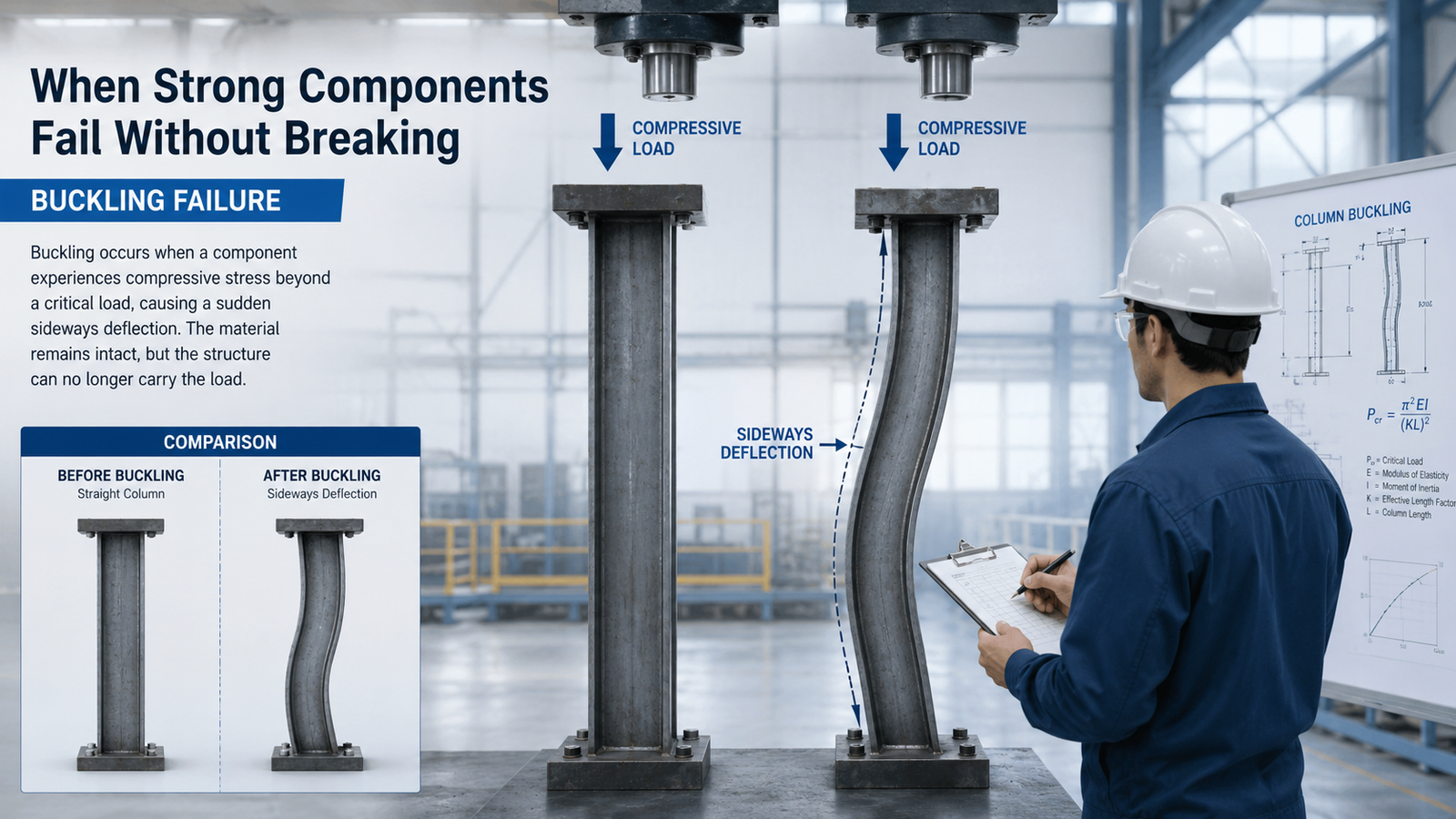
Imagine a steel column designed to carry thousands of kilograms of load. The material is strong, the dimensions are correct, and there are no visible cracks.
Yet suddenly, the column bends sideways and collapses.
Surprisingly, the material never actually breaks.
This type of failure is known as buckling, and it is one of the most important stability problems engineers must consider during design.
Unlike traditional failures where a component breaks because stress exceeds material strength, buckling occurs because the structure becomes unstable under compressive loading.
This is why understanding Buckling in Mechanical Components is essential for engineers working in machine design, structural engineering, aerospace systems, industrial equipment, and product development.
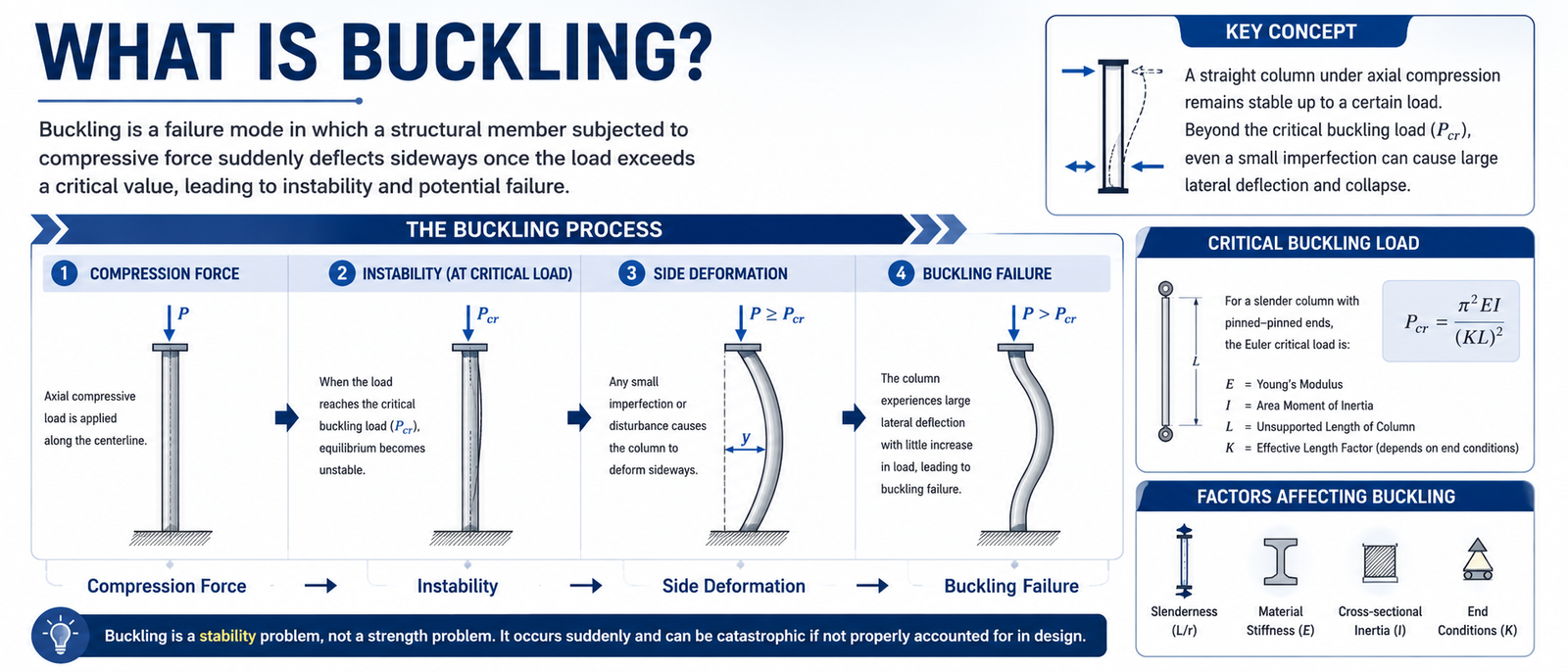
Buckling is a sudden sideways deformation that occurs when a structural member is subjected to compressive loading.
Instead of compressing in a straight line, the component becomes unstable and bends laterally.
What makes buckling dangerous is that failure can occur even when the material has not reached its ultimate strength.
This means a component can fail long before the material itself breaks.
Buckling is primarily a stability problem rather than a strength problem.
As a result, engineers must evaluate both structural strength and stability when designing mechanical components.
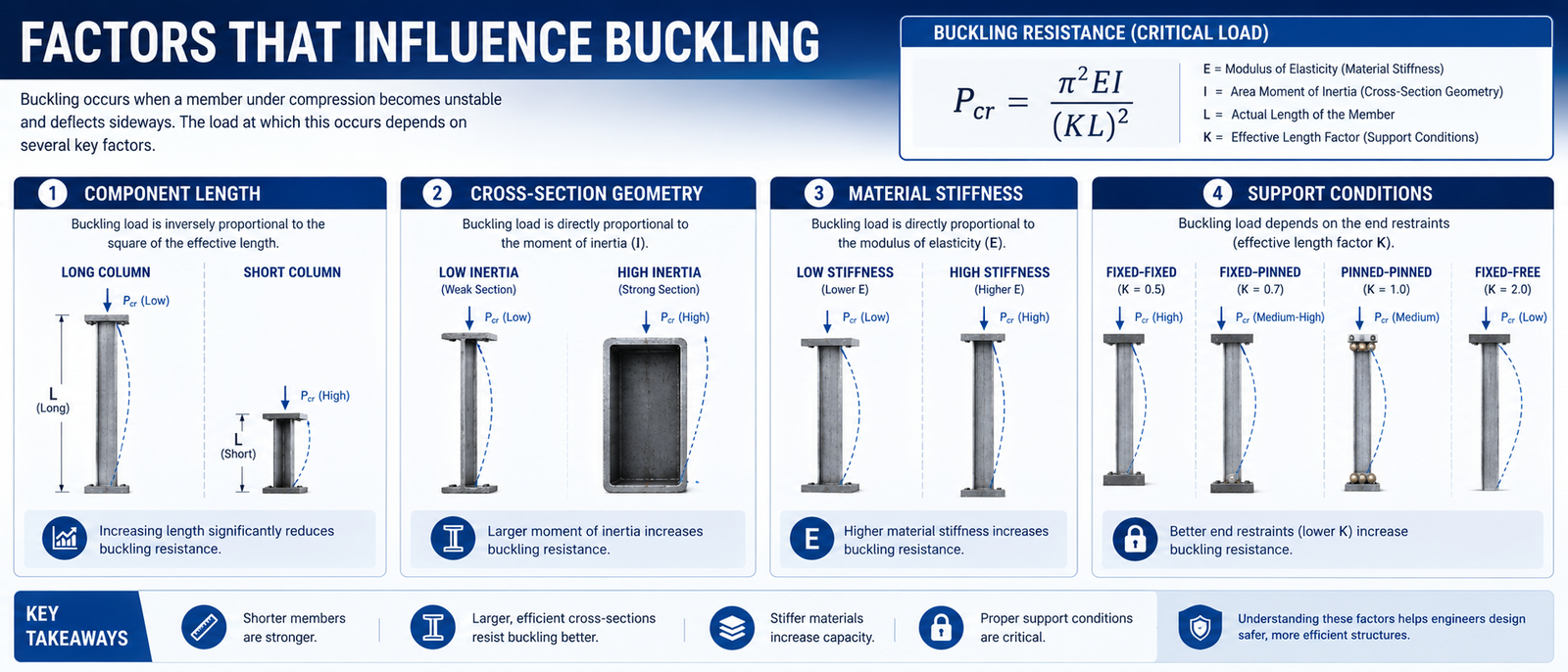
Not all mechanical components have the same resistance to buckling.
Several design factors influence how much compressive load a structure can withstand before becoming unstable.
These factors are also important in Static vs Dynamic Loading in Engineering Design, where loading conditions directly influence structural behavior.
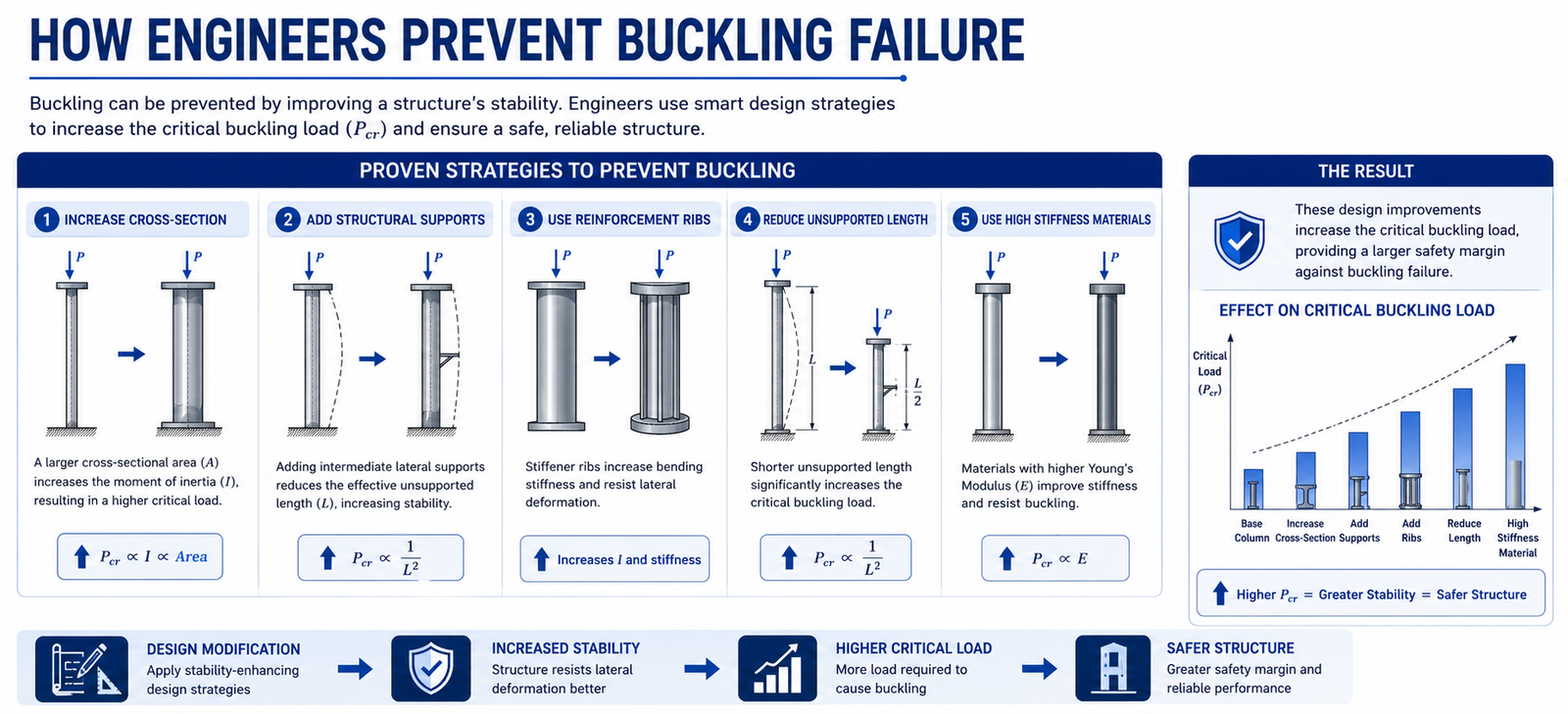
Engineers use several strategies to improve structural stability and prevent buckling failure.
Before manufacturing begins, engineers validate these improvements through testing and engineering analysis.
This process is closely related to Design Validation Before Manufacturing.
By addressing stability issues early, engineers can avoid costly failures and improve product safety.
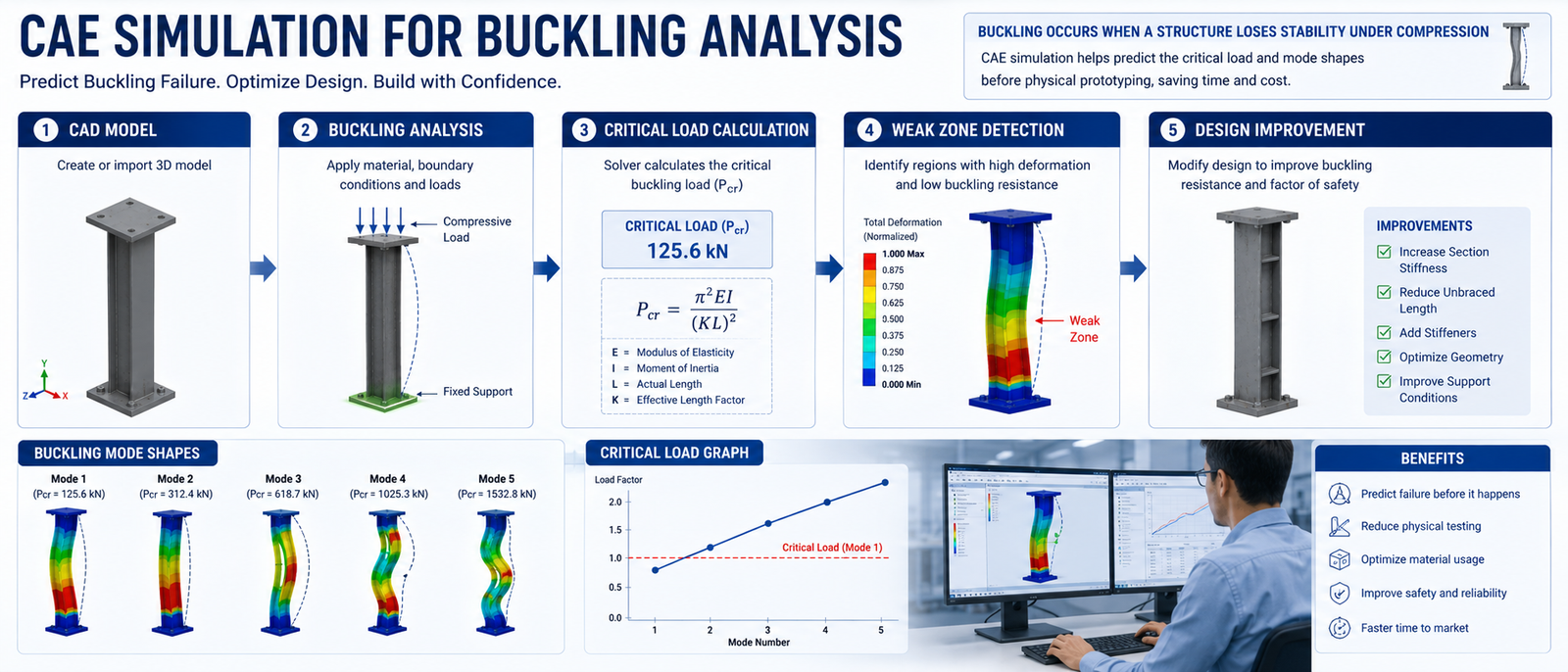
Modern engineering companies rarely rely only on calculations when evaluating buckling risks.
Instead, they use CAE simulation tools to predict how structures behave under compressive loads before manufacturing begins.
Buckling analysis helps engineers identify weak regions, calculate critical loads, and visualize instability before physical prototypes are produced.
This approach is part of CAE in Modern Engineering Design Process.
Simulation reduces development costs, improves safety, and allows engineers to optimize designs more efficiently.
Buckling analysis is essential in many engineering industries because stability failures can have serious consequences.
Because of its importance, buckling evaluation forms a critical part of the Product Design Engineering Workflow.
Buckling demonstrates that engineering failures are not always caused by material strength limitations. In many cases, instability becomes the real challenge.
By understanding buckling behavior, evaluating critical loads, and using modern CAE tools, engineers can design safer and more reliable mechanical systems.
Successful engineering design requires balancing both strength and stability to ensure long-term performance.
At 4Dimensions Infotech Pune, students learn practical engineering concepts used in real industries, including machine design, structural analysis, CAD modeling, and CAE simulation.
Whether you are searching for CAD Courses in Pune, a SolidWorks Course, a CATIA Course, or a complete Mechanical Design Course, understanding structural behavior and failure mechanisms is essential for becoming an industry-ready engineer.
1. What is buckling in mechanical components?
Buckling is a sudden sideways deformation caused by instability under compressive loading.
2. Why does buckling occur?
It occurs when compressive forces exceed the critical load that a structure can safely withstand.
3. What is the difference between buckling and material failure?
Material failure involves breaking, while buckling involves instability without necessarily breaking the material.
4. How can engineers prevent buckling?
By improving stiffness, reducing unsupported length, adding supports, and optimizing geometry.
5. Is buckling analysis important in engineering design?
Yes. It is critical for ensuring structural stability and preventing sudden failures.
6. How is buckling analyzed today?
Using engineering calculations and CAE simulation tools that predict instability before manufacturing.
© 2025 4Dimensions Infotech. All rights reserved. | Best Design Engineering Training Institute in Pune
Start your journey with the best design engineering training institute in Pune.