
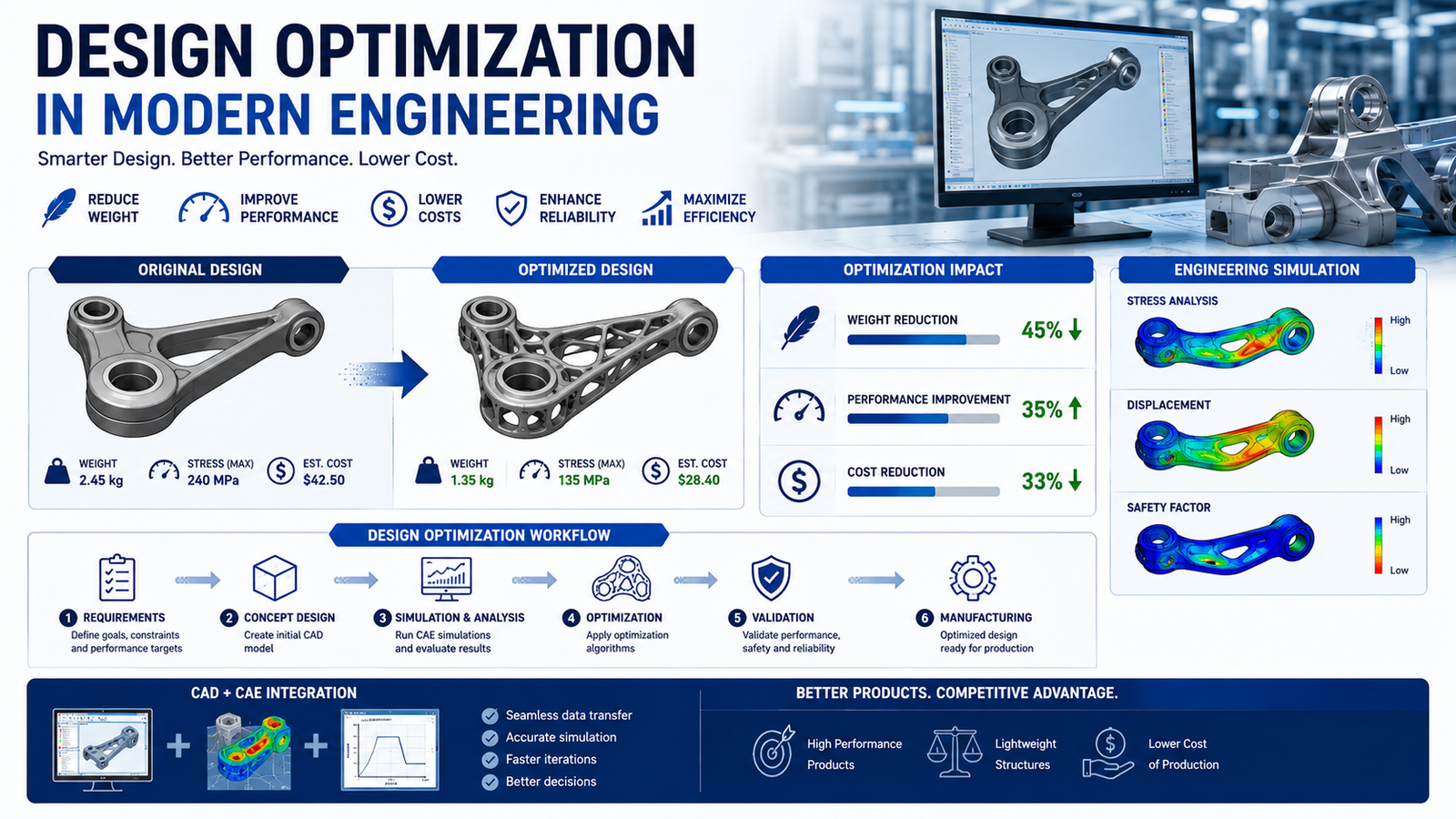
At 4Dimensions Infotech Pune, students working on real-world engineering projects quickly learn that creating a design is only the beginning of the product development process.
The real challenge is improving that design to achieve better performance, lower manufacturing costs, reduced weight, and increased reliability.
This process is known as design optimization in engineering.
Today, industries such as automotive, aerospace, manufacturing, automation, and product design rely heavily on optimization techniques to remain competitive.
Modern engineers use CAD software, simulation tools, and data-driven analysis to identify better design solutions before manufacturing begins.
As a result, optimized products perform more efficiently while consuming fewer resources.
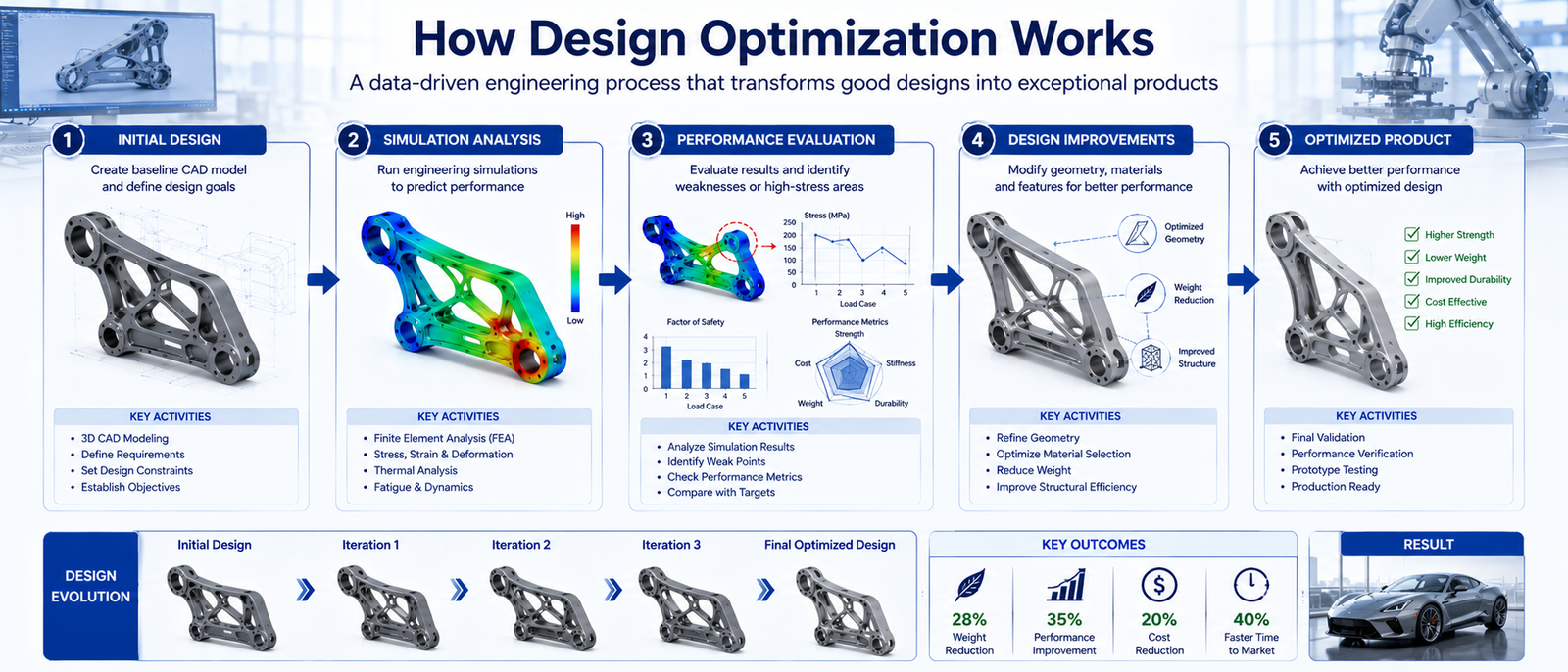
Design optimization is the process of improving a product by adjusting design parameters to achieve the best possible balance between performance, cost, weight, strength, and manufacturability.
Instead of selecting the first workable design, engineers evaluate multiple alternatives and identify the most efficient solution.
As a result, products become more reliable, lighter, stronger, and more cost-effective.
This approach is widely used in product design engineering workflows, where continuous improvement is essential.
Modern industries face constant pressure to reduce costs while improving product quality and performance.
Design optimization helps engineers achieve these goals by reducing unnecessary material usage, improving structural efficiency, and enhancing overall product performance.
In addition, optimized designs often require less maintenance, consume fewer resources, and offer better long-term value.
Because of these benefits, design optimization has become a standard practice across engineering industries.
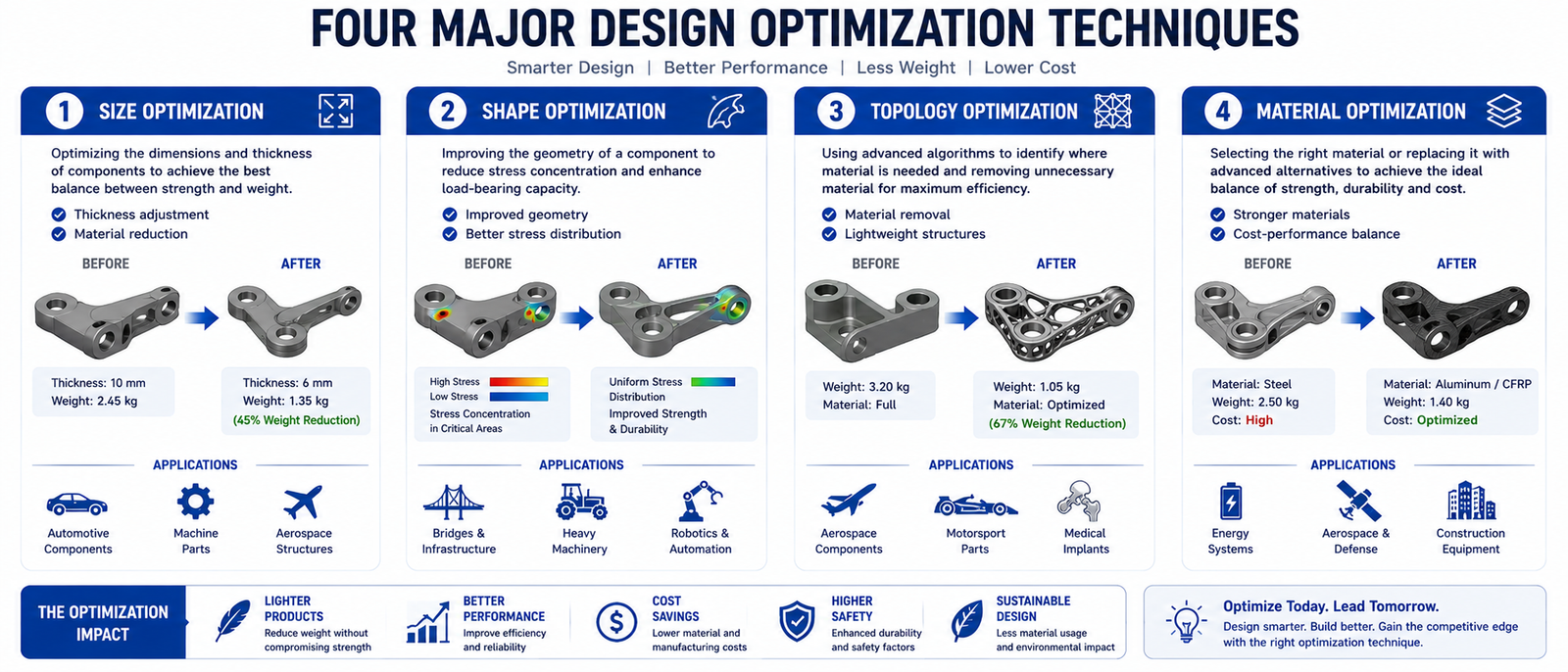
Size optimization focuses on adjusting dimensions such as thickness, diameter, width, or length while maintaining structural integrity.
The goal is to reduce material consumption without affecting performance.
This technique is commonly used alongside lightweight design strategies.
Shape optimization improves the geometry of components to reduce stress concentration and improve load distribution.
Engineers modify curves, fillets, and structural features to create more efficient designs.
This process is closely connected to stress analysis in mechanical design.
Topology optimization uses software algorithms to determine where material is necessary and where it can be removed.
The result is a lightweight structure that maintains strength while reducing weight and material costs.
This technique is especially common in aerospace and automotive industries.
Material optimization focuses on selecting materials that provide the best balance between strength, durability, weight, and cost.
This process directly relates to material selection in engineering design.
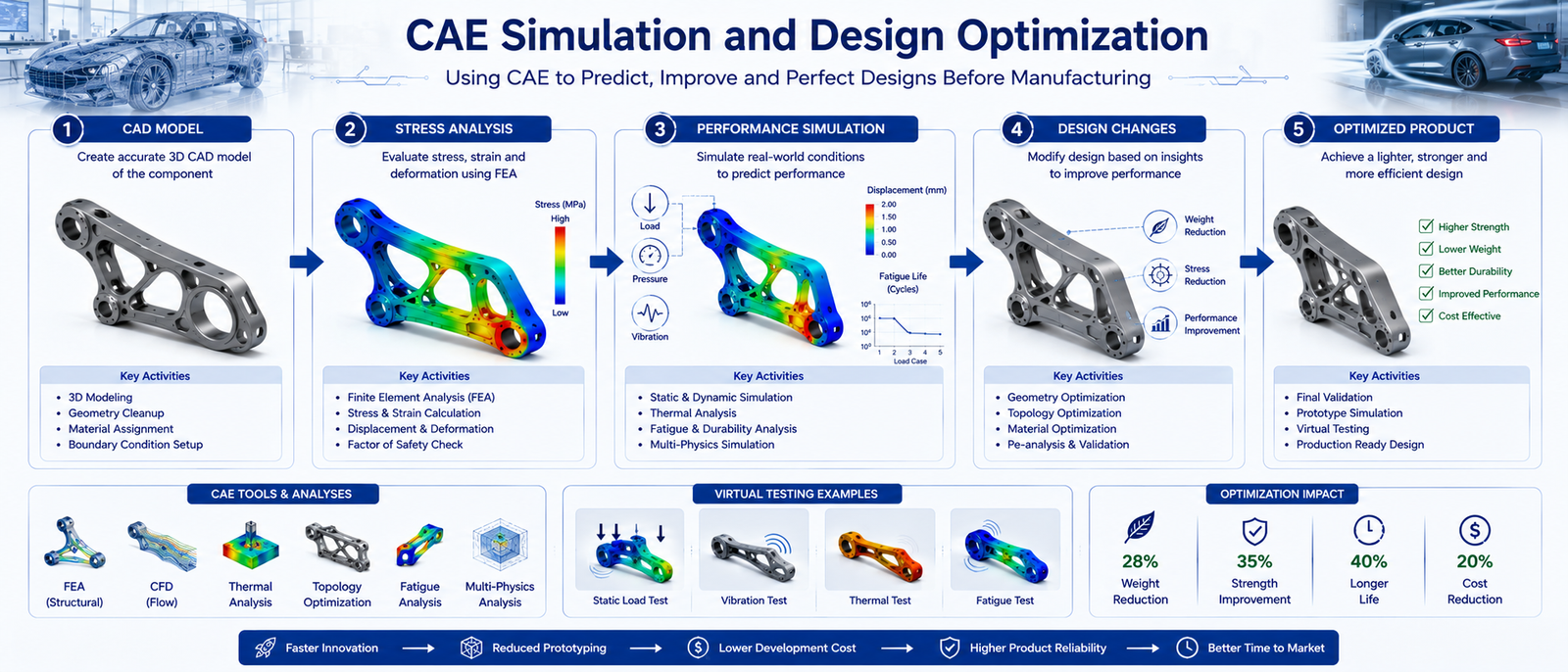
Modern design optimization depends heavily on simulation and CAE technologies.
Instead of building multiple physical prototypes, engineers can evaluate different design variations digitally.
Simulation tools help analyze stress, deformation, temperature distribution, vibration, and performance under real-world conditions.
This significantly reduces development time and minimizes costly trial-and-error processes.
The approach aligns closely with virtual testing methods in engineering, where digital analysis improves decision-making.
Industries such as automotive, aerospace, industrial machinery, and manufacturing use optimization techniques extensively.
Automotive companies optimize vehicle components to improve fuel efficiency and reduce weight.
Aerospace manufacturers use optimization to create stronger and lighter aircraft structures.
Manufacturing companies optimize machine parts to improve durability and reduce maintenance costs.
These improvements contribute directly to innovation in modern manufacturing.
Although optimization provides significant benefits, it also introduces challenges.
Engineers must balance competing requirements such as cost, performance, manufacturability, safety, and reliability.
Advanced software tools and simulation platforms also require specialized technical knowledge.
Because of this complexity, companies actively seek engineers who understand both design and optimization principles.
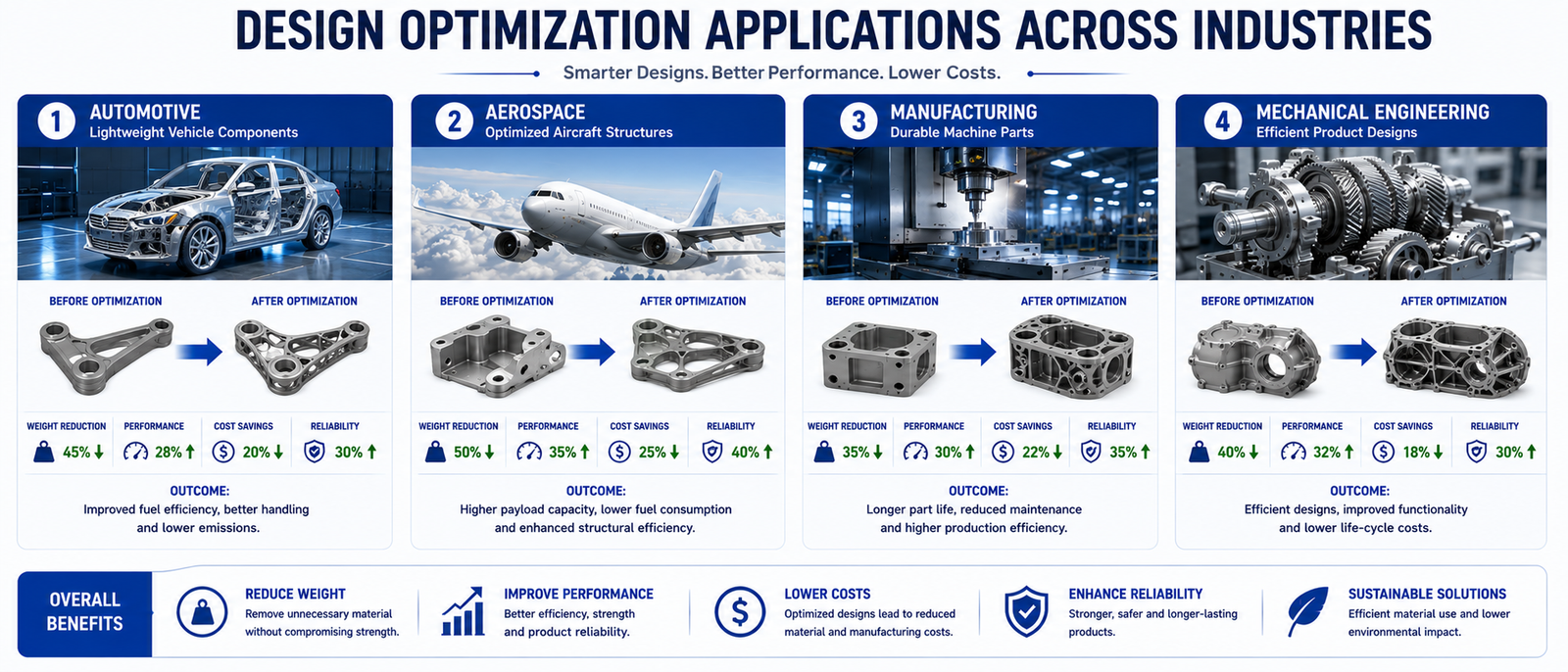
Design optimization techniques in engineering have become essential for creating high-performance, cost-effective, and reliable products.
From size optimization and topology optimization to material selection and simulation-driven analysis, engineers use multiple techniques to improve designs before manufacturing begins.
As industries continue to demand lighter, stronger, and more efficient products, optimization skills will remain highly valuable for modern engineers.
Understanding optimization techniques becomes far more effective when applied to real engineering projects.
At 4Dimensions Infotech Pune, students learn CAD modeling, CAE simulation, product development, and optimization workflows through practical industry-oriented training.
You can build expertise in CAD, SolidWorks, CATIA, and CAE tools while developing skills that match modern engineering industry requirements.
1. What is design optimization?
It is the process of improving a design for better performance, efficiency, and cost-effectiveness.
2. Why is optimization important in engineering?
It helps reduce costs, improve product quality, and enhance performance.
3. What tools are used for optimization?
CAE software, simulation tools, and CAD platforms are commonly used.
4. What is topology optimization?
It is a technique that removes unnecessary material while maintaining structural strength.
5. Which industries use design optimization?
Automotive, aerospace, manufacturing, and mechanical engineering industries use optimization extensively.
© 2025 4Dimensions Infotech. All rights reserved. | Best Design Engineering Training Institute in Pune
Start your journey with the best design engineering training institute in Pune.