
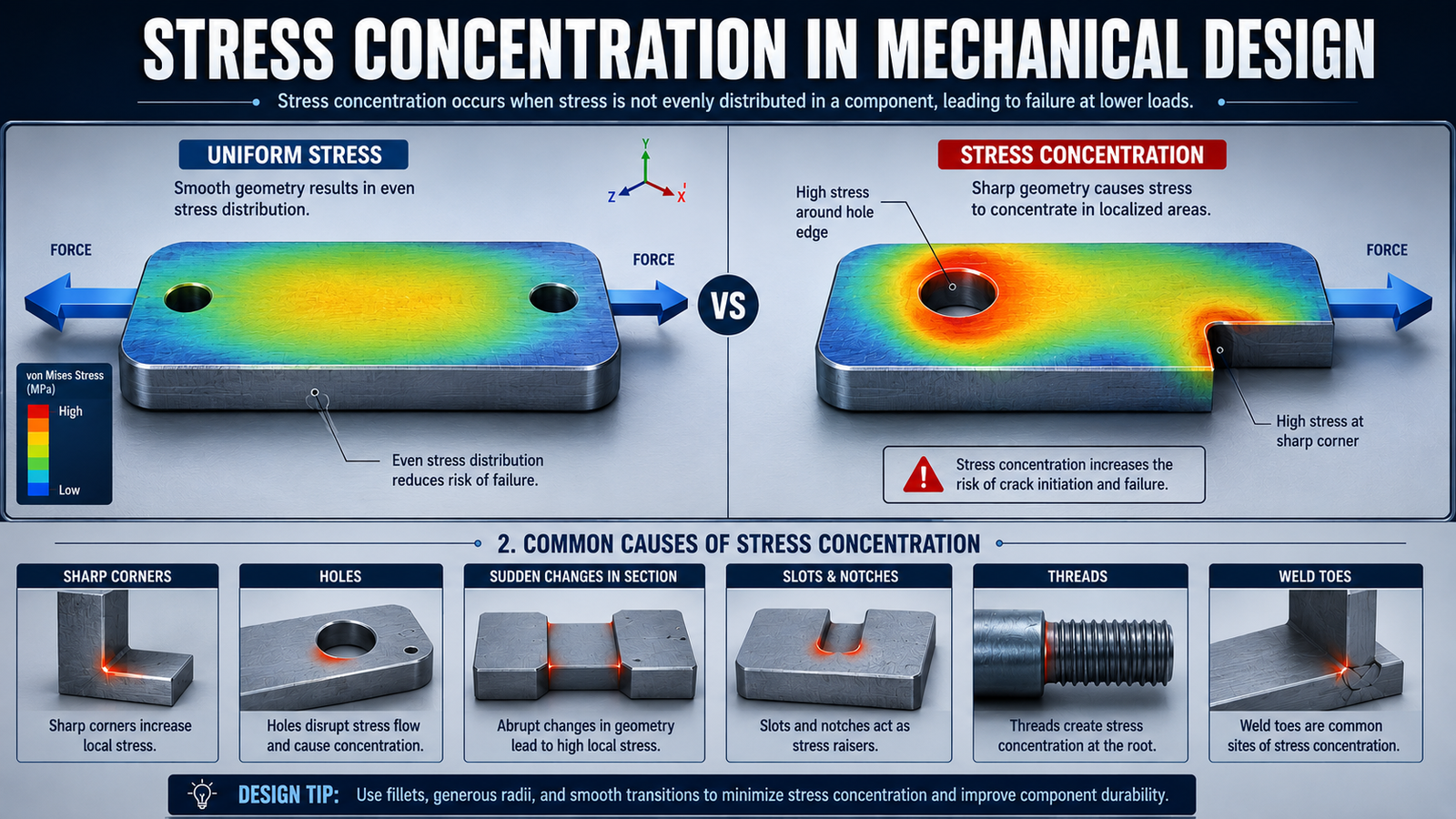
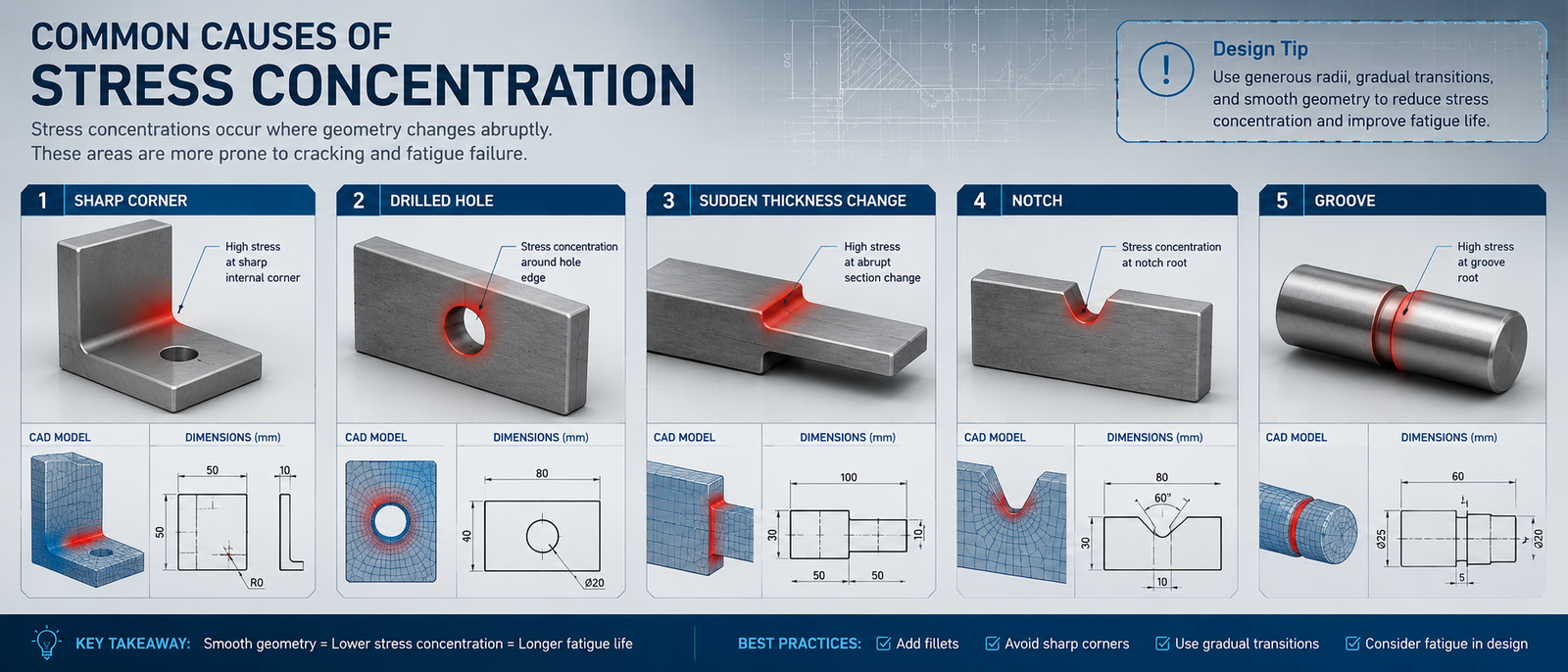
Earlier, engineers had to rely heavily on calculations and physical testing to identify stress-related issues.
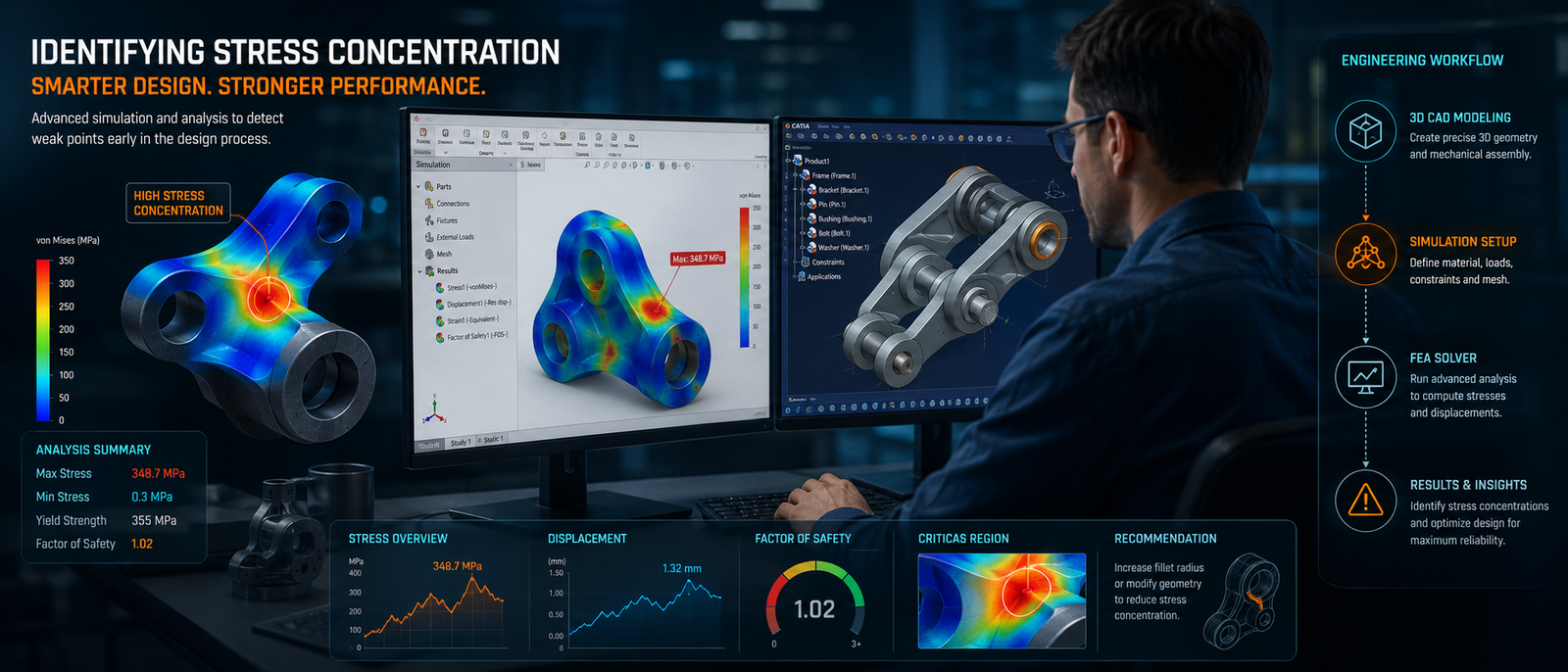
Today, modern CAD and simulation software make this process much faster and more accurate.
Software tools such as:
allow engineers to perform stress analysis virtually before manufacturing a product.
Using simulation workflows, engineers can:
Students learning through a SolidWorks course or Creo software course often begin understanding these concepts through simulation-based mechanical projects.
Reducing stress concentration is one of the most important goals during mechanical design optimization.
Engineers use several methods to improve stress distribution and reduce weak points inside components.
The most common techniques include:
Sharp corners create sudden stress buildup.
Adding smooth fillets helps distribute stress more evenly across the geometry.
Sudden thickness variation increases localized stress.
Gradual transitions improve load distribution significantly.
Poorly placed holes weaken structures.
Engineers carefully position holes to reduce stress buildup around edges.
Some materials handle stress concentration better because of higher fatigue resistance and flexibility.
Modern CAD workflows allow engineers to test multiple design variations before finalizing the product.
This helps improve strength while reducing manufacturing risks.
These optimization techniques are widely used in modern:
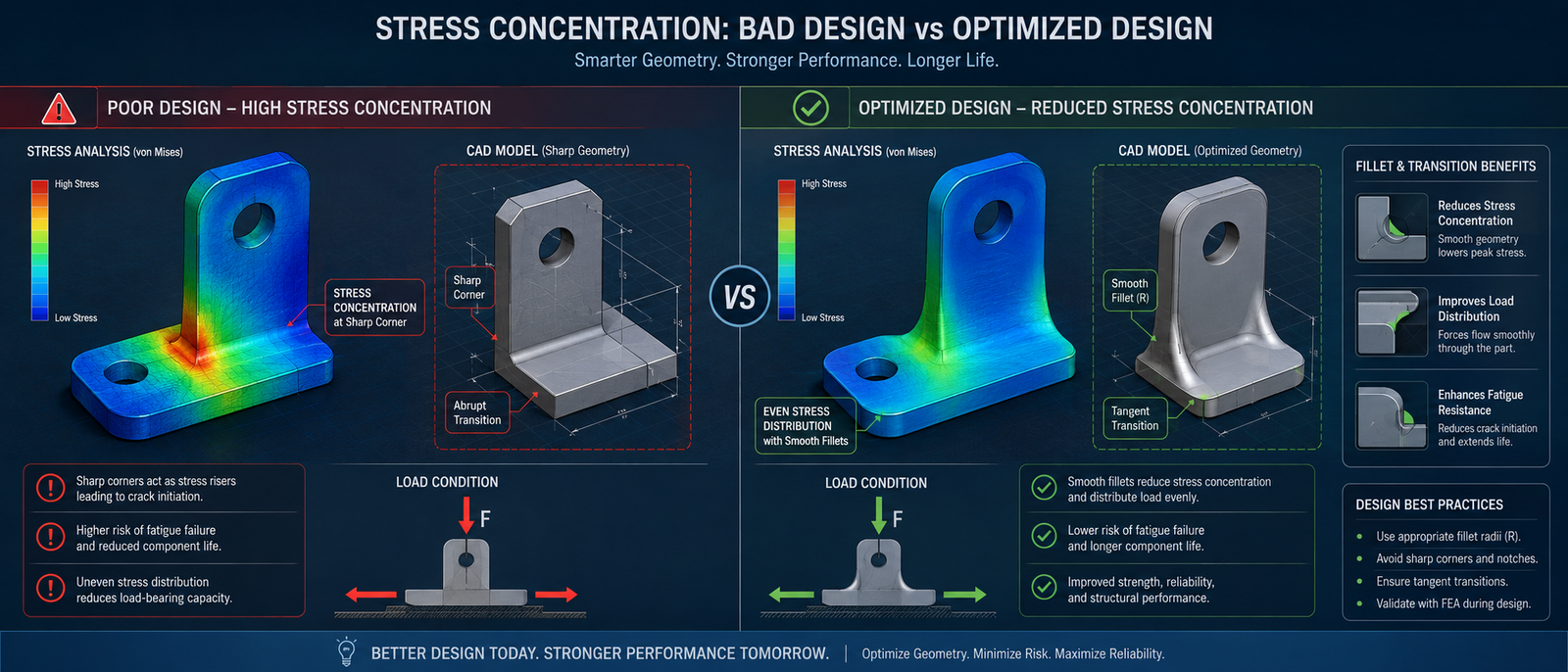
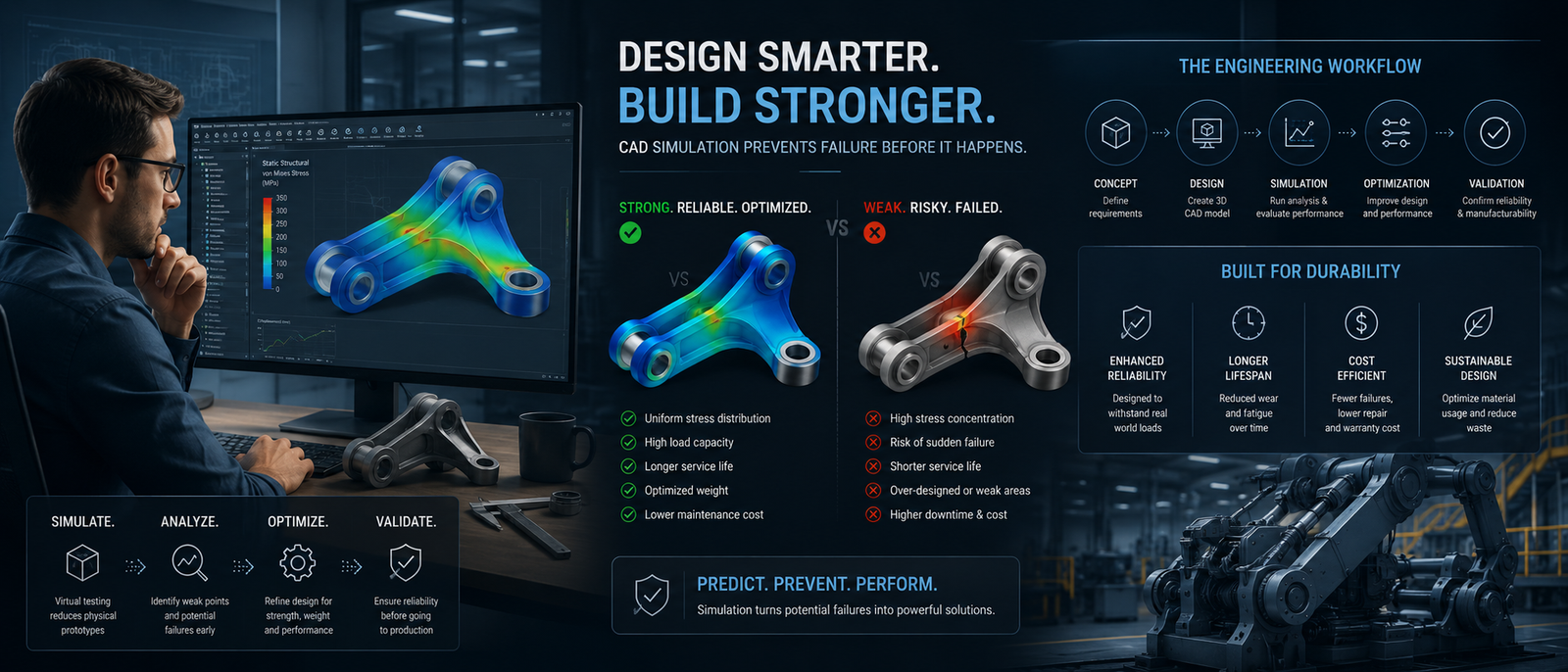
Consider a simple metal bracket used in industrial machinery.
If the bracket contains sharp internal corners, stress will become concentrated at those locations whenever load is applied.
Over time, repeated loading can cause:
However, if the same bracket is redesigned with smooth fillets and optimized geometry, the stress spreads more evenly across the structure.
This dramatically improves:
This is one reason why CAD-based simulation and product optimization are so important in modern engineering companies.
Today, stress concentration analysis is deeply connected with modern CAD and product design workflows.
Engineers no longer create designs based only on appearance.
Instead, they use simulation-driven engineering to validate designs before manufacturing begins.
This approach helps companies:
Students learning through:
must understand these concepts because industries increasingly expect engineers to think beyond basic drafting.
This shift toward intelligent engineering workflows is also changing how design engineering careers evolve.
You can understand more about this in:
How CAD is Used in Real Companies – Industry Workflow Explained
Many students learn software tools but fail to understand actual engineering logic behind designs.
This creates a major gap between software operation and real engineering capability.
Practical CAD training helps students:
This is why companies prefer engineers who can solve engineering problems instead of simply creating CAD models.
Stress concentration is one of the most important concepts in mechanical engineering and product design.
Ignoring stress concentration can lead to dangerous failures, while properly managing it results in stronger, safer, and more reliable products.
Modern CAD and simulation tools now allow engineers to detect and eliminate weak points early in the design process.
As industries continue moving toward simulation-driven engineering and intelligent product development, understanding stress concentration will become even more important for future mechanical engineers.
Understanding stress concentration is not just theory — it is a real engineering skill used in modern industries every day.
1. What is stress concentration in mechanical engineering?
Stress concentration is the buildup of stress in localized regions of a component caused by sudden geometry changes such as holes, grooves, or sharp corners.
2. Why is stress concentration dangerous?
It can cause cracks, fatigue failure, deformation, and reduced product life even when strong materials are used.
3. Which CAD software is used for stress analysis?
Software such as SolidWorks, CATIA, Creo, and ANSYS are commonly used for stress analysis and simulation.
4. How can stress concentration be reduced?
By using fillets, smooth transitions, optimized geometry, and simulation-based design improvements.
5. Is stress concentration important in real engineering jobs?
Yes, it is extremely important in automotive, aerospace, manufacturing, and mechanical product design industries.
© 2025 4Dimensions Infotech. All rights reserved. | Best Design Engineering Training Institute in Pune
Start your journey with the best design engineering training institute in Pune.