
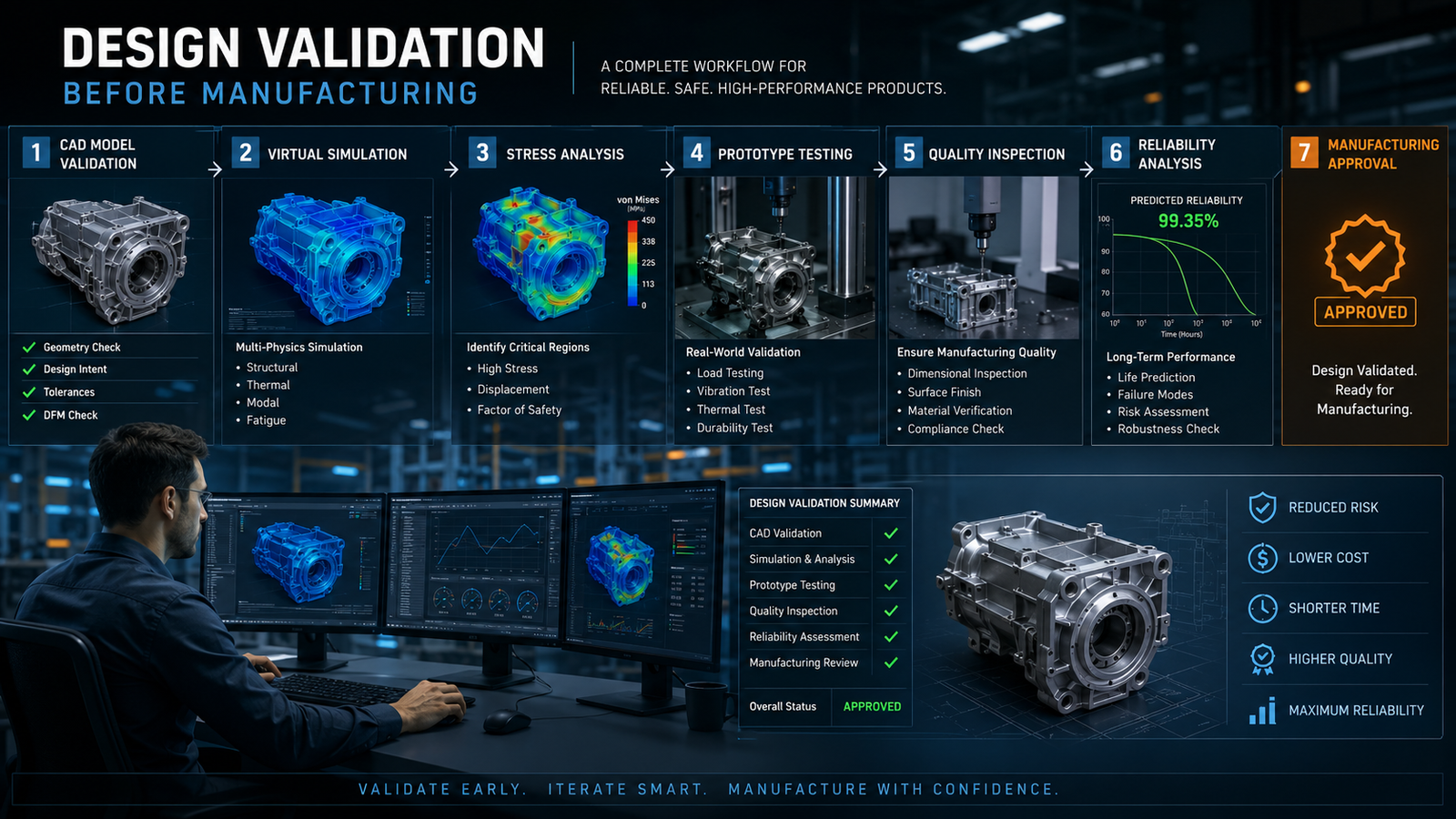
At 4Dimensions Infotech, students quickly learn that a product looking good on a CAD screen does not automatically mean it will perform successfully in the real world.
Modern engineering industries no longer depend only on theoretical calculations or visually accurate 3D models. Instead, companies focus heavily on design validation before any product reaches manufacturing.
In mechanical engineering, automotive design, aerospace systems, and industrial product development, even a small design issue can lead to serious failures after production.
Because of this, validation has become one of the most important stages in modern engineering workflows.
Today, industries use advanced CAD simulation, CAE analysis, virtual testing, and prototype validation techniques to ensure that designs are safe, reliable, and production-ready.
Students learning through a cad design course, engineering software course, or simulation-based CAD training programs must understand that validation is not just a software process it is a core engineering responsibility.
Design validation is the process of checking whether a product actually performs correctly under real-world operating conditions.
Many students confuse validation with verification, but both concepts are different.
Verification checks whether the design matches technical specifications and dimensions.
Validation, however, focuses on something much more important:
Will the product work safely and reliably when used in the real world?
For example, a component may look perfect inside CAD software, but if it cracks under vibration or fails under repeated loading, the design is not truly validated.
This is why validation connects closely with concepts explained in virtual testing vs physical testing in engineering design.
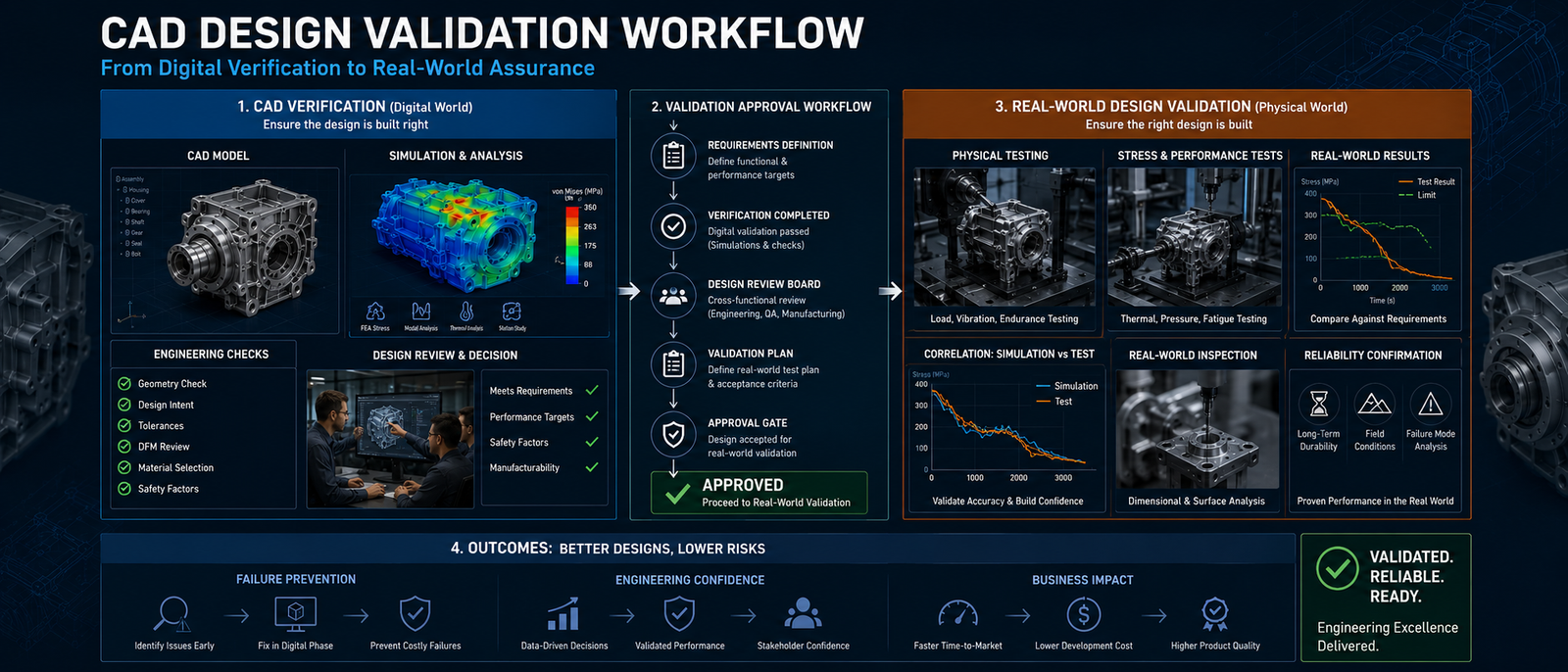
Modern products operate under highly demanding conditions.
Mechanical systems experience vibration, cyclic loading, heat variation, impact forces, pressure changes, and long-term fatigue.
Because of this, designs that appear stable during initial modeling may fail during actual operation.
For example, a machine bracket may pass dimensional checks but crack after repeated vibration cycles.
An automotive component may perform correctly during simulation but deform unexpectedly under real driving conditions.
Without proper validation, these problems often appear only after manufacturing begins — which leads to:
This is why companies invest heavily in CAD simulation and validation-based engineering workflows.
Modern engineering industries explained in real CAD industry workflows rely extensively on testing and validation before manufacturing approval.
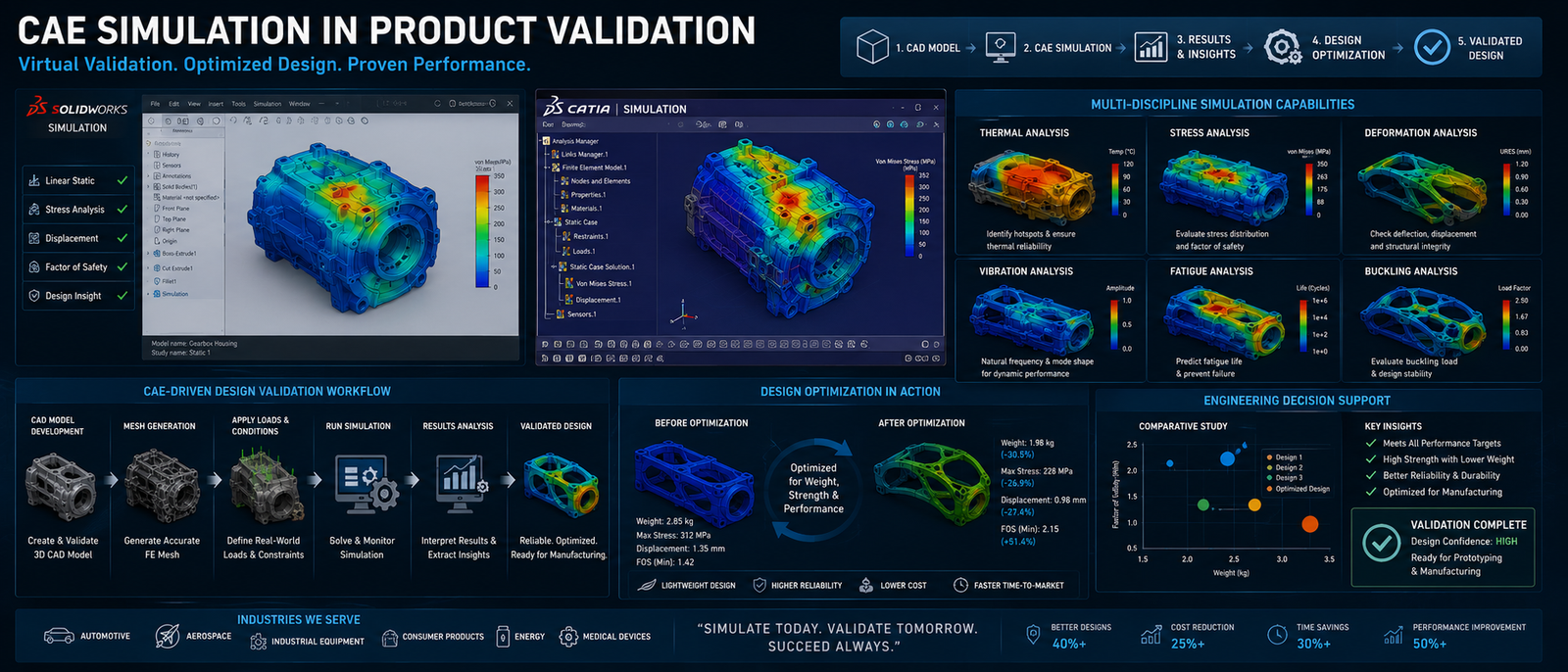
Simulation has completely transformed the way engineers validate products today.
Instead of immediately building physical prototypes, engineers first test digital models using CAE tools and simulation software.
Software used in a SolidWorks course, CATIA course, or advanced engineering software course allows engineers to simulate:
This process helps engineers identify weak points early in the design stage.
As a result, companies reduce development cost, improve safety, and optimize products before manufacturing even begins.
This modern engineering approach is closely related to concepts discussed in CAE-driven engineering design processes.
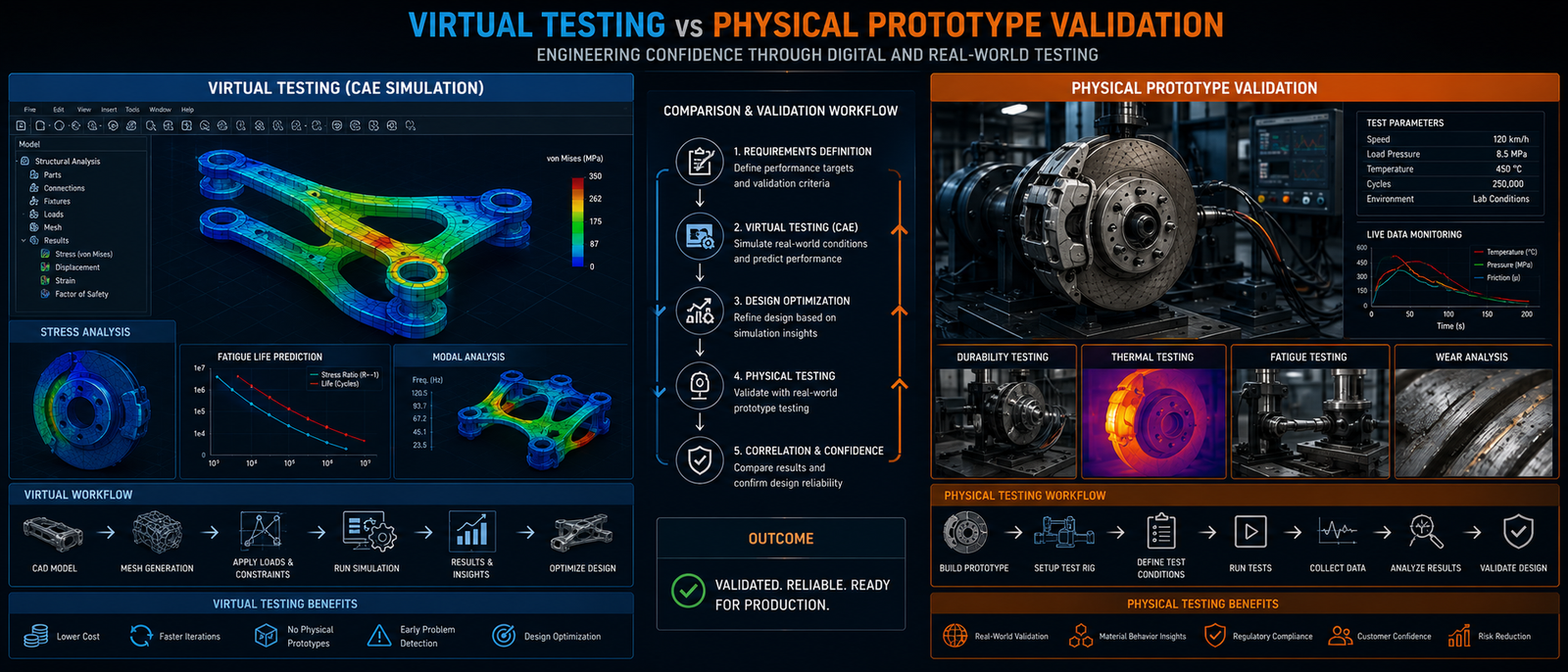
Modern engineering uses both virtual testing and physical testing together because each method provides unique advantages.
Virtual testing allows engineers to simulate hundreds of conditions quickly without building multiple prototypes.
This makes the design process much faster and more cost-efficient.
However, simulations still depend on assumptions, material models, and mathematical conditions.
Because of this, physical validation remains extremely important.
During physical testing, engineers manufacture prototypes and evaluate them under real operating conditions.
This helps validate whether simulation results match actual performance.
Industries such as automotive and aerospace rely heavily on this combined workflow:
This workflow is also connected with modern prototyping-based product development.
Consider an automotive brake system.
Before manufacturing begins, engineers first create CAD models and simulate:
After virtual testing, physical prototypes are tested on actual vehicles under real driving conditions.
Only after passing both validation stages is the design approved for production.
This process ensures safety, durability, and long-term reliability.
Many engineering failures occur because products move into production without proper validation.
In some cases, companies focus too heavily on deadlines and underestimate real operating conditions.
This often leads to:
Even a small design flaw can create major problems when products are manufactured at large scale.
This is why validation is considered one of the most critical responsibilities in mechanical engineering.
Modern concepts explained in stress concentration analysis and static vs dynamic loading analysis also play a major role during validation processes.
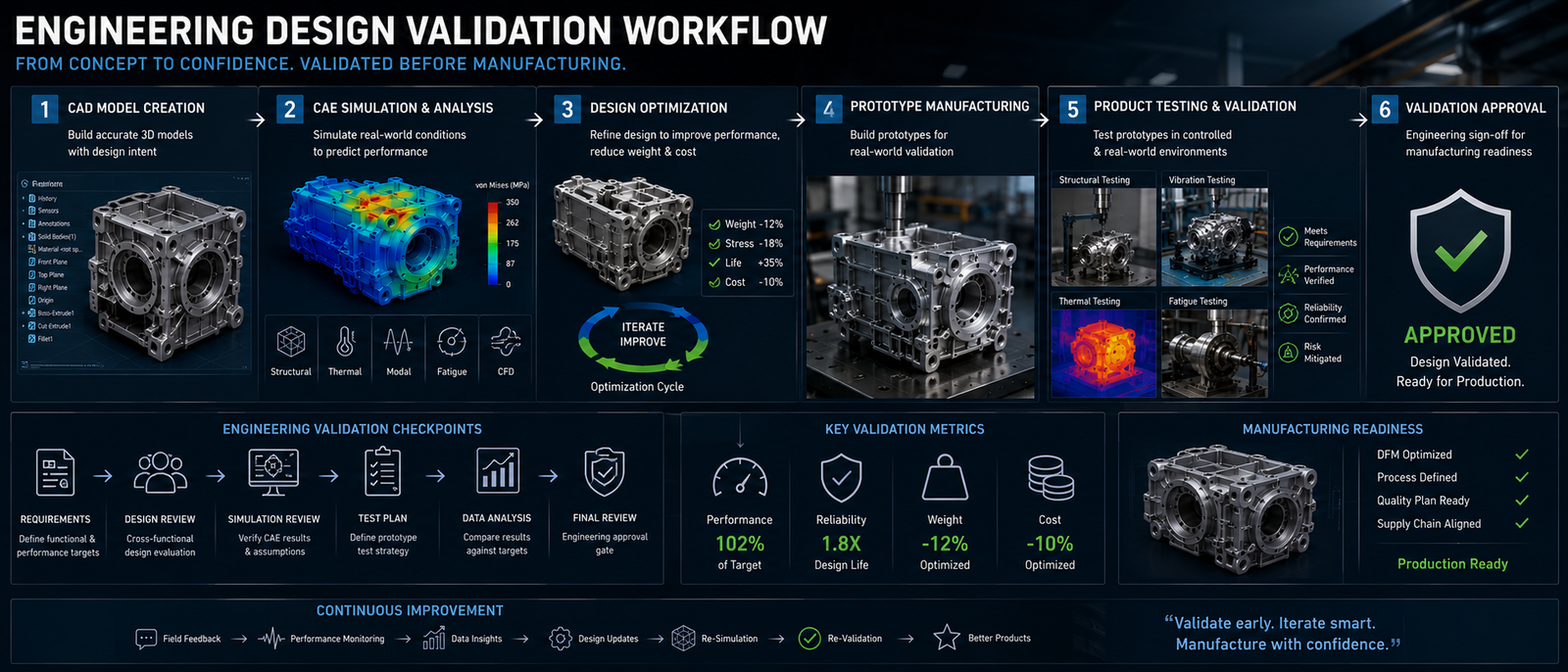
Design validation is one of the most important stages in modern engineering product development.
It ensures that products are not only visually correct inside CAD software, but also safe, durable, and reliable under real-world operating conditions.
By combining CAD modeling, simulation analysis, virtual testing, and physical validation, engineers can identify failures early and improve product quality significantly.
As industries continue moving toward simulation-driven engineering workflows, validation skills are becoming increasingly important for modern engineers.
Real engineering learning begins when students understand how products behave outside the computer screen.
The focus is not only on learning software — it is on building engineers who can design reliable real-world products.
1. What is design validation?
Design validation checks whether a product performs correctly under real-world operating conditions.
2. Why is design validation important?
It helps prevent failures, improves product safety, and reduces manufacturing risks.
3. Which software is used for validation?
SolidWorks, CATIA, ANSYS, and other CAE simulation tools are commonly used.
4. Is physical testing still necessary?
Yes, physical testing validates simulation results under real operating conditions.
5. What happens if validation is skipped?
Skipping validation can lead to product failure, financial loss, and safety risks.
© 2025 4Dimensions Infotech. All rights reserved. | Best Design Engineering Training Institute in Pune
Start your journey with the best design engineering training institute in Pune.