
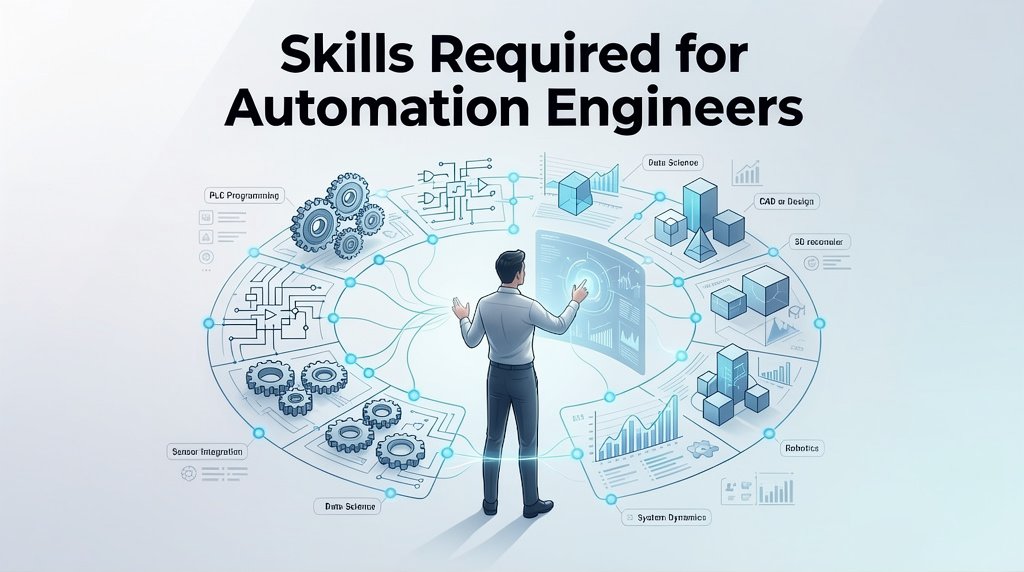
Automation is transforming engineering across industries.
Today, companies rely on automation to improve efficiency, accuracy, and productivity. Therefore, understanding automation engineer skills is important for anyone who wants to build a career in this field.
However, automation engineering requires more than just software knowledge. It combines technical skills, problem-solving, and practical understanding.
First, automation engineers must understand how systems work.
They deal with machines, sensors, and control systems. As a result, they need a strong foundation in engineering concepts.
In addition, they must understand how different components interact within a system.
This concept connects with automation vs manual engineering, where system efficiency plays a key role.
Automation engineers use different software tools for design and analysis.
They often work with CAD tools to design systems and components. Moreover, they use simulation tools to test performance before implementation.
Therefore, learning software becomes essential for automation roles.
This aligns with engineering software skills used in modern industries.
Automation systems can become complex.
Therefore, engineers must identify issues quickly and find effective solutions. In addition, they must analyze data and improve system performance.
As a result, strong analytical thinking becomes a key skill.
This is also related to root cause analysis in engineering.
Control systems play a major role in automation.
Engineers must understand how machines respond to inputs and maintain stability. Therefore, they need knowledge of system behavior and feedback mechanisms.
This helps them design efficient and reliable systems.
Automation is closely linked with modern technologies such as smart manufacturing and digital systems.
Engineers must stay updated with new tools and trends. Moreover, they must learn how to integrate automation into real-world applications.
This is explained in smart manufacturing processes.
Automation engineers rarely work alone.
They collaborate with design, production, and maintenance teams. Therefore, clear communication becomes important.
In addition, teamwork helps ensure that systems function correctly in real environments.
This connects with engineering team communication.
Technology changes quickly.
Therefore, automation engineers must keep learning new tools and techniques. As a result, continuous learning helps them stay relevant in the industry.
Automation engineering requires a combination of technical knowledge and practical skills.
Engineers must understand systems, software, and real-world applications. Therefore, building these skills is essential for a successful career.
To become an automation engineer, you need hands-on experience with tools and systems.
At 4Dimensions Infotech, students learn automation concepts through practical training and real-world projects.
As a result, you gain the skills required for modern engineering roles.
👉 Start building your automation engineering skills today.
1. What skills are required for automation engineers?
Automation engineers need software knowledge, problem-solving skills, and system understanding.
2. Do automation engineers need coding?
Basic coding knowledge can help, but it is not always required.
3. Which software is used in automation?
CAD, simulation, and control system tools are commonly used.
4. Is automation engineering a good career?
Yes, it offers strong growth and job opportunities.
5. Do automation engineers work in teams?
Yes, they collaborate with different departments.
6. How can I become an automation engineer?
By learning engineering tools and gaining practical experience.
© 2025 4Dimensions Infotech. All rights reserved. | Best Design Engineering Training Institute in Pune
Start your journey with the best design engineering training institute in Pune.