
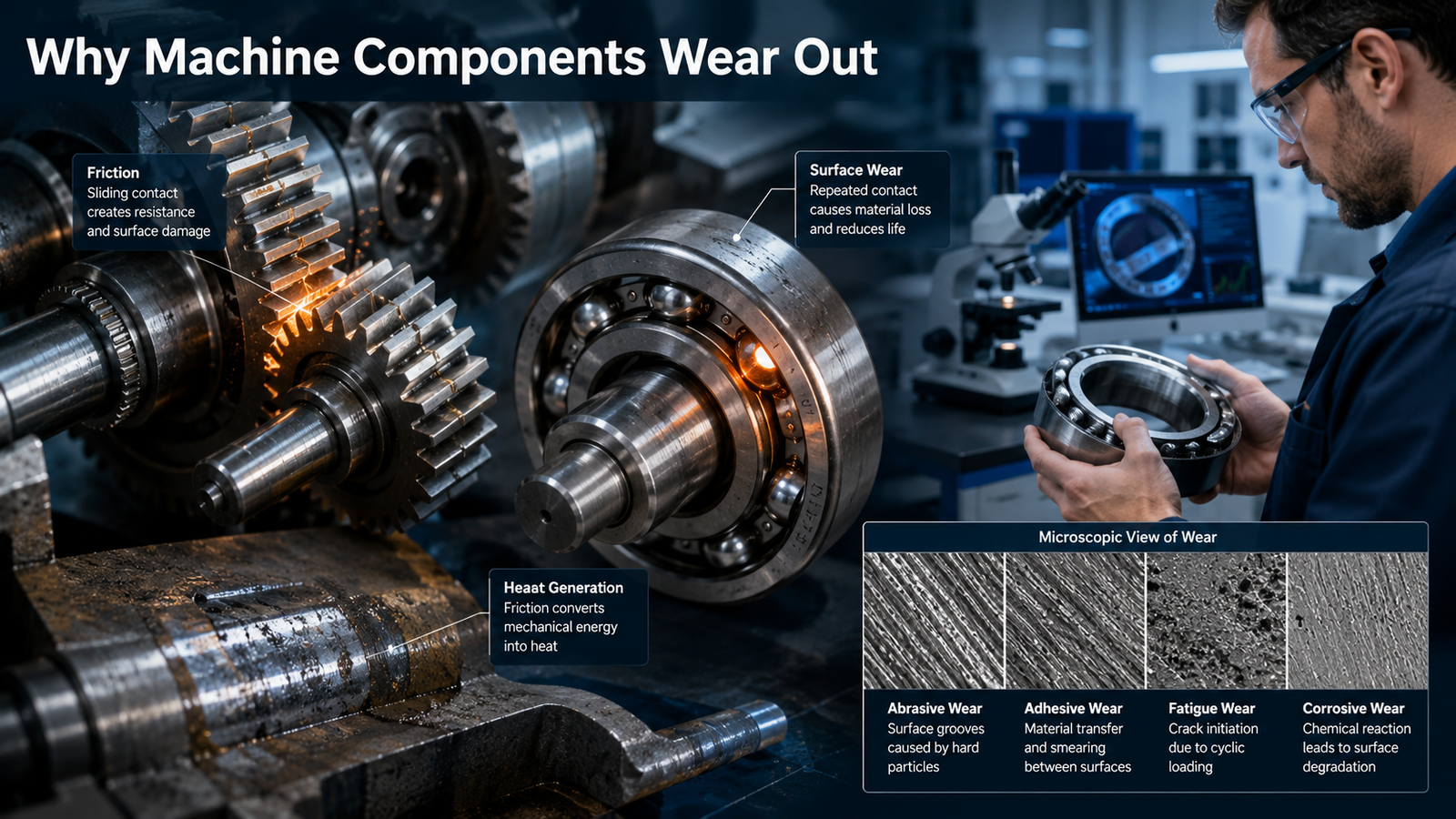
Why do expensive machine components eventually fail even when they are manufactured from strong materials?
Many people assume mechanical failures happen because a component is weak or poorly designed. However, in many cases, failure begins with something much simpler: friction.
Whenever two surfaces come into contact and move relative to each other, friction is generated. While friction is necessary for many engineering applications, it also produces heat, energy loss, and gradual surface damage.
Over time, this damage develops into wear. Components slowly lose material, surface quality decreases, and performance begins to decline.
This is why understanding Friction and Wear in Mechanical Systems is important for mechanical engineers. From gears and bearings to engines and turbines, controlling friction and wear directly affects reliability, efficiency, and service life.
Engineers must understand not only how friction occurs but also how it can be controlled to improve machine performance.
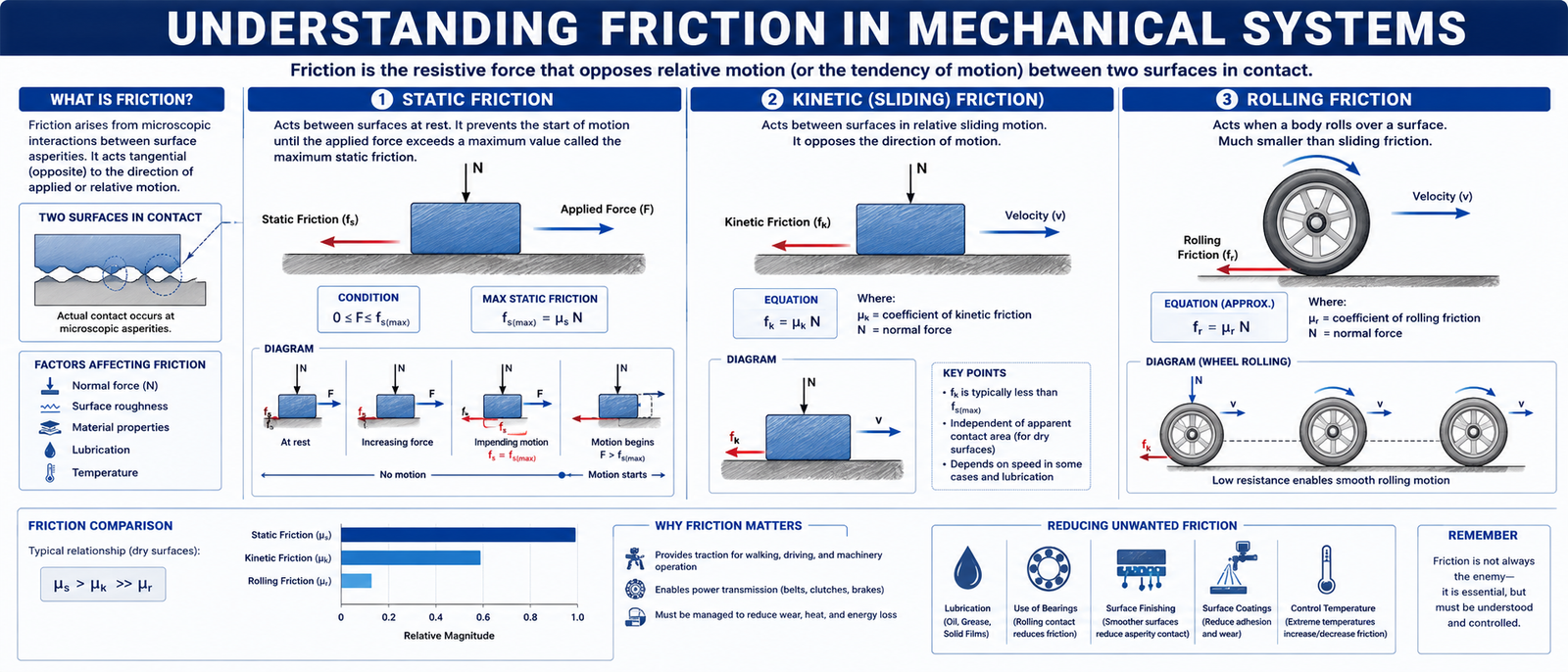
Friction is the resistance that occurs when two surfaces attempt to move against each other.
Although friction is often viewed as a problem, it actually plays both positive and negative roles in engineering.
Without friction, vehicles could not move, brakes would not function, and machines would struggle to transmit motion effectively.
Static friction acts when surfaces remain at rest relative to each other. It must be overcome before motion can begin.
Kinetic friction occurs when surfaces are already moving. It is usually lower than static friction and continuously consumes energy during operation.
Rolling friction occurs when an object rolls across a surface. This type of friction is significantly lower than sliding friction, which is why wheels and bearings improve efficiency.
Understanding friction allows engineers to predict energy losses and improve machine performance.
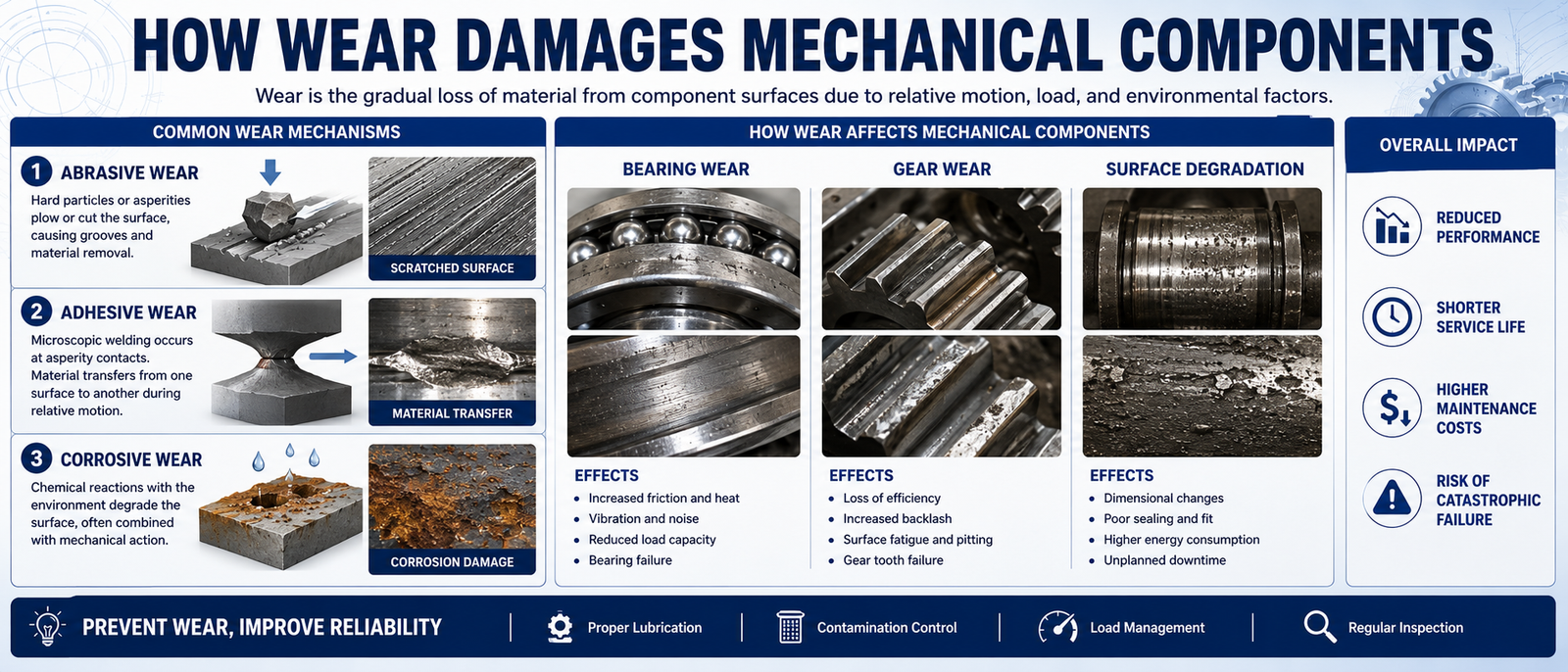
Wear is the gradual removal or deformation of material from a surface due to repeated contact and motion.
Unlike sudden failures, wear develops slowly over time and often goes unnoticed until performance begins to decline.
Abrasive wear occurs when hard particles scratch or cut softer surfaces. This is commonly seen in dusty environments and poorly lubricated systems.
Adhesive wear occurs when surface materials stick together and then separate during motion, removing small amounts of material.
Corrosive wear results from chemical reactions combined with mechanical action. It is common in harsh industrial environments.
Excessive wear can eventually lead to vibration, reduced efficiency, component failure, and increased maintenance costs.
This is closely related to Material Fatigue and Life Prediction.
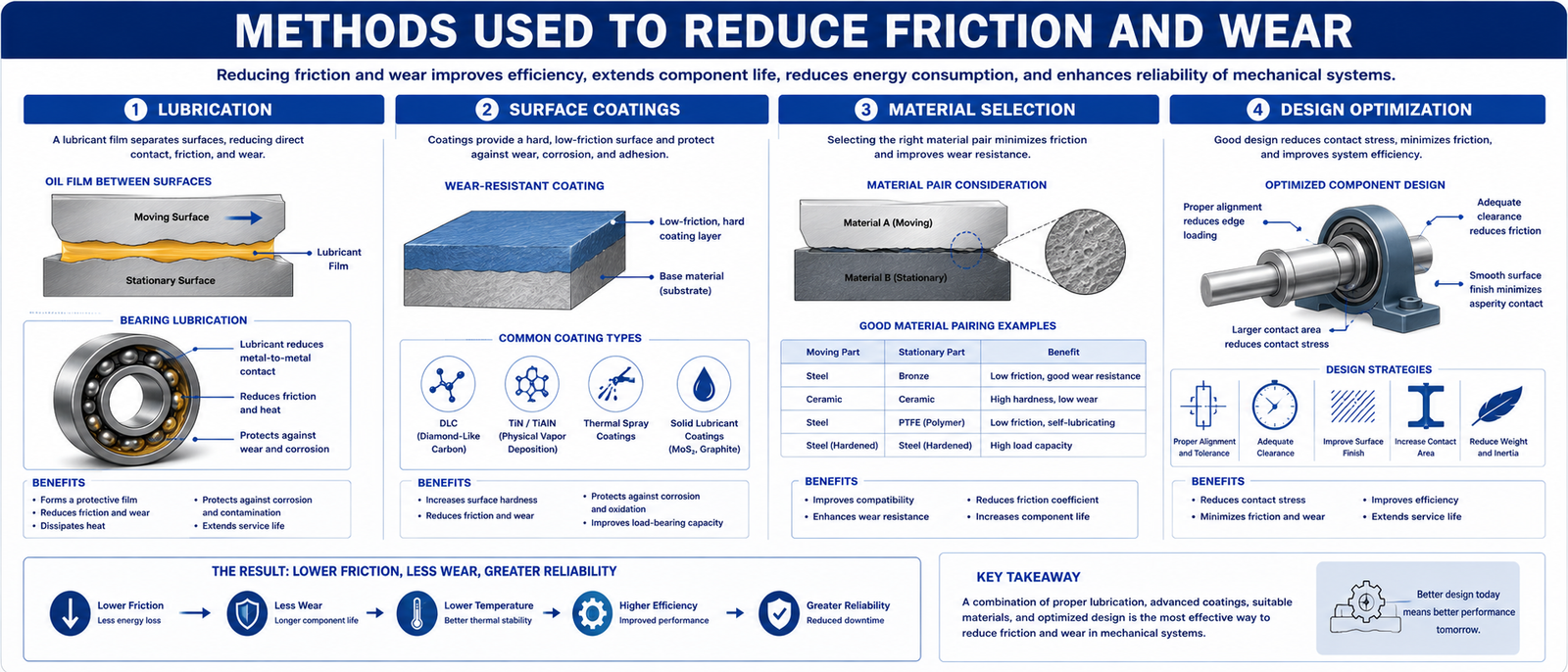
Because friction and wear cannot be completely eliminated, engineers focus on controlling them.
Lubricants create a protective film between surfaces, reducing direct contact and minimizing wear.
Engineers choose materials based on hardness, strength, corrosion resistance, and wear resistance.
This connects with Material Selection in Mechanical Design.
Coatings, heat treatments, and polishing processes improve surface durability and reduce wear rates.
Engineers modify geometry, reduce contact stresses, and improve load distribution to extend component life.
This is part of Engineering Design Optimization Techniques.
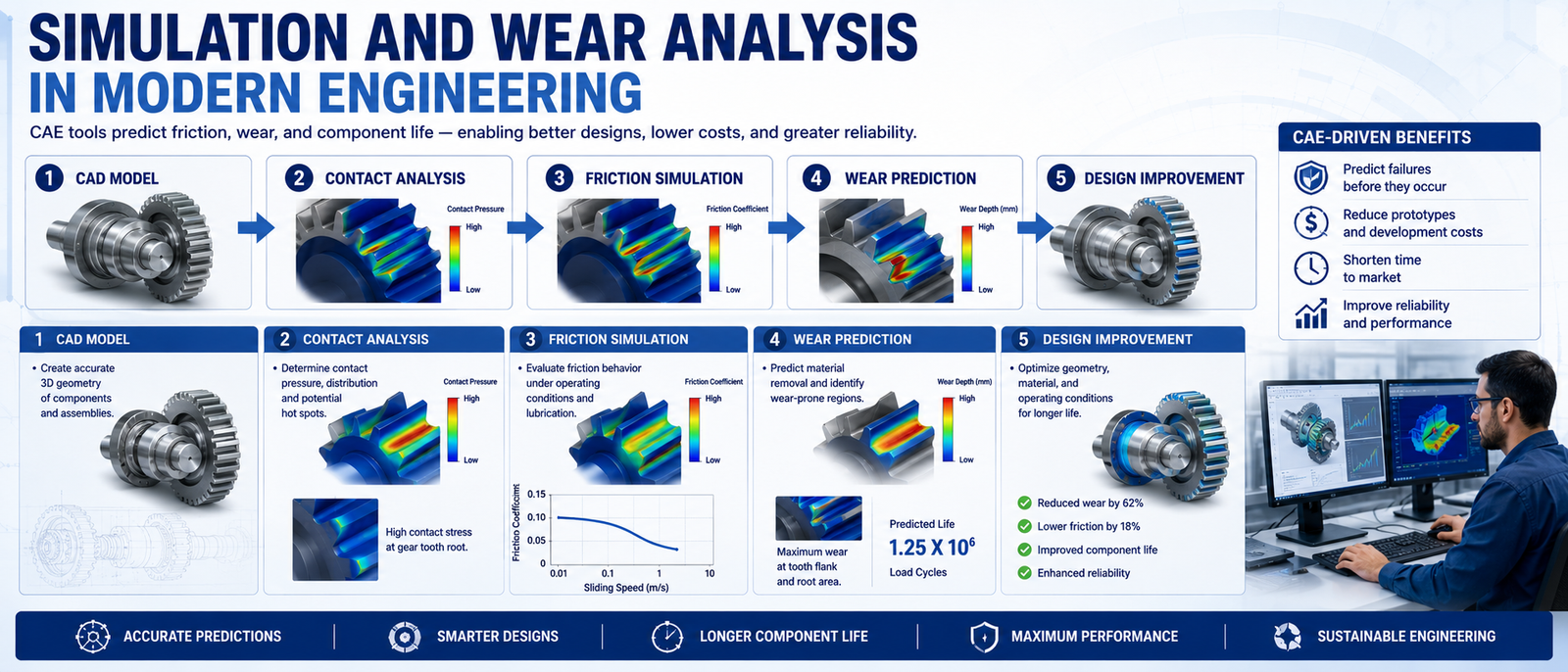
Today, engineers use simulation tools to study friction and wear before manufacturing begins.
CAE software can predict contact stresses, wear patterns, lubrication effectiveness, and potential failure zones.
This allows engineers to improve designs before physical prototypes are built.
Simulation reduces development costs, shortens testing cycles, and improves product reliability.
This process is part of CAE in Engineering Design.
Industries such as automotive, aerospace, manufacturing, and heavy machinery rely heavily on wear analysis to improve component life and system performance.
Friction and wear are unavoidable in mechanical systems, but they can be controlled through proper engineering practices.
By understanding how surfaces interact and how wear develops, engineers can design machines that operate more efficiently, last longer, and require less maintenance.
Modern engineering combines material science, tribology, lubrication technology, and simulation tools to reduce wear and improve reliability.
At 4Dimensions Infotech, students learn practical mechanical design, CAD, CAE, simulation, and engineering analysis concepts used in real industries.
1. What is friction in mechanical systems?
Friction is the resistance to motion between two contacting surfaces.
2. What is wear?
Wear is the gradual removal or deformation of material due to surface interaction.
3. Why is wear important in engineering?
Wear affects component life, maintenance costs, and overall machine reliability.
4. How can wear be reduced?
Lubrication, material selection, surface treatment, and design optimization help reduce wear.
5. Where is friction important?
Friction plays a critical role in brakes, engines, bearings, gears, and industrial machinery.
© 2025 4Dimensions Infotech. All rights reserved. | Best Design Engineering Training Institute in Pune
Start your journey with the best design engineering training institute in Pune.