
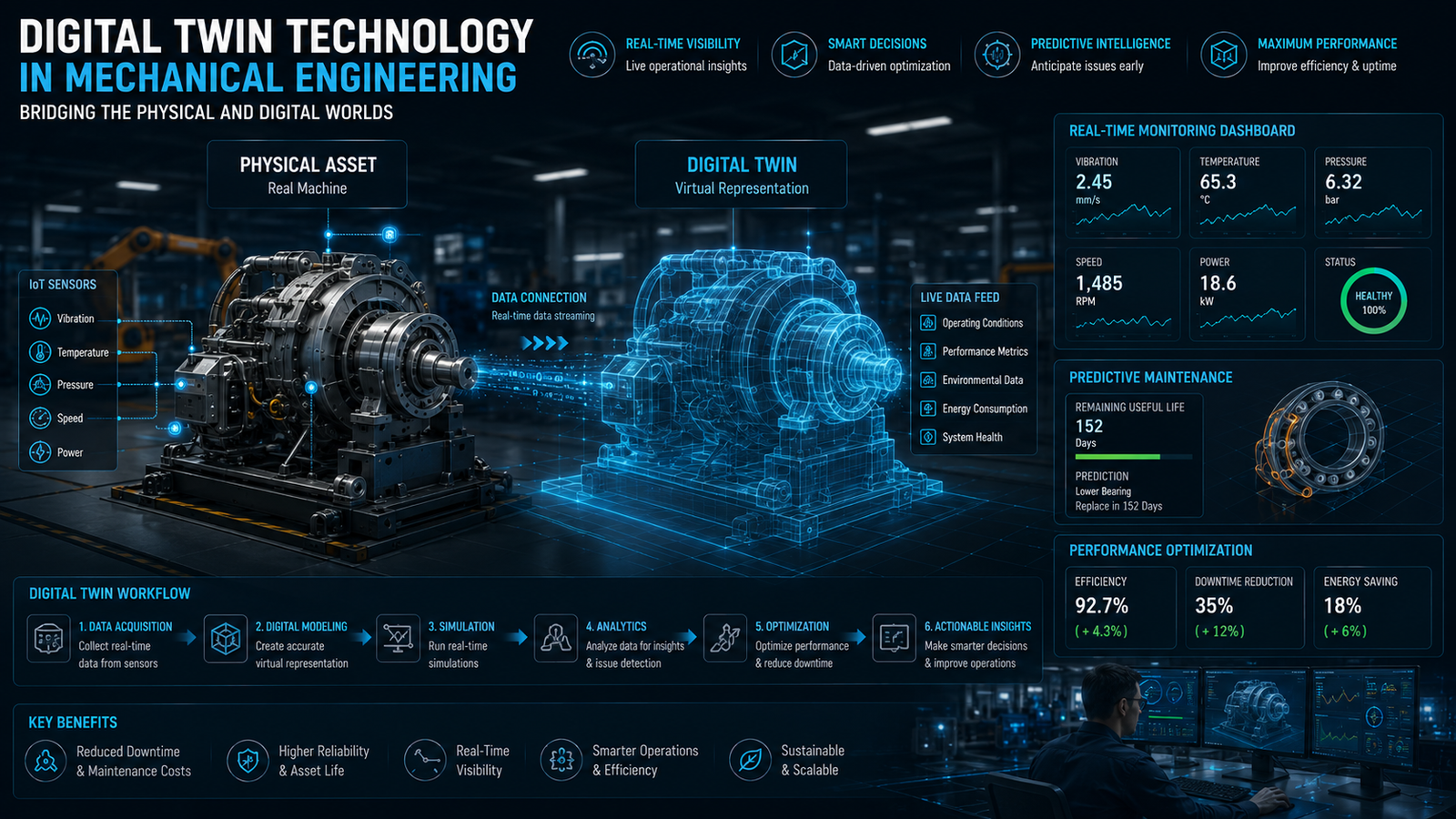
At 4Dimensions Infotech, students learning modern CAD and engineering workflows are now being introduced to one of the fastest-growing technologies in the industry — Digital Twin Technology in Engineering.
Modern engineering is no longer limited to creating static CAD models or physical prototypes.
Today, industries want intelligent systems that can simulate, monitor, predict, and optimize product behavior continuously in real time.
This is exactly where digital twin technology is transforming modern engineering design.
Instead of relying only on physical testing, engineers now create virtual replicas of products and systems that behave exactly like their real-world counterparts.
These digital twins continuously receive data, simulate operating conditions, and help engineers improve performance before failures occur.
Because of this, digital twin technology has become one of the most important innovations in modern mechanical engineering, smart manufacturing, CAD simulation, and Industry 4.0 workflows.
Students learning through a cad design course, engineering software course, or simulation-focused CAD training now increasingly encounter concepts related to smart engineering systems and digital twin workflows.
A digital twin is a virtual representation of a real physical product, machine, system, or process.
Unlike traditional CAD models, a digital twin is not static.
Instead, it continuously evolves using real-world operating data.
This means engineers can monitor how a product behaves under actual conditions while simultaneously analyzing its virtual counterpart.
Modern digital twins combine:
As a result, engineers can improve product performance, reduce failures, and optimize systems continuously.
This evolution of intelligent engineering systems connects closely with concepts explained in AI-driven CAD and engineering workflows.
Digital twin technology is now widely used across automotive engineering, aerospace systems, manufacturing industries, robotics, and smart infrastructure projects.
For example, engineers can create a digital twin of a machine and simulate how it behaves under different operating conditions.
They can monitor:
Because the virtual system continuously receives real-world operational data, engineers can predict failures before they actually happen.
This helps industries reduce downtime, improve safety, and optimize maintenance schedules.
Modern engineering workflows explained in real CAD industry applications now increasingly involve smart simulation and connected engineering systems.
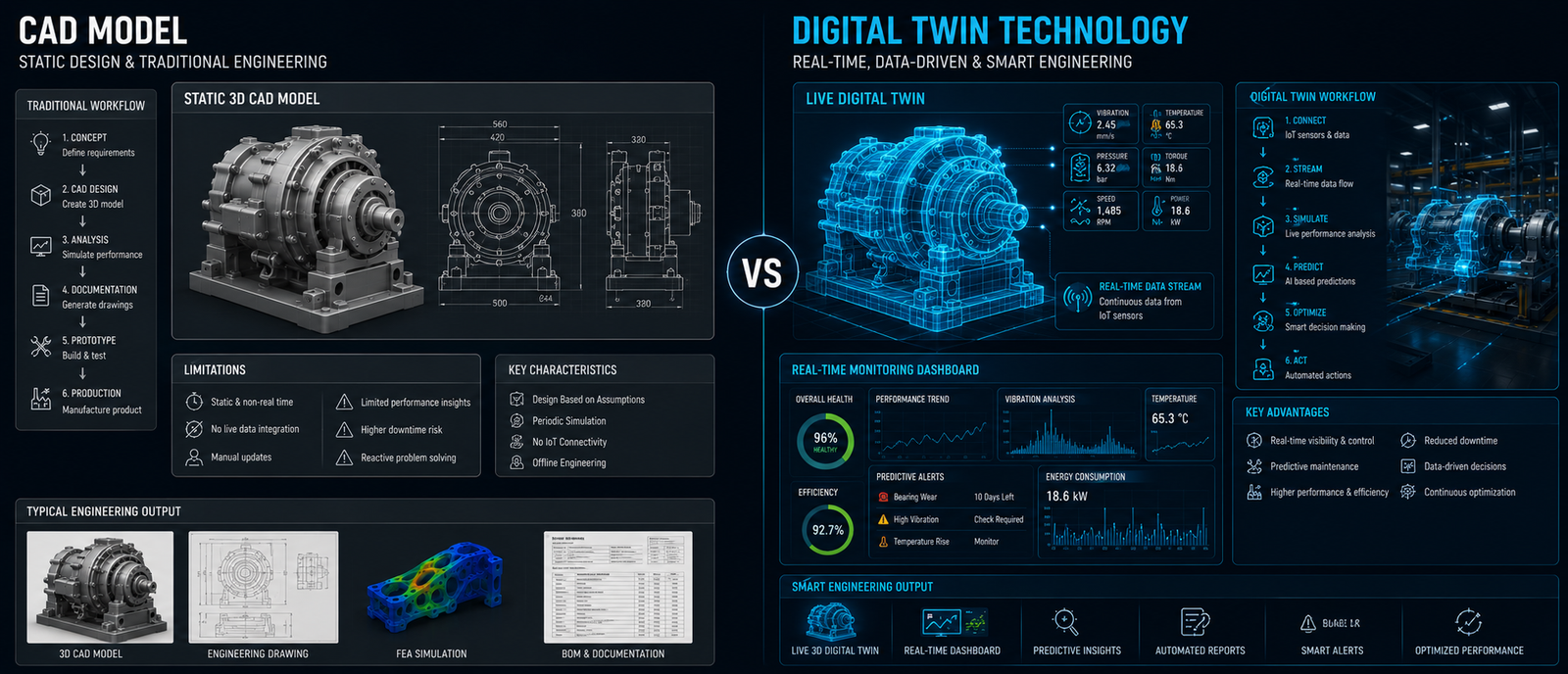
Many engineering students assume that CAD models and digital twins are the same thing, but they are fundamentally different.
A CAD model mainly represents the geometry and structure of a product.
It helps engineers visualize dimensions, assemblies, and manufacturing details.
However, a digital twin goes far beyond geometry.
It combines CAD design with:
Because of this, digital twins act like intelligent living systems that evolve over time.
This transition from static design to smart engineering systems is becoming one of the biggest shifts in modern product development.
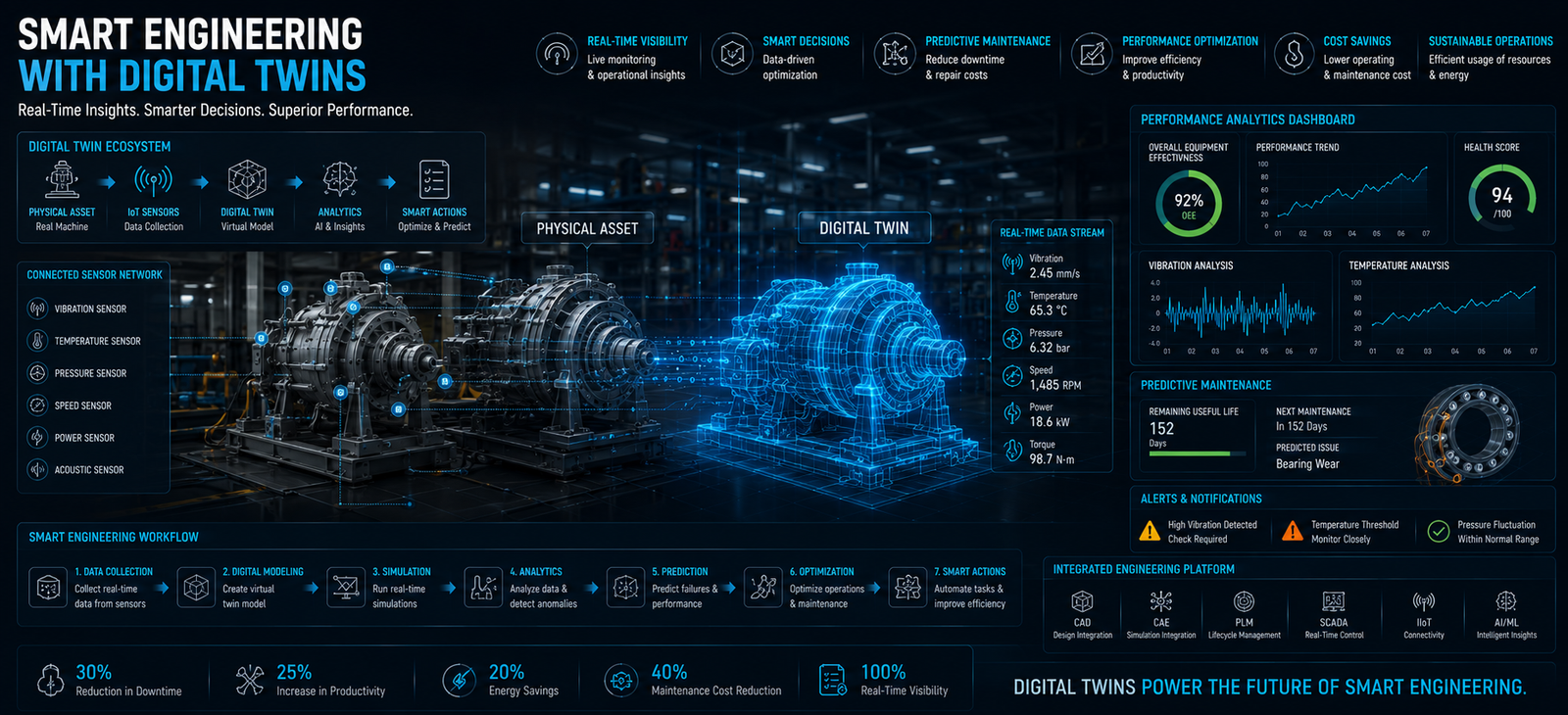
Digital twin technology depends heavily on simulation and real-world data integration.
Engineers first create the base CAD model using software taught in a SolidWorks course, CATIA course, or engineering software course.
Then, simulation tools analyze:
After deployment, real-world sensor data continuously updates the digital twin.
This creates a feedback loop between the physical product and the virtual engineering model.
As a result, engineers can predict failures, optimize maintenance, and improve designs continuously.
This workflow also connects strongly with concepts explained in CAE-based engineering simulation workflows.
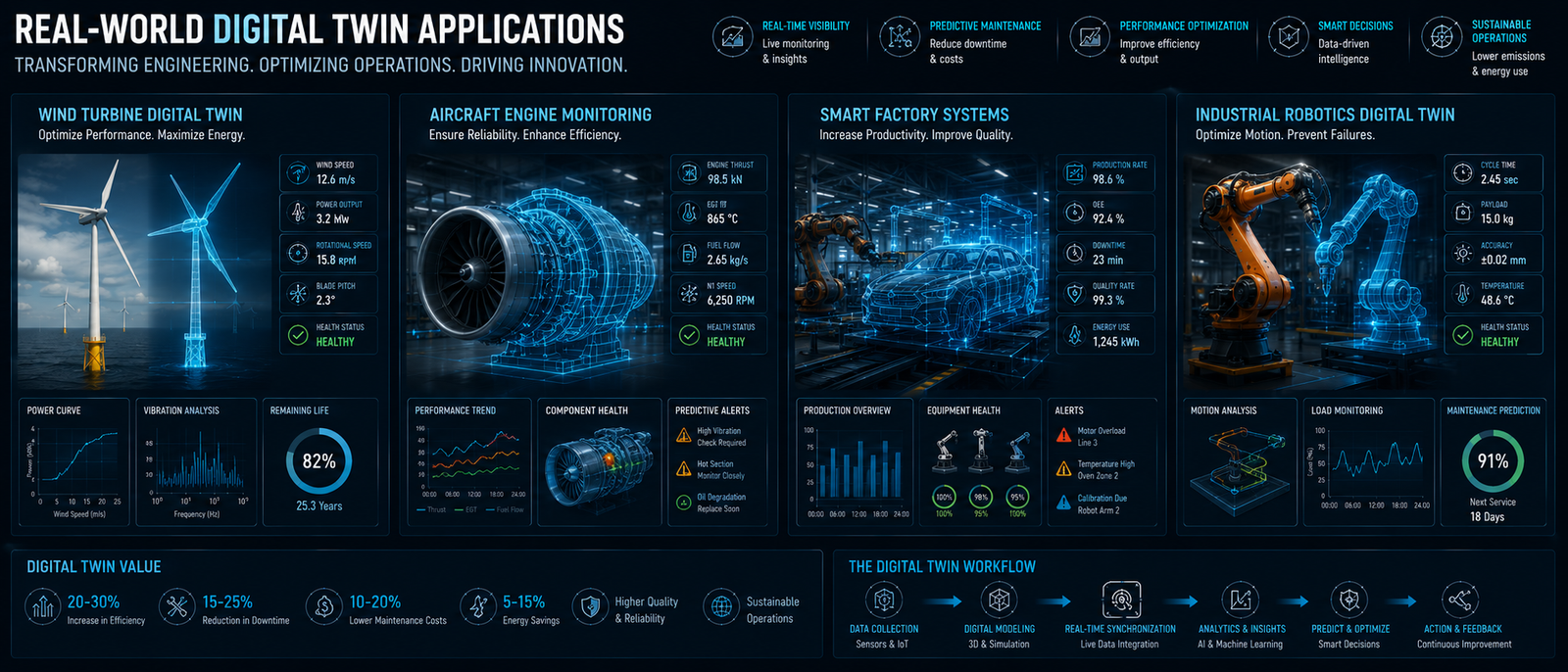
One of the best examples of digital twin technology can be seen in wind turbines.
A digital twin of a wind turbine continuously monitors:
If abnormal behavior appears, engineers can identify the issue early before a major failure occurs.
This helps improve efficiency, reduce downtime, and lower maintenance cost significantly.
Similar digital twin systems are now being used in:
Digital twin technology provides major advantages in modern engineering industries.
One of the biggest benefits is reduced development time.
Because engineers can test systems virtually, companies need fewer physical prototypes during product development.
Digital twins also improve:
Another major advantage is continuous product improvement.
Even after deployment, engineers can keep optimizing products using real-world performance data.
This is why digital twin technology is becoming a key part of smart manufacturing and future engineering systems.
It also connects closely with concepts explained in design validation before manufacturing and virtual prototyping workflows.
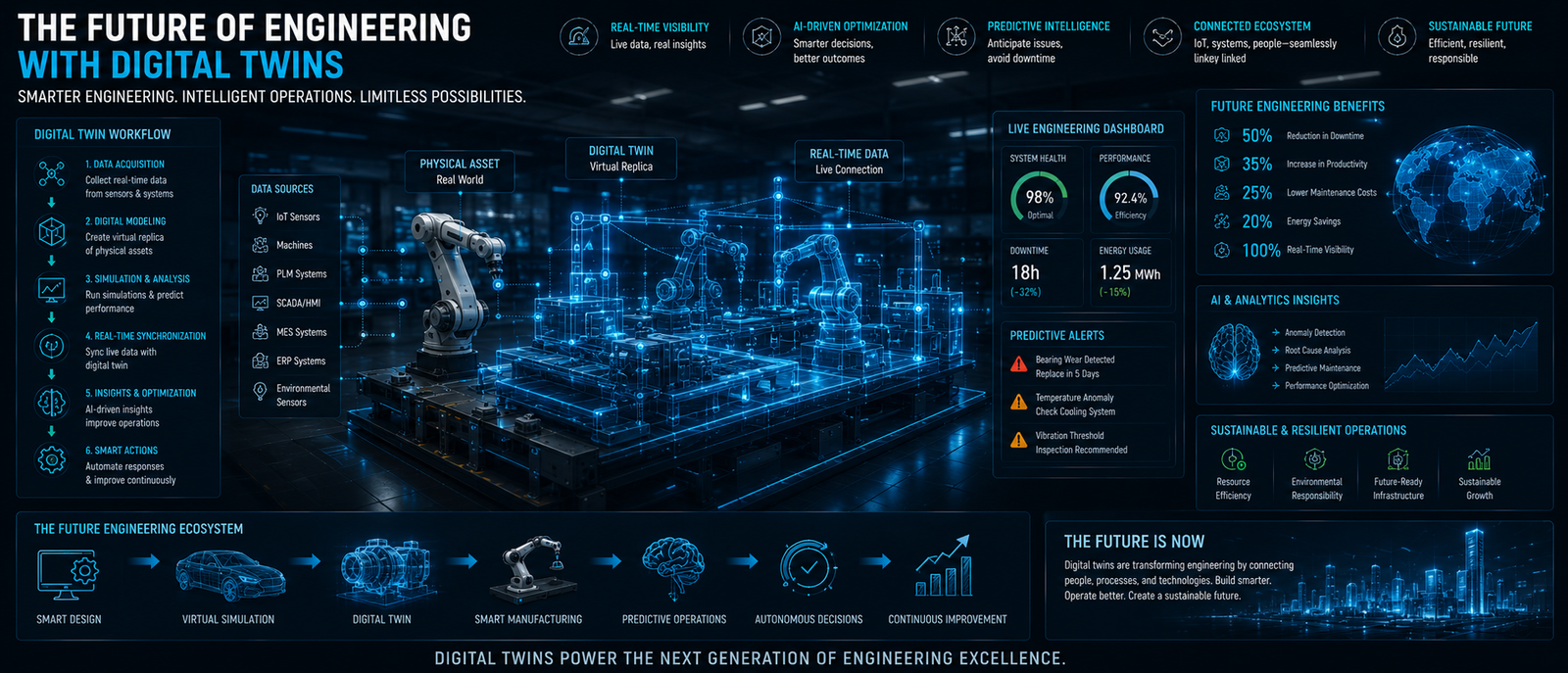
Digital twin technology is transforming modern engineering by combining CAD models, simulation systems, real-world data, and predictive analytics into intelligent engineering workflows.
Instead of simply designing products, engineers can now monitor, test, optimize, and improve systems continuously through virtual replicas.
As industries move toward smart manufacturing and Industry 4.0 systems, digital twins will become one of the most important technologies in future engineering careers.
Engineers who understand CAD simulation, data-driven design, and smart engineering workflows will gain a major advantage in modern industries.
Modern engineering careers now demand more than basic CAD software knowledge.
The goal is to build engineers who understand not only design — but also intelligent engineering systems and future-ready workflows.
1. What is a digital twin in engineering?
A digital twin is a virtual replica of a physical product or system that behaves like the real-world object.
2. How is a digital twin different from a CAD model?
A CAD model shows geometry, while a digital twin includes real-time performance and operational behavior.
3. Which industries use digital twin technology?
Automotive, aerospace, manufacturing, robotics, and smart infrastructure industries use digital twins extensively.
4. Why is digital twin technology important?
It helps improve efficiency, predict failures, optimize maintenance, and reduce development cost.
5. Can students learn digital twin concepts?
Yes, students can build foundational knowledge through CAD, simulation, and engineering software training.
© 2025 4Dimensions Infotech. All rights reserved. | Best Design Engineering Training Institute in Pune
Start your journey with the best design engineering training institute in Pune.