
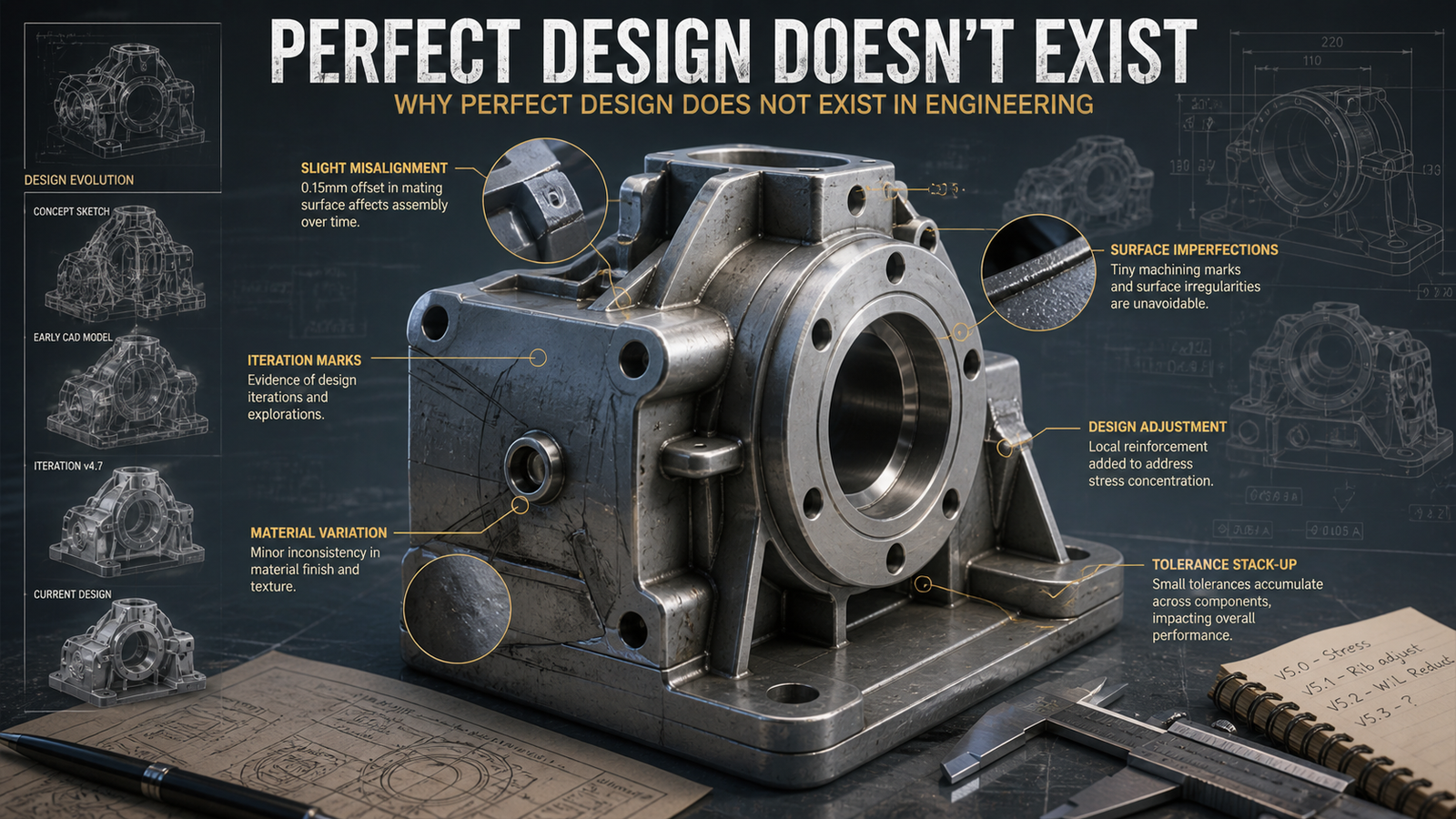
Many beginners in engineering believe that every design can be perfect.
However, in reality, perfect design does not exist. Every engineering solution involves trade-offs, limitations, and compromises.
Therefore, understanding this concept is essential for becoming a practical and effective engineer.
A perfect design would mean a solution that meets all requirements without any compromise.
It would be:
At first glance, this seems ideal. However, achieving all of these at once is not realistic.
In most projects, improving one aspect often affects another.
For example, increasing strength may increase weight. Similarly, reducing cost may reduce performance.
Every project operates under limitations such as budget, materials, and time.
These constraints directly influence design decisions. This challenge is similar to what engineers face in urban design environments with multiple limitations.
Not all designs can be easily manufactured.
Some complex designs may look good in theory but are difficult or expensive to produce.
Project requirements often evolve over time.
As a result, engineers must adapt designs instead of chasing perfection.
Engineering is about making the best possible decision within given constraints.
Instead of aiming for perfection, engineers focus on balance.
For instance:
This decision-making approach is also seen in risk and reward considerations in engineering.
Design is not a one-time activity.
Engineers improve designs through multiple iterations. Each version solves some problems while introducing new challenges.
Therefore, the goal is continuous improvement, not perfection.
This process is an important part of iterative design workflows used in real projects.
Although perfect design is not possible, modern tools help engineers get closer to optimal solutions.
Using simulation and analysis, engineers can test designs before manufacturing.
This approach is widely used in CAE-driven design processes.
Perfect design may sound ideal, but it does not exist in real engineering.
Instead, engineers focus on creating the best possible solution within constraints.
By understanding trade-offs and working through iterations, engineers deliver practical and efficient designs.
To succeed in engineering, you must learn how to think beyond theory and handle real-world constraints.
At 4Dimensions Infotech, students learn how to approach design problems using practical methods and industry tools.
You gain the skills needed to balance performance, cost, and feasibility in real projects.
👉 Start developing practical engineering skills and become industry-ready.
1. Why does perfect design not exist?
Because every design involves trade-offs between cost, performance, and feasibility.
2. What are design trade-offs?
They are compromises made between different design factors like cost, strength, and efficiency.
3. Can engineers achieve an optimal design?
Yes, engineers aim for the best possible solution within constraints, not perfection.
4. What is iterative design?
It is the process of improving a design through repeated modifications.
5. How do tools help in design improvement?
They allow simulation, testing, and optimization before production.
6. How can I improve my design skills?
By practicing real projects and understanding practical constraints.
© 2025 4Dimensions Infotech. All rights reserved. | Best Design Engineering Training Institute in Pune
Start your journey with the best design engineering training institute in Pune.