
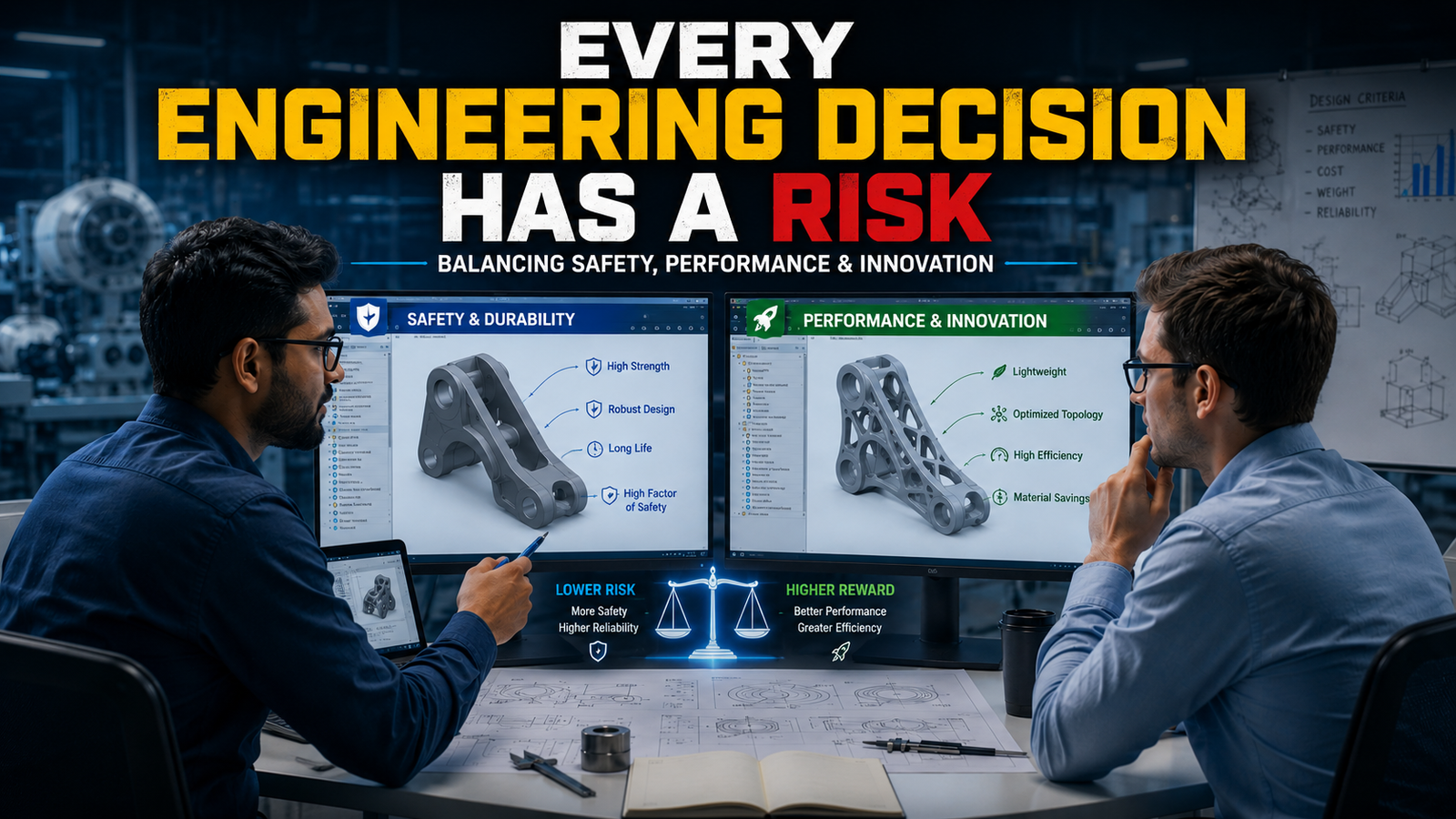
Two engineers are asked to redesign the same mechanical component.
The first engineer chooses a proven design that has worked successfully for years. It is safe, reliable, and carries very little risk.
The second engineer suggests a completely new approach using lighter materials and an optimized geometry. If successful, the component could become stronger, lighter, and cheaper to manufacture. However, it also introduces uncertainty.
So which engineer made the better decision?
The answer depends on one of the most important concepts in engineering: Risk vs Reward in Engineering.
Every engineering project involves decisions that balance safety, performance, cost, innovation, and reliability. Engineers are constantly evaluating whether the potential benefits of a new idea justify the risks involved.
The goal is not to eliminate risk completely. Instead, successful engineers learn how to identify risks, analyze them carefully, and make decisions that maximize rewards while keeping projects safe and practical.
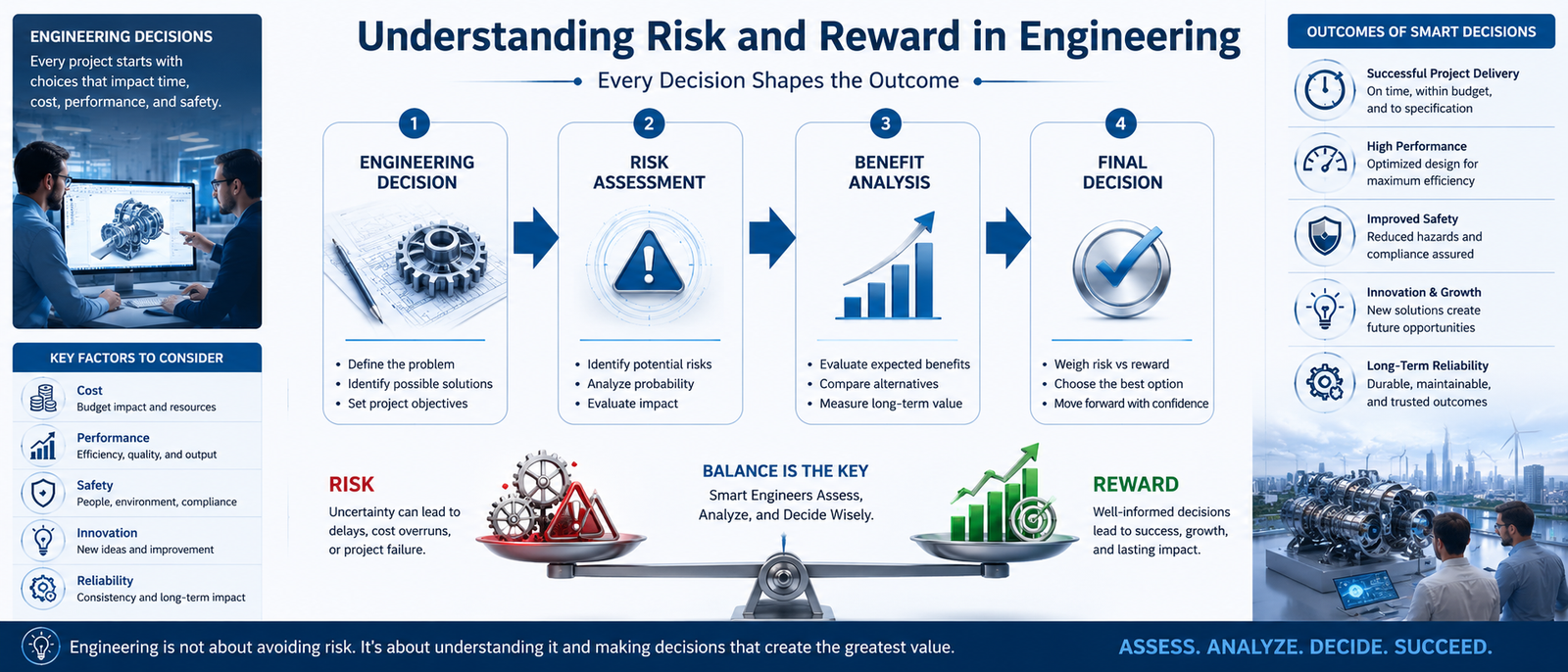
Engineering is a profession built on decision-making. Every design choice has advantages and disadvantages, and every improvement introduces new questions.
Risk refers to the possibility that something may not perform as expected. This could involve structural failure, increased manufacturing costs, project delays, or performance issues.
Reward, on the other hand, is the benefit gained by making that decision. Rewards may include lower production costs, improved efficiency, lighter products, better performance, or innovative solutions that outperform existing designs.
The challenge is that engineers rarely have perfect information. They must evaluate available data, consider possible outcomes, and choose the option that provides the greatest overall benefit while keeping risks under control.
This decision-making process is a key part of Design Validation Before Manufacturing, where engineers verify whether a design is ready for production.
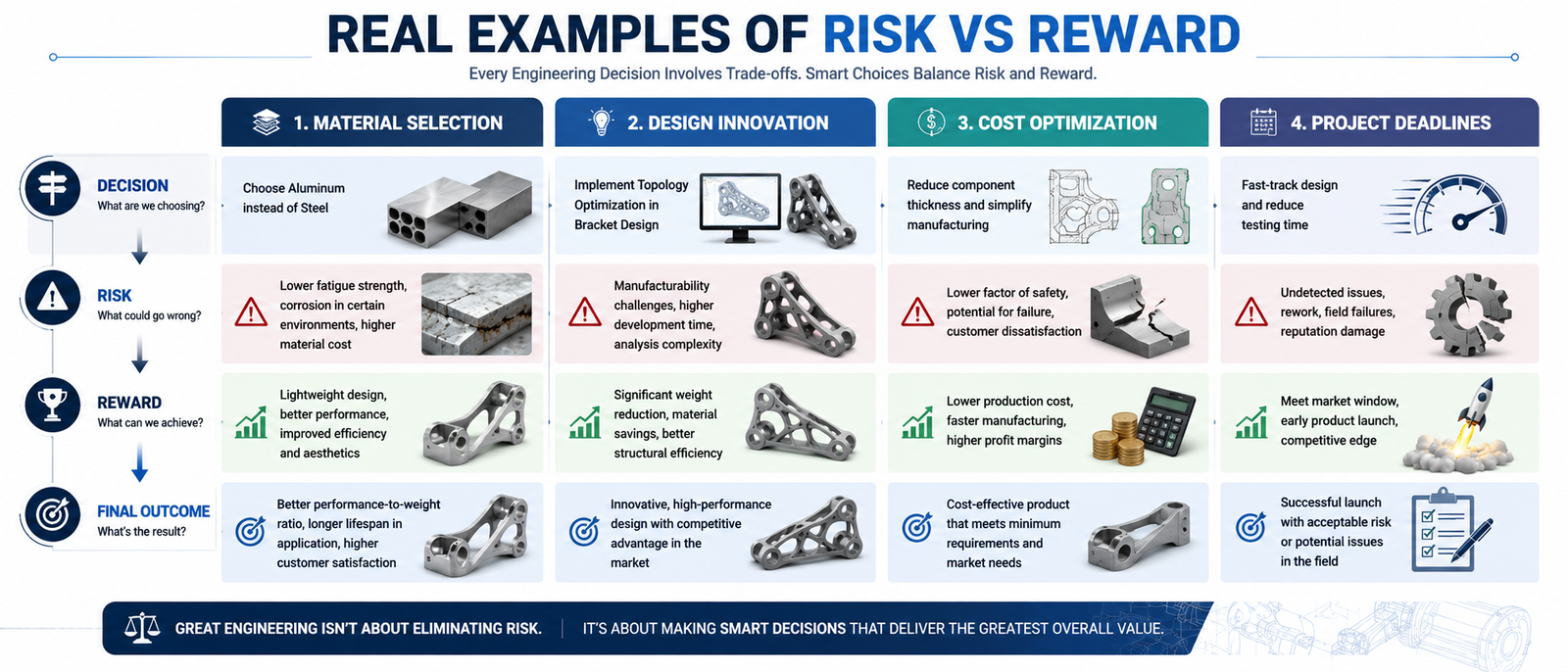
Choosing a lightweight alloy may improve fuel efficiency and reduce manufacturing costs. However, engineers must also verify whether the material can withstand long-term loading and fatigue.
Introducing a completely new design may significantly improve product performance, but it also increases uncertainty because the concept has not been extensively tested.
Reducing manufacturing costs can improve profitability. However, cutting costs too aggressively may reduce product quality and reliability.
Delivering a project earlier improves customer satisfaction, but rushing design reviews and testing increases the likelihood of engineering mistakes.
These decisions often involve concepts discussed in Importance of Material Selection in Mechanical Design, where engineers evaluate both performance and long-term durability.
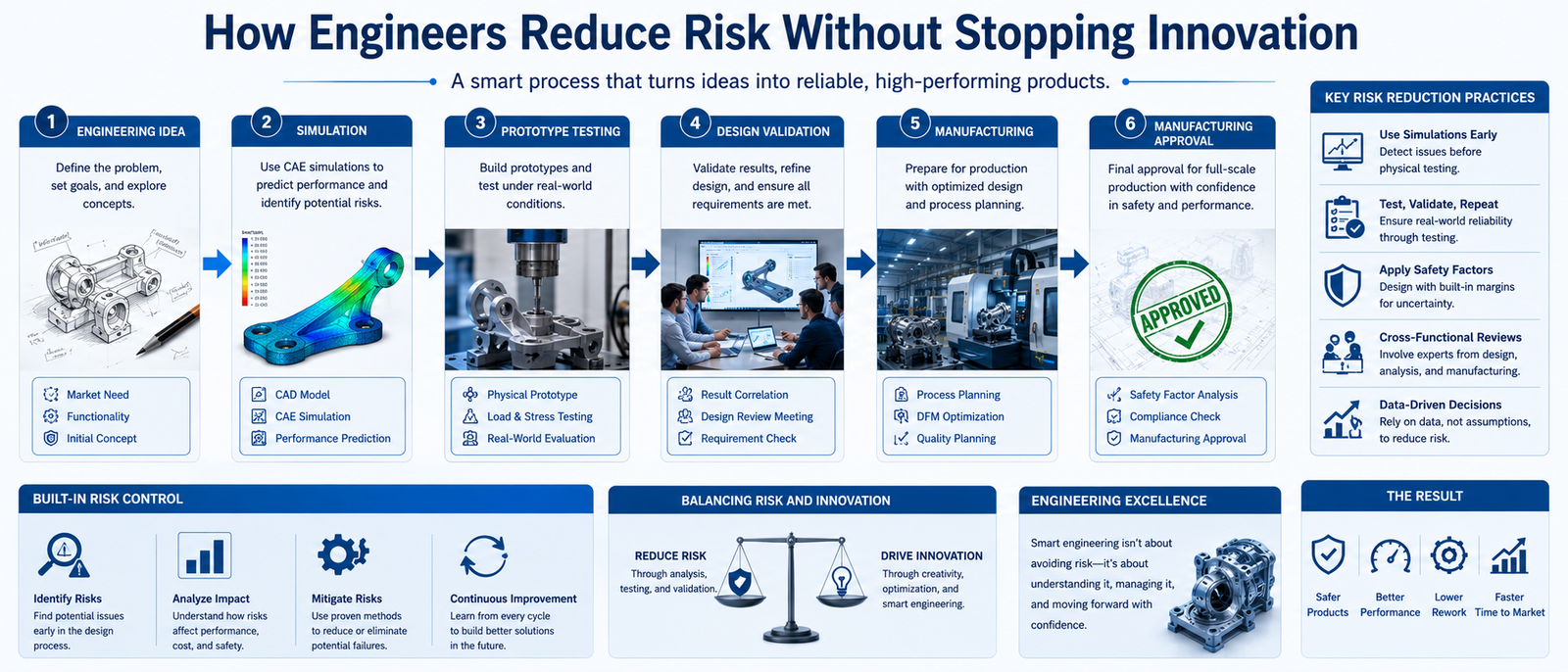
Great engineering is not about avoiding every possible risk. If engineers always selected the safest option, innovation would slow down dramatically. Instead, successful engineers learn how to manage uncertainty using structured engineering methods.
Before a new design reaches manufacturing, it goes through several stages of analysis and validation. Each stage reduces uncertainty and increases confidence in the final product.
Modern engineers use CAD and CAE software to evaluate designs long before a physical prototype is built. Stress analysis, thermal analysis, vibration analysis, and motion simulations allow engineers to predict problems early.
This process is explained in Role of CAE in Modern Engineering Design Process, where digital simulations help reduce engineering risks before production.
Even the best computer simulations cannot replace real-world testing. Engineers build prototypes to verify assumptions, measure performance, and identify unexpected problems.
Engineering companies regularly conduct design review meetings where experienced engineers evaluate proposed solutions from different perspectives. These reviews often identify issues that individual designers may overlook.
Instead of designing components to operate exactly at their limits, engineers include safety factors to account for unknown loads, material variations, manufacturing tolerances, and real operating conditions.
By combining simulations, testing, reviews, and safety factors, engineers significantly reduce project risks while still pursuing innovative solutions.
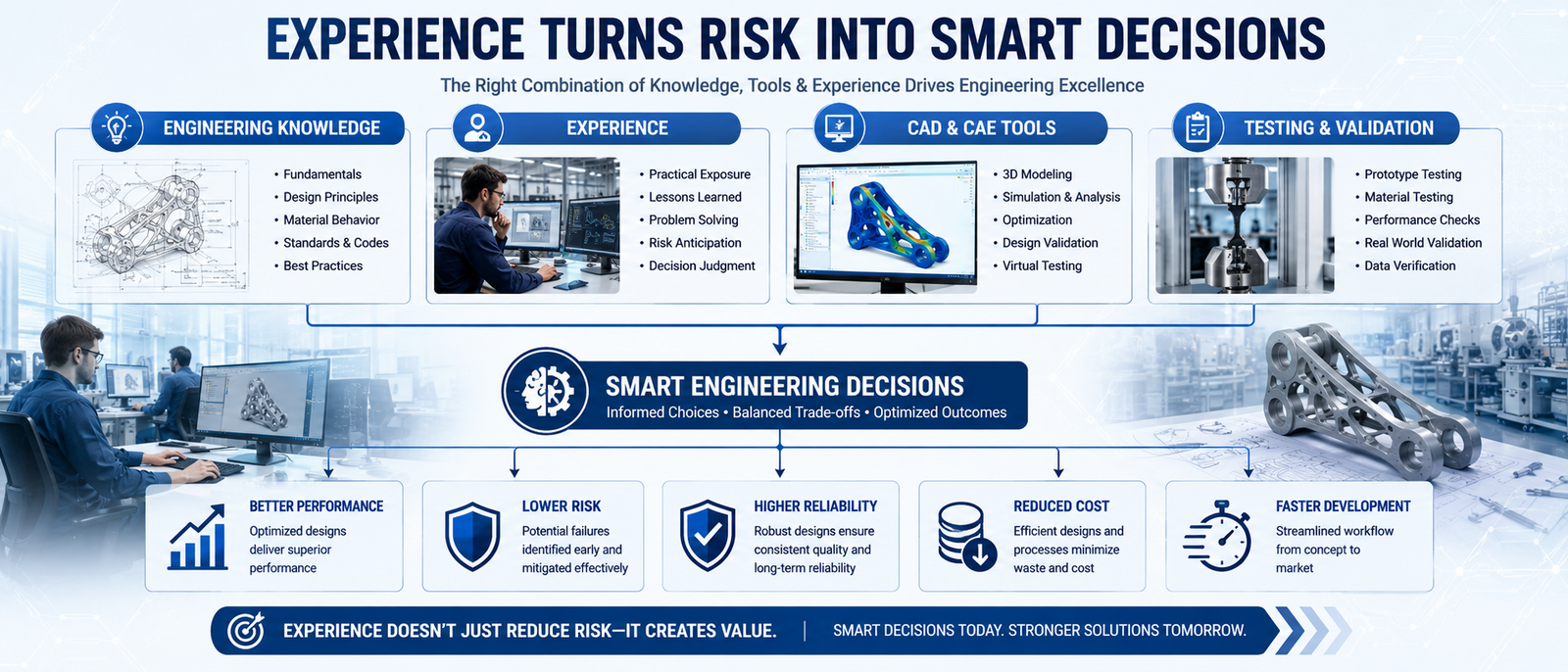
Engineering software has become incredibly powerful, but software alone cannot make engineering decisions.
Two engineers using the same CAD model and simulation results may still choose different solutions because experience influences how risks are interpreted.
Experienced engineers understand where uncertainty exists, which assumptions are reasonable, and when additional testing is necessary.
They know when innovation creates competitive advantages and when a conservative approach is the smarter decision.
This balance between technical knowledge and engineering judgment is what separates beginners from professionals.
Students often believe engineering is only about calculations and software. In reality, companies value engineers who can analyze problems, communicate decisions, and justify why one solution is better than another.
Developing this mindset is just as important as learning AutoCAD, SolidWorks, CATIA, or Creo because engineering is ultimately about solving problems—not simply creating drawings.
Every engineering project involves balancing risk and reward. Choosing the safest option is not always the best decision, and taking unnecessary risks can lead to costly failures.
The most successful engineers evaluate available information, analyze possible outcomes, and make informed decisions that maximize performance while minimizing uncertainty.
Modern engineering combines experience, simulations, testing, design validation, and practical judgment to achieve this balance.
Whether designing a machine, developing a building, or creating a new product, understanding Risk vs Reward in Engineering helps engineers deliver safer, smarter, and more innovative solutions.
Learning engineering software is only one part of becoming an industry-ready engineer. The real value comes from understanding how professional engineers make design decisions using CAD, simulations, engineering standards, and practical experience.
At 4Dimensions Infotech Pune, students work on real engineering projects while learning modern industry workflows used by leading companies.
Whether you’re searching for an AutoCAD Course in Pune, an AutoCAD Course Near Me, a CAD Course Near Me, or a comprehensive CAD Course in Pune, practical training helps you develop both software expertise and engineering decision-making skills.
Our programs also cover SolidWorks, CATIA, Creo, CAE, and product design workflows, helping students become confident design engineers ready for real industry challenges.
1. What is risk in engineering?
Risk is the possibility that a design, process, or project may not perform as expected, leading to failures, delays, or additional costs.
2. What does reward mean in engineering?
Reward refers to the benefits gained from an engineering decision, such as improved performance, lower costs, better efficiency, or innovation.
3. Why is risk vs reward important in engineering?
It helps engineers make informed decisions by balancing safety, performance, cost, and innovation throughout a project.
4. How do engineers reduce risk?
Engineers reduce risk through CAD modeling, CAE simulations, prototype testing, design validation, engineering reviews, and safety factors.
5. Can risk be completely eliminated?
No. Engineering always involves some level of uncertainty, but proper planning and analysis help minimize it.
6. How can I improve my engineering decision-making skills?
By learning engineering fundamentals, practicing with CAD and CAE software, working on real projects, and understanding industry workflows through practical training.
© 2025 4Dimensions Infotech. All rights reserved. | Best Design Engineering Training Institute in Pune
Start your journey with the best design engineering training institute in Pune.