
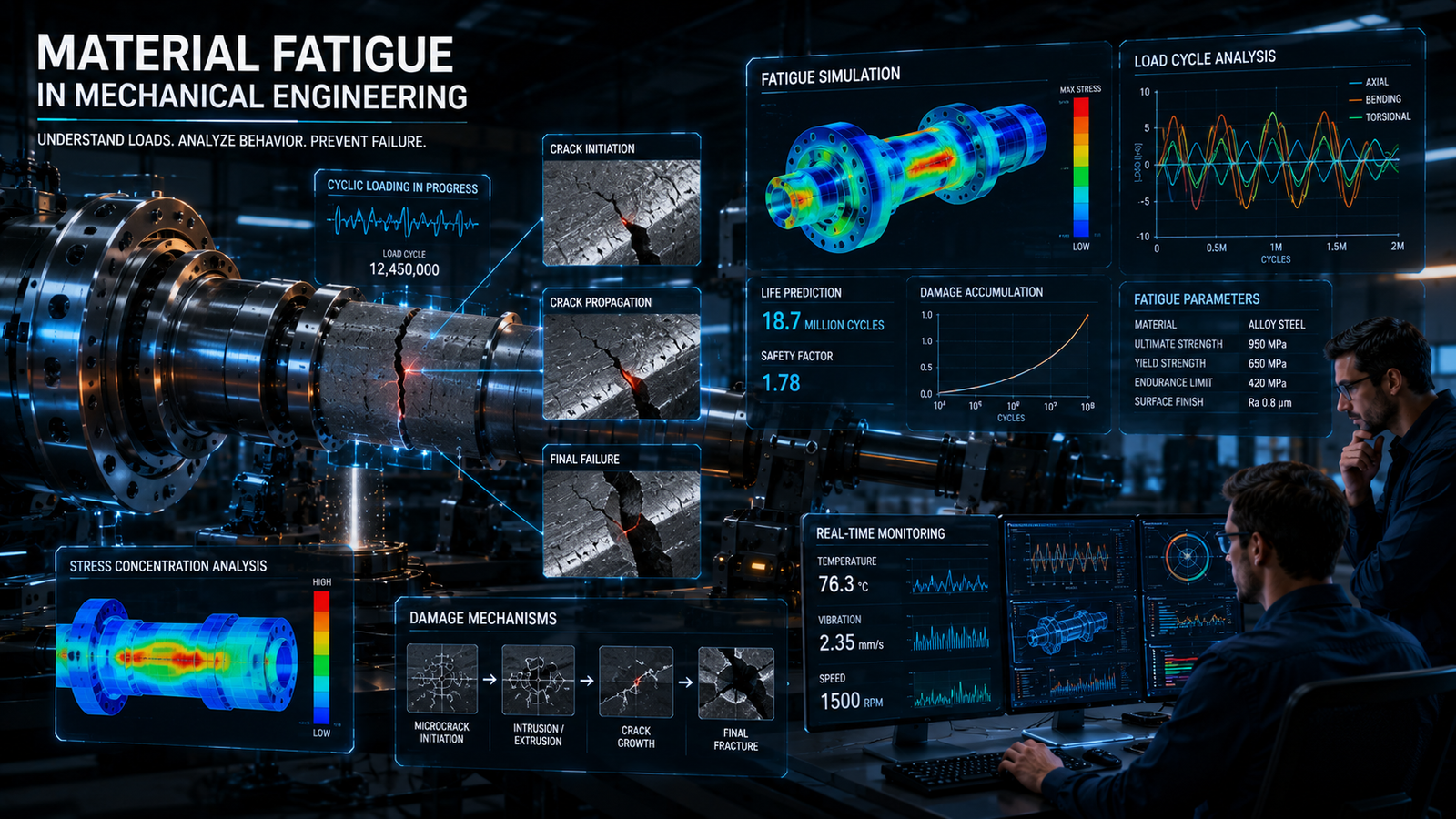
At 4Dimensions Infotech Pune, students learning mechanical engineering design quickly realize that products rarely fail instantly.
In most real engineering systems, failure happens gradually due to repeated loading, vibration, stress cycles, and long-term operational conditions.
This process is known as material fatigue, and it plays a critical role in product durability, machine reliability, and structural safety.
Modern industries today heavily depend on fatigue analysis because even small fatigue cracks can eventually lead to catastrophic failures if ignored.
Because of this, engineers working in automotive, aerospace, manufacturing, industrial machinery, and product design industries must understand how fatigue affects engineering components over time.
Students learning through a CAD course in Pune, SolidWorks course, CATIA course, or engineering software course must understand how fatigue behavior influences real-world product design.
Modern fatigue analysis workflows also connect strongly with reverse engineering in automotive and aerospace industries, where reliability and safety become extremely important.
Material fatigue occurs when a component experiences repeated loading and unloading cycles over time.
Even if the applied stress remains below the material’s maximum strength, continuous cyclic loading slowly weakens the structure internally.
Initially, microscopic cracks form inside weak regions of the material.
As stress cycles continue, these cracks gradually grow until sudden failure occurs.
Because fatigue damage develops slowly, it is often difficult to detect visually during early stages.
This makes fatigue one of the most dangerous failure mechanisms in modern mechanical engineering.
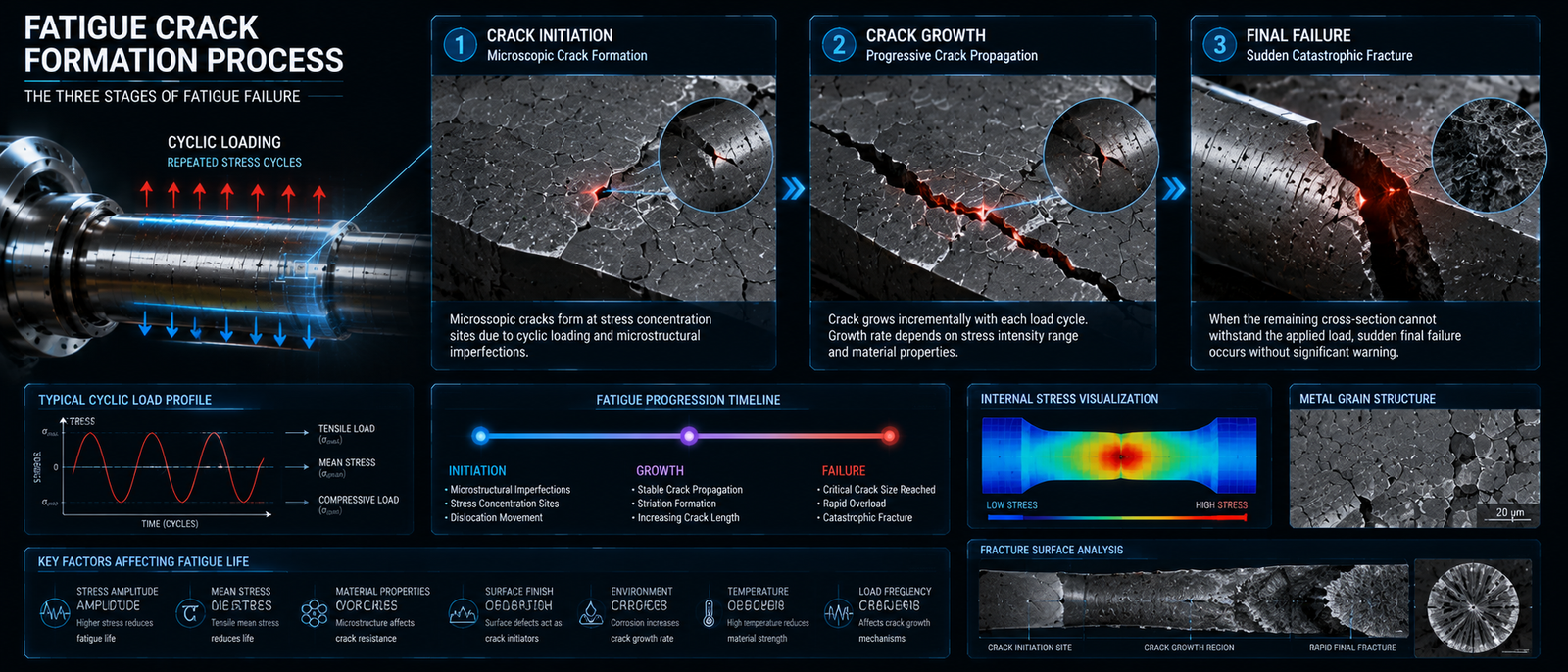
Material fatigue is one of the most common reasons behind mechanical failure in engineering systems.
Components such as rotating shafts, aircraft structures, industrial machinery, bridges, and automotive systems continuously experience repeated loading during operation.
Over time, this repeated stress gradually weakens the material.
Because of this, engineers must include fatigue analysis during the design stage itself.
Modern industries now focus heavily on durability prediction and long-term reliability instead of only initial strength calculations.
This requirement also strongly connects with design validation before manufacturing, where engineers test and optimize products before production begins.
Fatigue failure usually develops in three major stages.
The first stage involves microscopic crack initiation.
Small imperfections, sharp corners, stress concentration regions, or surface defects become weak points where cracks begin forming.
The second stage involves gradual crack propagation.
Every repeated loading cycle causes the crack to grow slightly larger.
Finally, during the third stage, the crack becomes large enough to cause sudden catastrophic failure.
This final fracture often happens unexpectedly because the material may still appear normal externally.
Because of this, fatigue analysis becomes extremely important in high-performance engineering systems.
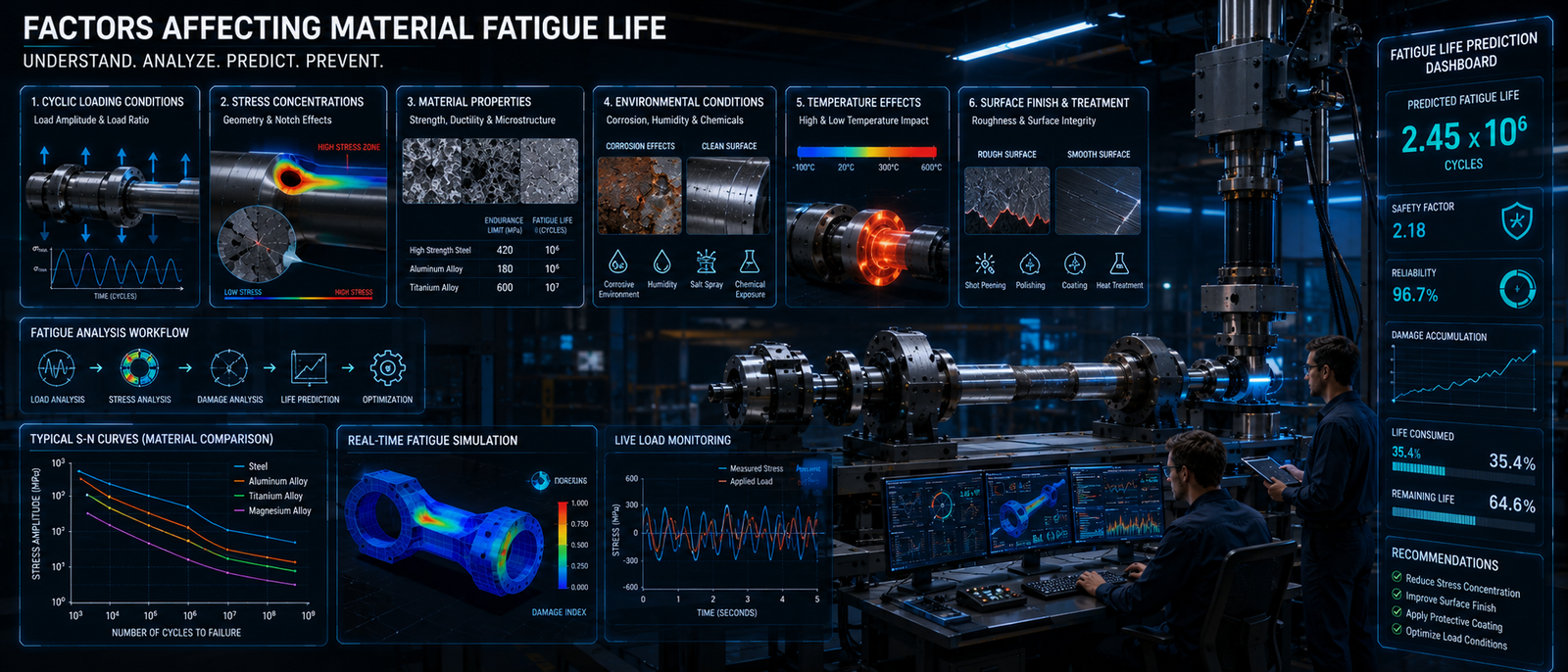
Life prediction helps engineers estimate how long a component can safely operate before failure becomes likely.
Instead of waiting for components to fail physically, engineers use calculations, simulations, testing data, and operational analysis to predict fatigue life in advance.
This helps industries improve safety, maintenance planning, and long-term product reliability.
Modern life prediction methods also allow companies to reduce unnecessary maintenance costs while improving operational efficiency.
Because of this, fatigue life prediction has become a major part of advanced mechanical design workflows.
Several important factors directly influence fatigue behavior and material lifespan.
Material selection plays a major role because different materials resist fatigue differently.
Environmental conditions such as temperature, vibration, corrosion, and moisture also affect durability significantly.
In addition, stress concentration regions caused by sharp corners, holes, or improper geometry increase fatigue risk.
Repeated loading cycles further reduce component life over time.
These engineering decisions strongly connect with concepts explained in functional vs aesthetic design in engineering, where performance and durability remain critical priorities.
Modern engineers rely heavily on CAD simulation and fatigue analysis software to predict failure before manufacturing begins.
Using tools like SolidWorks Simulation, CATIA analysis systems, and advanced CAE platforms, engineers can simulate repeated loading conditions digitally.
These simulations help identify weak regions, predict crack growth, and improve product durability early in the design process.
As a result, industries reduce development cost while improving engineering safety.
Modern fatigue prediction workflows also strongly connect with digital twin technology in engineering design, where real-time operational data improves predictive analysis accuracy.
Consider a rotating industrial shaft used inside heavy machinery.
During operation, the shaft experiences repeated bending and torsional stress cycles continuously.
Over time, microscopic fatigue cracks begin forming near stress concentration regions.
If engineers fail to predict and manage this fatigue behavior properly, sudden shaft failure may occur.
Because of this, industries carefully test rotating systems using fatigue simulations, durability testing, and predictive maintenance strategies.
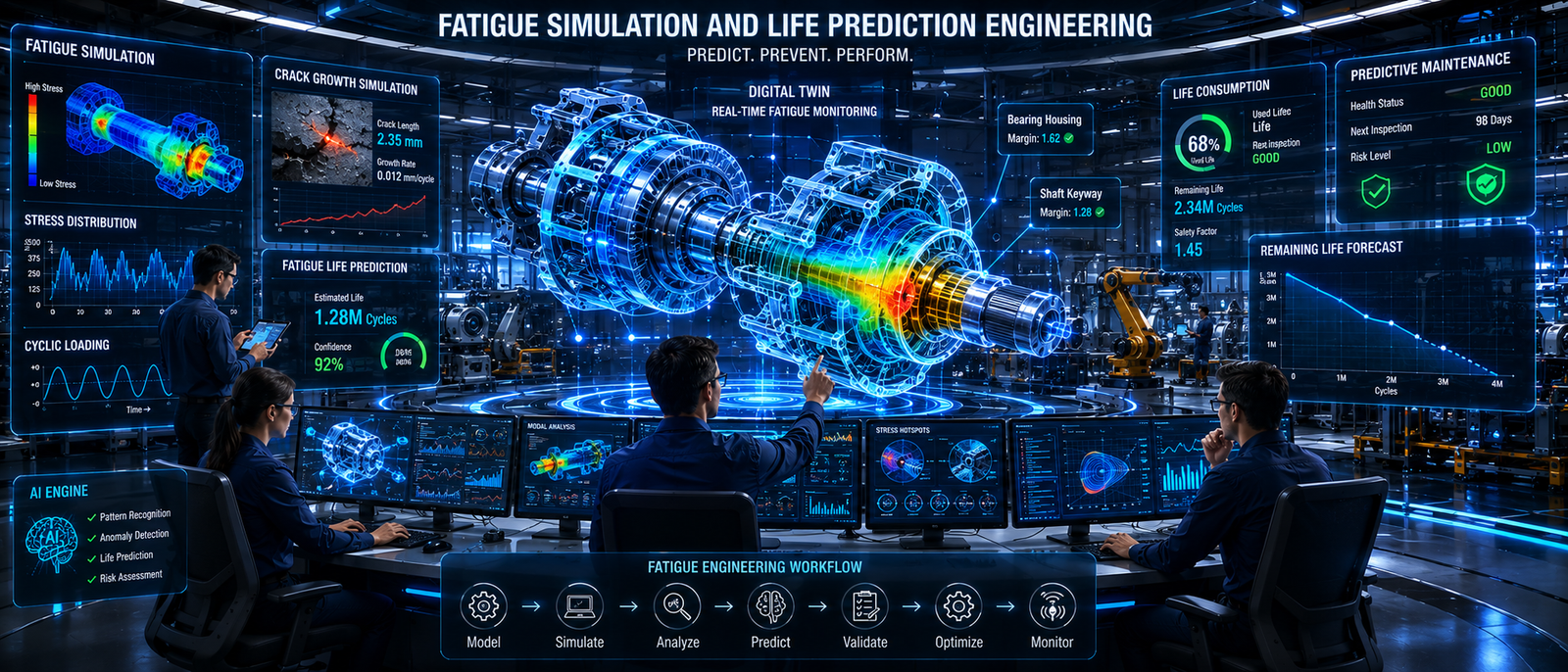
Material fatigue and life prediction are among the most important concepts in modern mechanical engineering design.
Ignoring fatigue behavior can lead to dangerous product failures, reduced durability, and serious safety risks.
However, engineers who understand fatigue analysis, stress behavior, and predictive simulation methods can create stronger, safer, and more reliable engineering systems.
Modern industries now depend heavily on fatigue simulations, CAD analysis workflows, and predictive engineering technologies to improve long-term performance and reliability.
Understanding fatigue theory becomes valuable only when engineers apply it using real-world CAD tools, simulations, and engineering projects.
Students gain hands-on exposure to tools like SolidWorks, CATIA, AutoCAD, Revit, and Civil 3D while learning how real industrial products are designed and validated.
1. What is material fatigue?
Material fatigue is the gradual weakening and failure of a material due to repeated loading cycles over time.
2. Why is fatigue important in engineering?
Because fatigue is one of the most common causes of mechanical and structural failure in engineering systems.
3. What is life prediction?
Life prediction is the process of estimating how long a component can safely operate before failure occurs.
4. Which software is used for fatigue analysis?
SolidWorks Simulation, CATIA, ANSYS, and other CAE tools are commonly used.
5. Can students learn fatigue analysis concepts?
Yes. Through CAD training, simulation workflows, and practical engineering projects, students can understand fatigue behavior effectively.
© 2025 4Dimensions Infotech. All rights reserved. | Best Design Engineering Training Institute in Pune
Start your journey with the best design engineering training institute in Pune.