
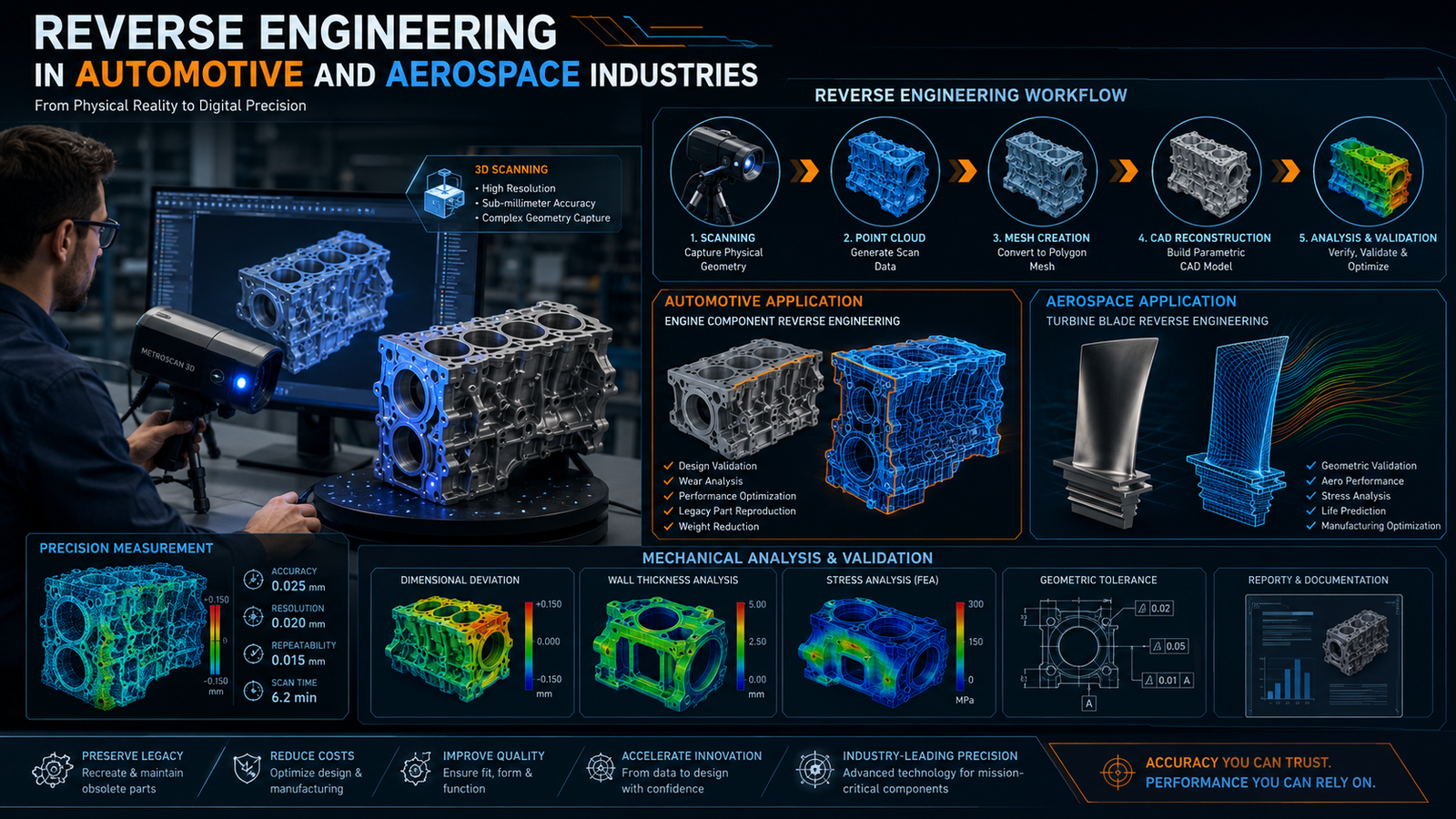
Modern engineering does not always begin from a completely new idea. In many industries, engineers first study existing products to understand how they work, how they were manufactured, and how they can be improved further.
This process is known as reverse engineering, and it has become one of the most valuable techniques in modern product development.
Today, reverse engineering plays an important role in industries such as automotive engineering, aerospace systems, manufacturing, industrial design, and advanced product development.
Because of this growing importance, many cad design course, engineering software course, and solidworks course programs now include reverse engineering workflows as an essential engineering skill.
Modern industries no longer focus only on creating products from scratch. Instead, they also focus on analyzing, improving, optimizing, and recreating existing systems more efficiently.
Reverse engineering is the process of studying an existing product, component, or system to understand its structure, dimensions, functionality, and manufacturing process.
Engineers take a physical object and convert it into a digital engineering model using scanning technologies and CAD software.
This digital reconstruction helps engineers recreate, modify, optimize, or improve the original design more effectively.
Unlike traditional engineering, where products are designed first and manufactured later, reverse engineering starts with the finished product itself.
As a result, engineers can understand how complex systems work even when original design data is unavailable.
This workflow is commonly used in automotive industries, aerospace engineering, industrial machinery, robotics, and advanced manufacturing sectors.
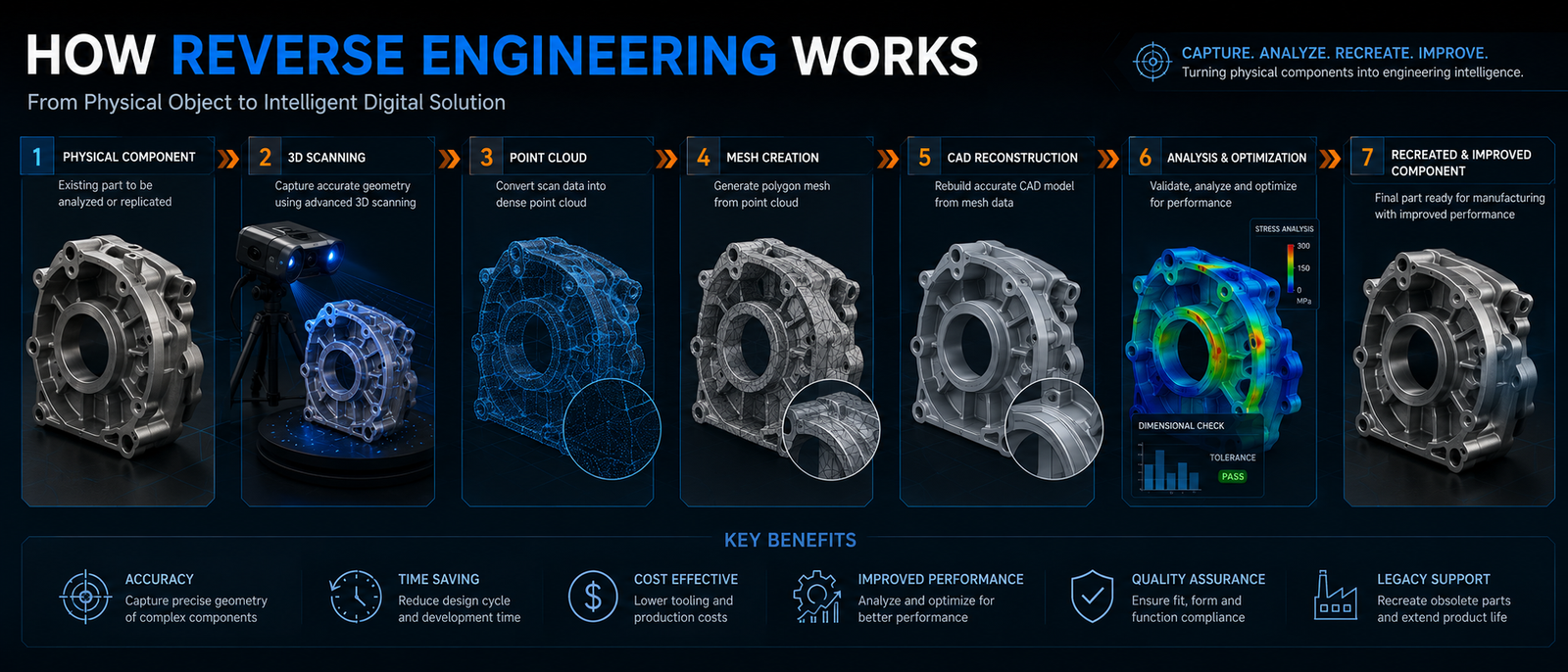
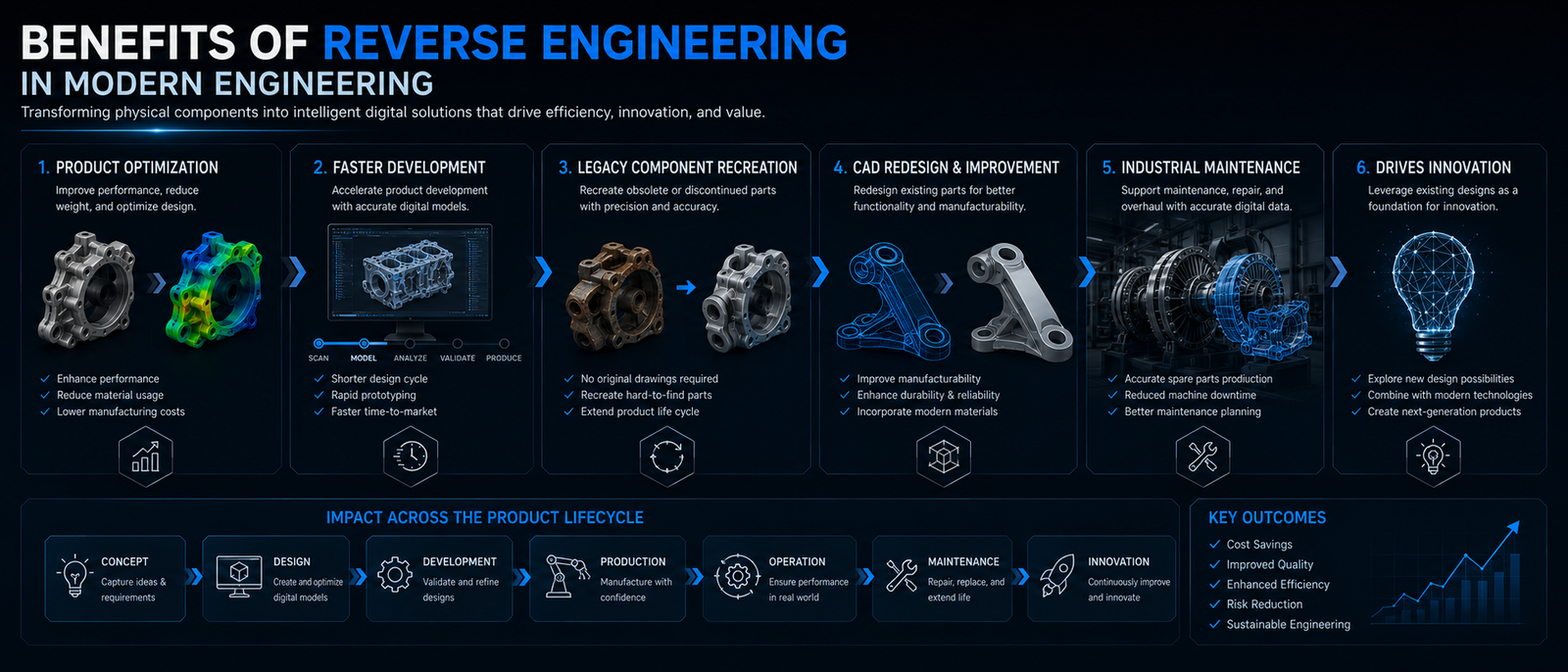
Reverse engineering provides several major advantages in modern engineering industries.
First, it helps engineers save significant development time. Instead of creating a completely new product from zero, engineers can study and improve existing designs.
Second, it helps companies understand competitor products and identify opportunities for innovation and optimization.
In many industries, reverse engineering is also used to restore old or discontinued components where original design files no longer exist.
This is especially important in aerospace systems, industrial machinery, and manufacturing industries where replacing legacy components can be extremely difficult.
As a result, reverse engineering improves:
Modern engineering companies increasingly rely on reverse engineering because it allows faster product improvement while reducing overall development effort.
This workflow is also closely connected with real-world CAD workflows used inside engineering industries.
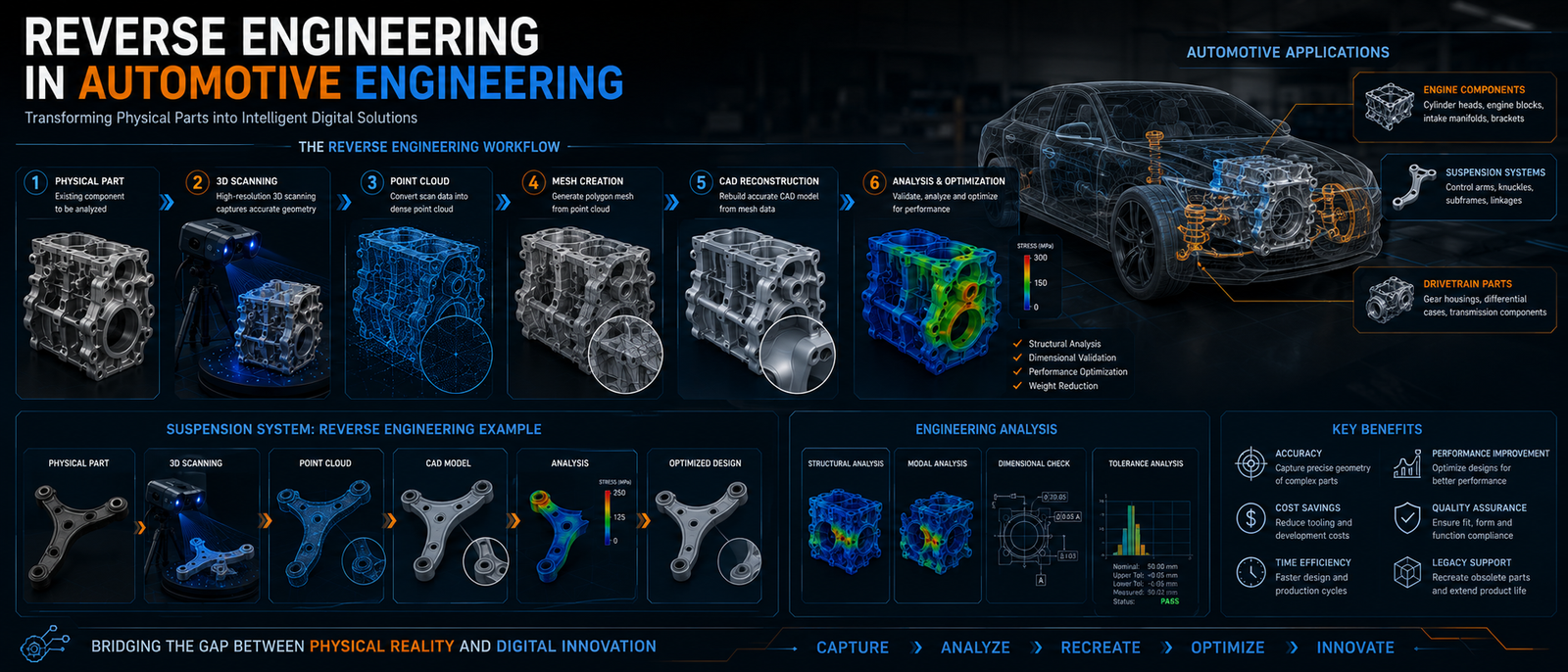
The automotive industry uses reverse engineering extensively for product improvement, redesign, and performance optimization.
Engineers often scan engine parts, suspension systems, transmission components, and structural assemblies to recreate them digitally.
Using tools learned in a solidworks course or CATIA training workflow, engineers convert scanned data into accurate CAD models.
These models are then analyzed and optimized for:
Automotive companies also use reverse engineering to redesign aftermarket components, improve fuel efficiency, and modernize older systems.
As a result, reverse engineering has become a standard workflow in automotive product development.
In aerospace engineering, reverse engineering is used with extremely high precision because even small design inaccuracies can affect performance and safety.
Engineers analyze complex aerospace components such as:
Advanced CAD tools help engineers recreate these parts digitally with highly accurate measurements and engineering tolerances.
This process improves:
Reverse engineering is especially valuable in aerospace industries where older aircraft components must be maintained even when original design data is unavailable.
This also connects closely with concepts explained in modern automation and design engineering workflows, where digital analysis and smart engineering systems are becoming increasingly important.
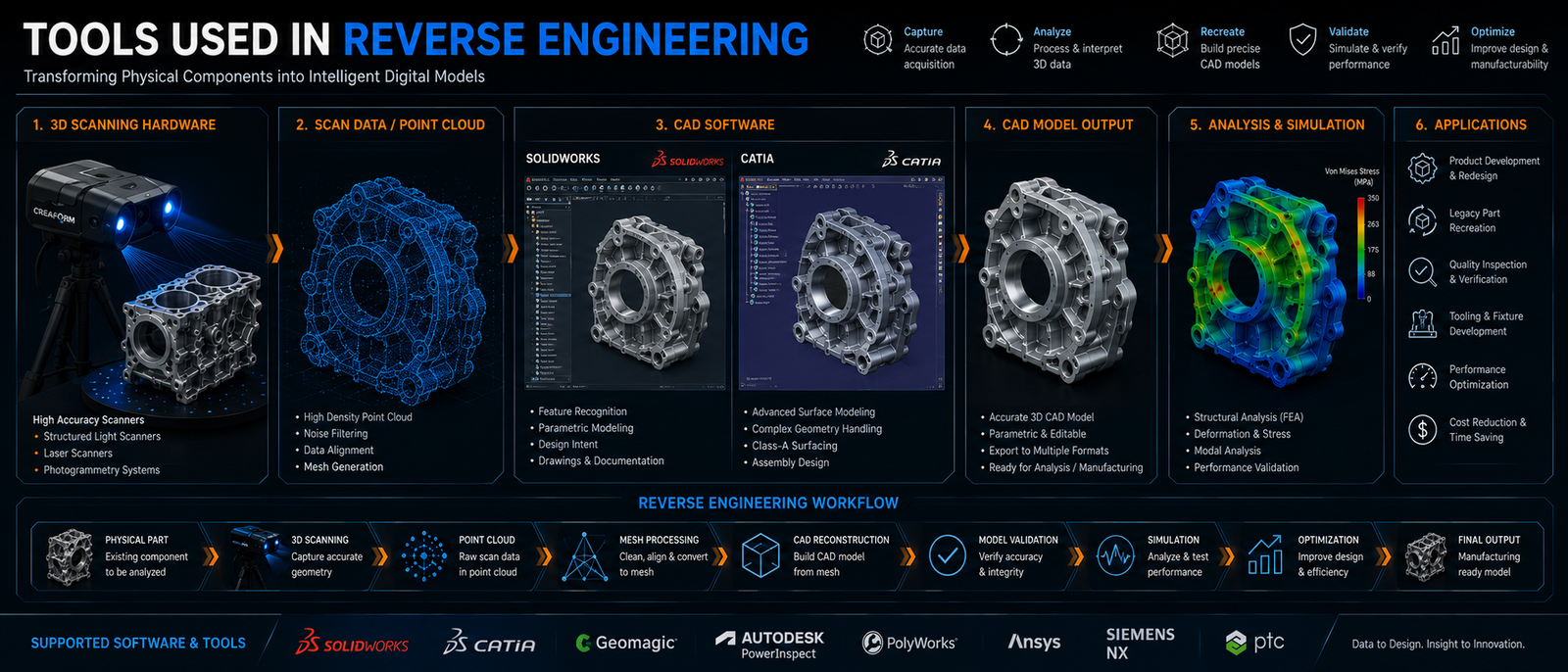
Modern reverse engineering combines both hardware and software technologies.
First, engineers use advanced 3D scanners to capture the exact geometry of physical objects.
These scanners generate detailed point cloud data representing the shape and dimensions of the product.
Next, engineers use CAD software such as:
to convert scanned data into accurate digital engineering models.
After reconstruction, simulation tools are often used to test performance, stress behavior, and product durability digitally before manufacturing begins.
Consider an old industrial machine component that is no longer available in the market.
Instead of redesigning the part completely from scratch, engineers can scan the original component and create a digital CAD model.
This model can then be modified, optimized, and manufactured again using modern production techniques.
As a result, reverse engineering helps industries maintain older systems efficiently while reducing downtime and replacement cost.
Reverse engineering provides several important benefits in modern engineering industries.
It helps engineers learn from existing designs and improve products more effectively.
In addition, it reduces development time, improves innovation speed, and supports maintenance workflows.
Key benefits include:
Students who complete a cad design course in Pune or engineering software course gain practical exposure to these workflows through modern CAD projects and industry-oriented training systems.
Reverse engineering has become an essential skill in modern automotive, aerospace, manufacturing, and product development industries.
It helps engineers analyze, recreate, improve, and optimize products more efficiently using digital engineering workflows.
As industries continue becoming more technology-driven, reverse engineering knowledge combined with CAD and simulation skills will become increasingly valuable for future engineers.
To succeed in modern engineering careers, students must understand how real products are designed, analyzed, and improved.
Focus on understanding how products work not just how they look.
1. What is reverse engineering?
Reverse engineering is the process of analyzing an existing product to recreate or improve its design.
2. Why do engineers use reverse engineering?
Engineers use it to improve products, reduce development time, restore old parts, and optimize existing systems.
3. Which industries use reverse engineering?
Automotive, aerospace, manufacturing, robotics, and industrial engineering industries use it widely.
4. Which software is used for reverse engineering?
Software like SolidWorks, CATIA, AutoCAD, and Creo are commonly used for reverse engineering workflows.
5. Is reverse engineering useful for students?
Yes, reverse engineering helps students build practical CAD, design analysis, and product development skills.
© 2025 4Dimensions Infotech. All rights reserved. | Best Design Engineering Training Institute in Pune
Start your journey with the best design engineering training institute in Pune.