
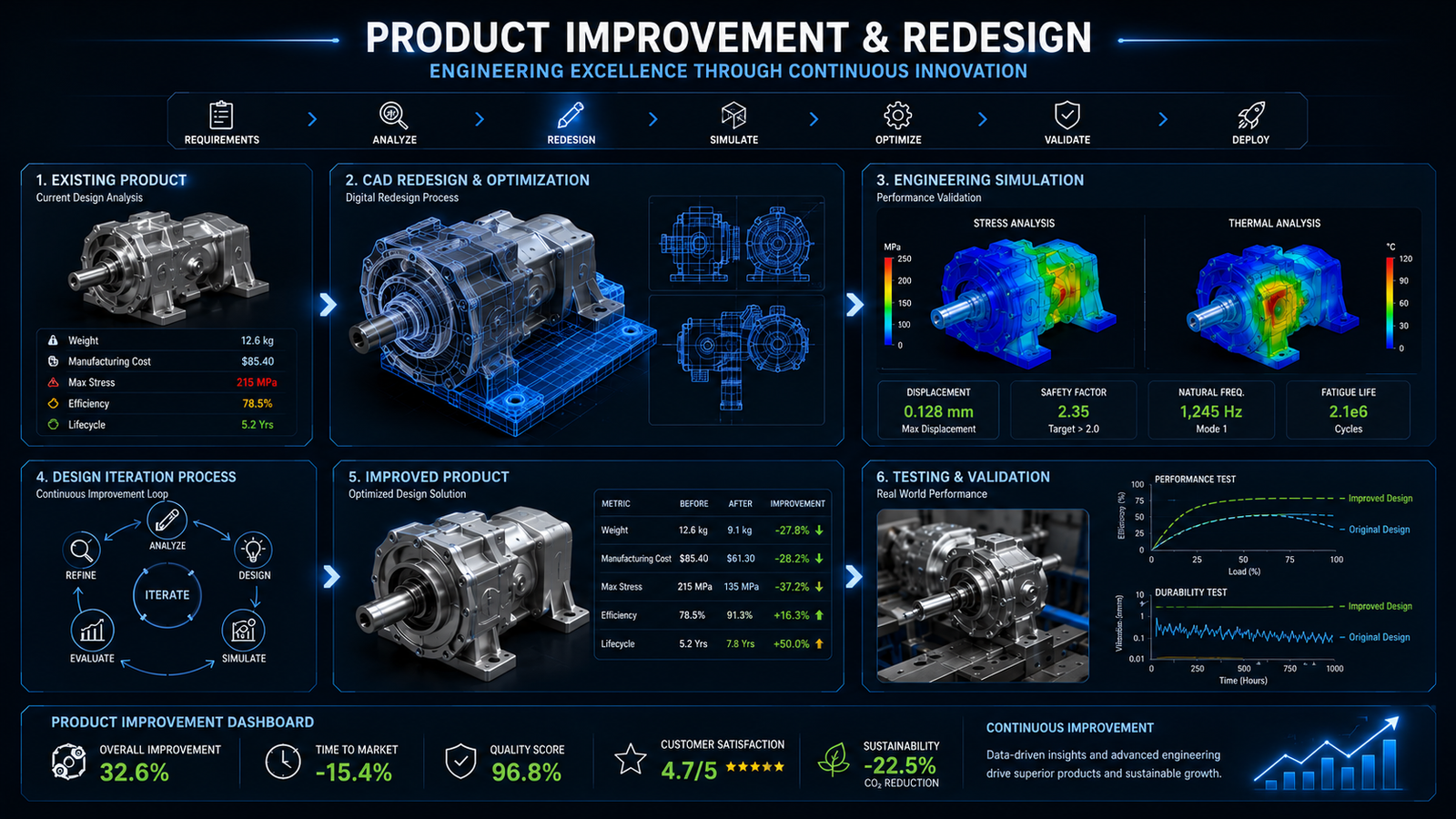
At 4Dimensions Infotech, students learning modern CAD workflows quickly discover an important industry reality — most successful engineering products are not designed perfectly on the first attempt.
In real industries, companies continuously improve existing products instead of always creating completely new ones from scratch.
Modern engineering focuses heavily on product optimization, redesign, simulation, and continuous improvement.
This process allows companies to improve product performance, reduce manufacturing costs, increase durability, and enhance user experience over time.
As industries become more competitive, product improvement has become one of the most valuable skills in mechanical engineering and product development.
Because of this, students learning through a cad design course, engineering software course, or solidworks course are now expected to understand how engineers analyze and improve existing products using CAD tools, simulation systems, and real engineering workflows.
This modern engineering mindset also connects strongly with concepts explained in real CAD industry workflows, where engineers continuously optimize products instead of relying only on initial designs.
Launching a completely new product requires significant investment in research, manufacturing, testing, and marketing.
Because of this, many companies focus on improving products that already work successfully in the market.
Even small engineering improvements can create major benefits such as:
Modern engineering companies now treat product development as a continuous improvement cycle rather than a one-time process.
This is why industries actively hire engineers who understand redesign, optimization, simulation, and product validation workflows.
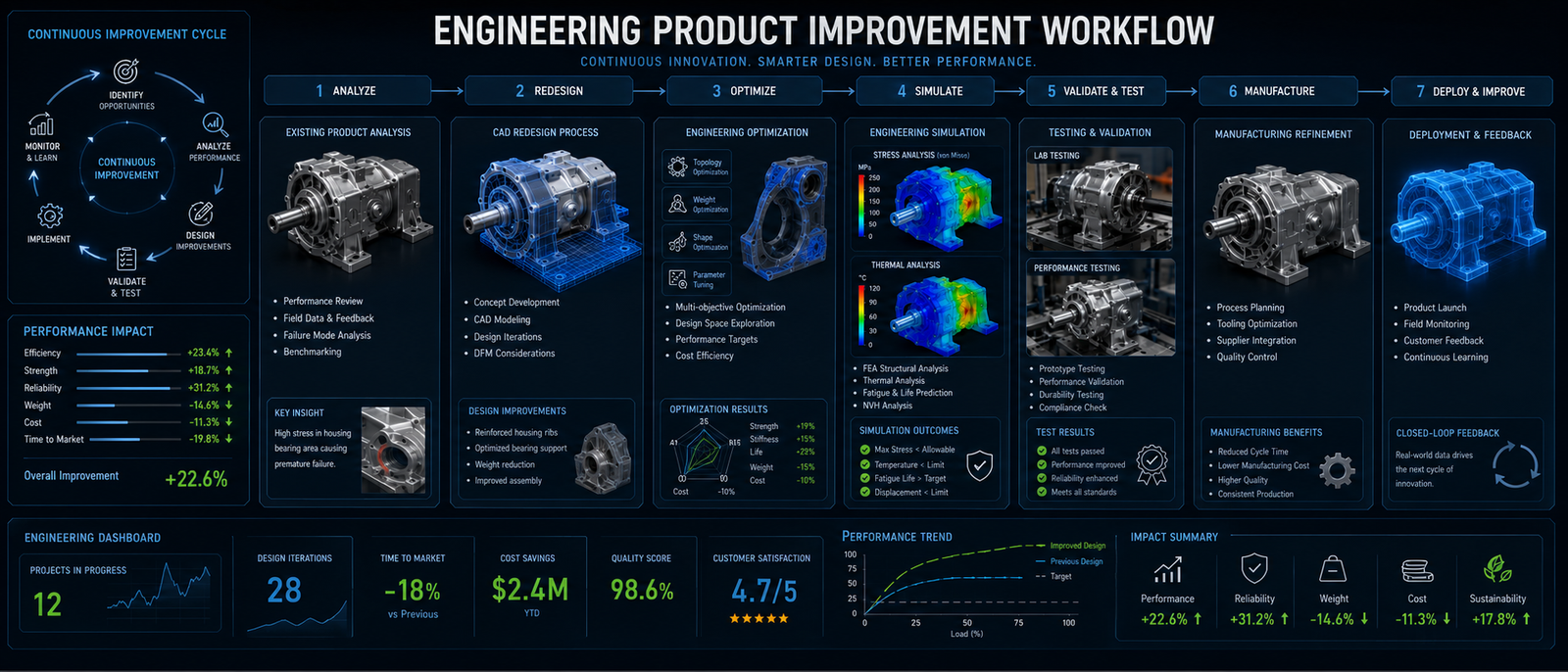
Before engineers improve a product, they first study how the current design behaves in real-world conditions.
This stage is extremely important because poor analysis can lead to ineffective redesign decisions.
Engineers analyze:
In many industries, engineers also use techniques explained in reverse engineering workflows to understand existing components in detail.
Products are often broken down into smaller assemblies so engineers can study each part individually.
This process helps identify where improvements are truly needed instead of making random design changes.
Once engineers fully understand the existing product, they begin identifying opportunities for improvement.
Some improvements focus on performance, while others focus on manufacturing efficiency or customer experience.
Common product optimization goals include:
Sometimes, even a very small geometric issue can reduce product performance significantly.
This is why engineers trained in stress concentration analysis and simulation-based design workflows are highly valuable in modern industries.
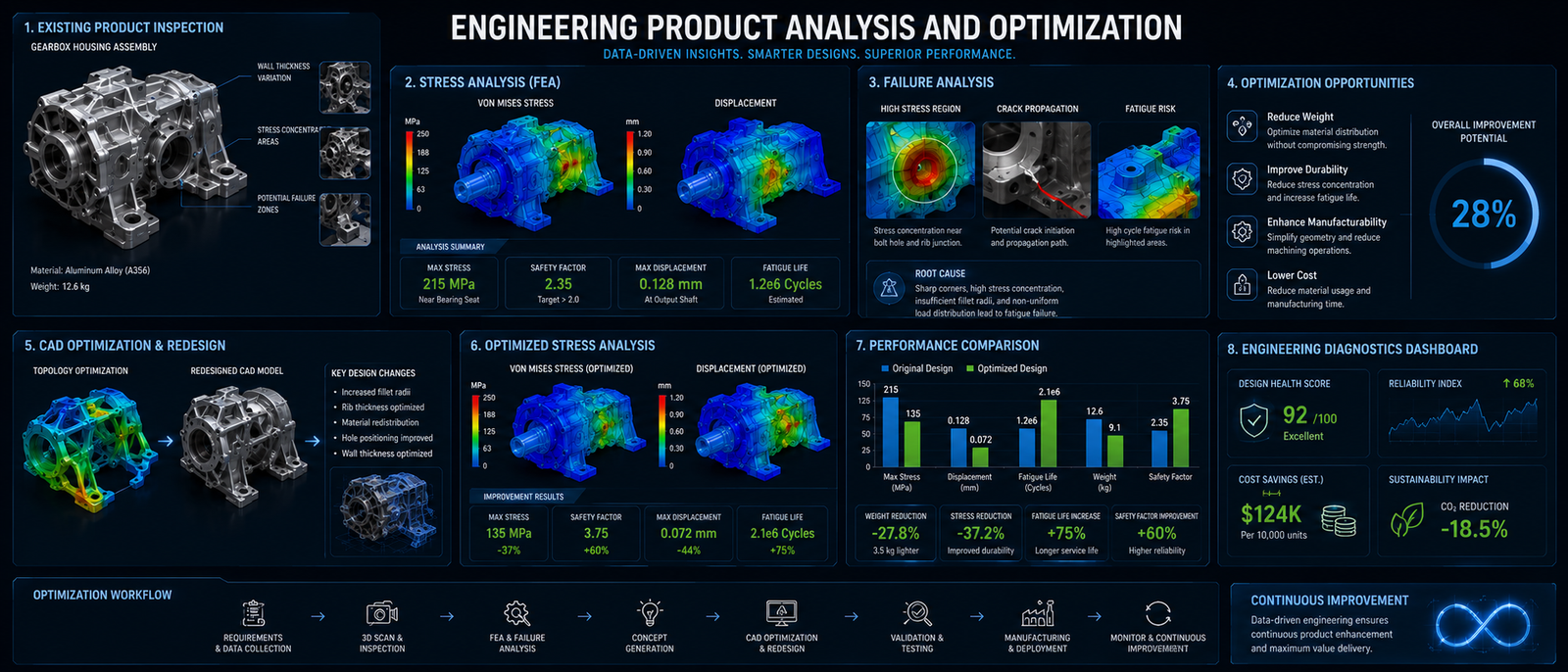
After identifying improvement opportunities, engineers begin redesigning components using modern CAD software.
Tools taught in a SolidWorks course, CATIA course, or cad software course allow engineers to modify products efficiently and test multiple design variations quickly.
Modern CAD systems help engineers:
Because CAD tools allow rapid iteration, engineers can compare multiple design options before finalizing the best solution.
This design optimization process strongly connects with concepts explained in lightweight engineering design strategies, where engineers reduce material while maintaining performance.
Redesign alone is not enough.
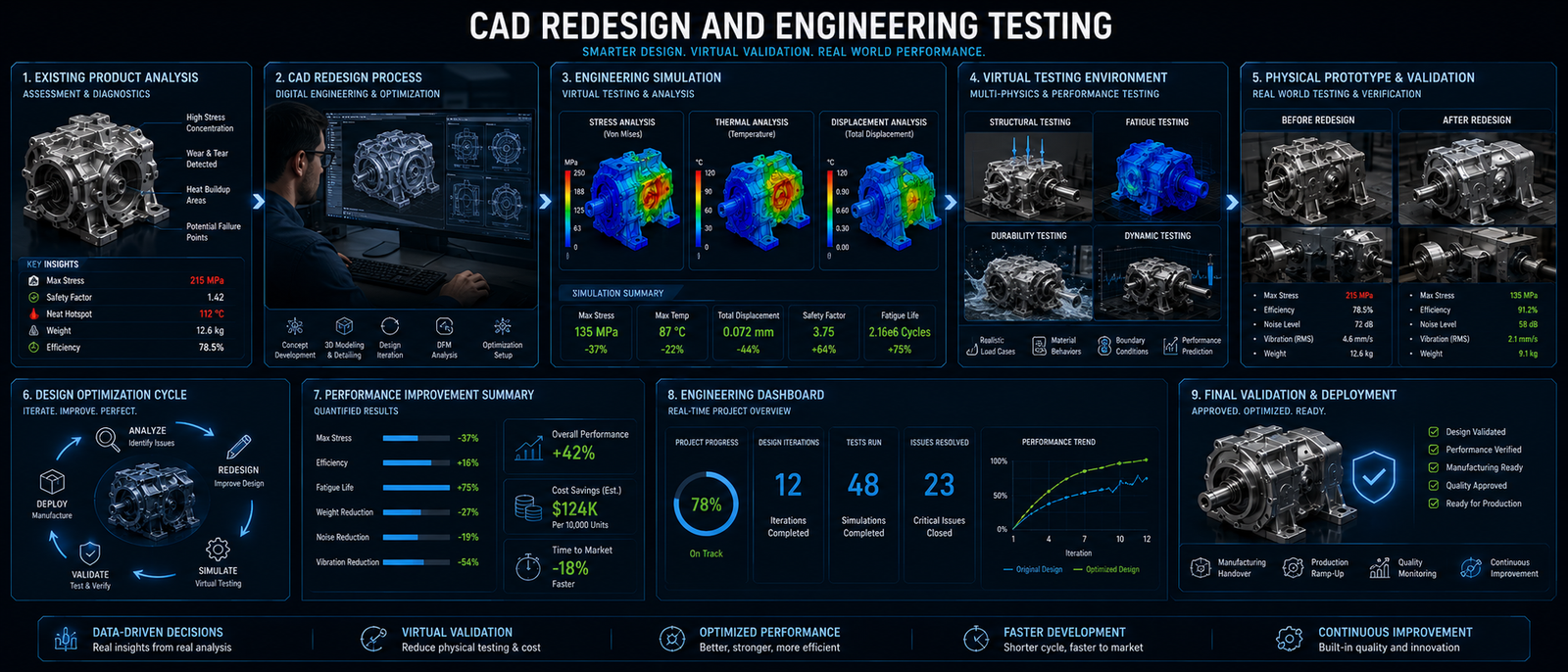
After modifying a product, engineers must verify that the new design actually performs better than the previous version.
This is where simulation and testing become extremely important.
Engineers use:
to validate improvements before manufacturing begins.
Modern workflows explained in virtual vs physical testing systems help companies reduce cost while improving product reliability.
If results are unsatisfactory, engineers repeat the redesign process again.
Because of this, product improvement becomes an iterative engineering cycle focused on continuous optimization.
One of the best examples of continuous engineering improvement can be seen in smartphones.
Every new smartphone generation improves upon the previous version rather than becoming a completely new product.
Engineers continuously improve:
As a result, products become more efficient, reliable, and user-friendly over time.
Similar improvement cycles are followed in:
Continuous product improvement provides major advantages to engineering companies.
It reduces development cost because companies improve existing systems instead of redesigning products entirely from zero.
It also speeds up innovation because engineers already understand the existing product structure.
Most importantly, it helps companies:
Modern engineering industries now rely heavily on continuous optimization instead of one-time product development.
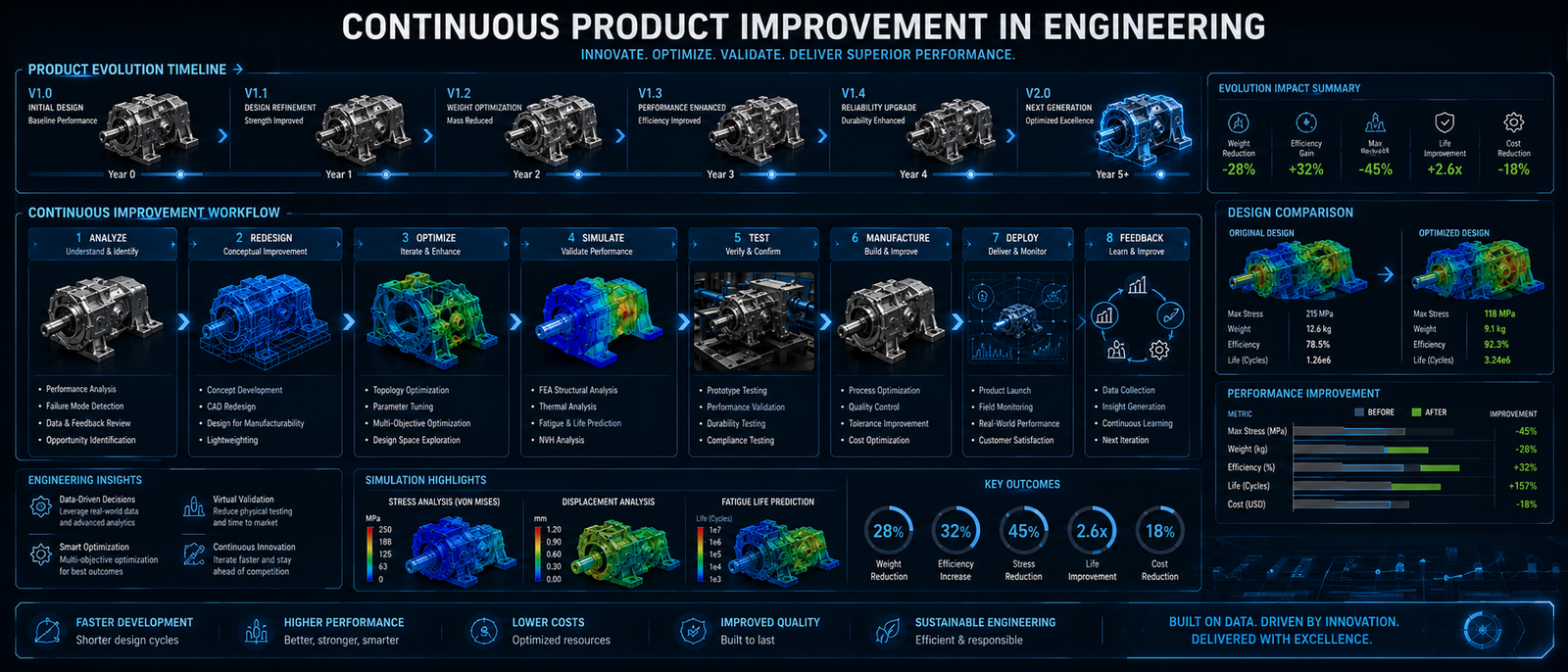
Modern engineering is not only about creating new products.
It is equally about improving existing systems through analysis, redesign, simulation, testing, and optimization.
Companies that continuously improve products gain a major competitive advantage because they can deliver better performance, reliability, and customer experience over time.
As industries become more technology-driven, engineers who understand CAD optimization, simulation workflows, and product redesign strategies will become increasingly valuable.
Real engineering careers require more than software knowledge.
The goal is to build engineers who can improve real products — not just create basic CAD models.
1. What is product improvement in engineering?
It is the process of improving an existing product to enhance performance, durability, usability, or efficiency.
2. Why do companies improve products instead of creating new ones?
Because improving existing products is faster, more cost-effective, and builds on proven designs.
3. Which software is used for product improvement?
CAD tools like SolidWorks, CATIA, AutoCAD, and simulation software are commonly used.
4. Why is testing important after redesign?
Testing ensures the updated design performs better under real-world conditions.
5. Can students learn product improvement workflows?
Yes, through practical CAD training, simulation exposure, and real engineering projects.
© 2025 4Dimensions Infotech. All rights reserved. | Best Design Engineering Training Institute in Pune
Start your journey with the best design engineering training institute in Pune.