
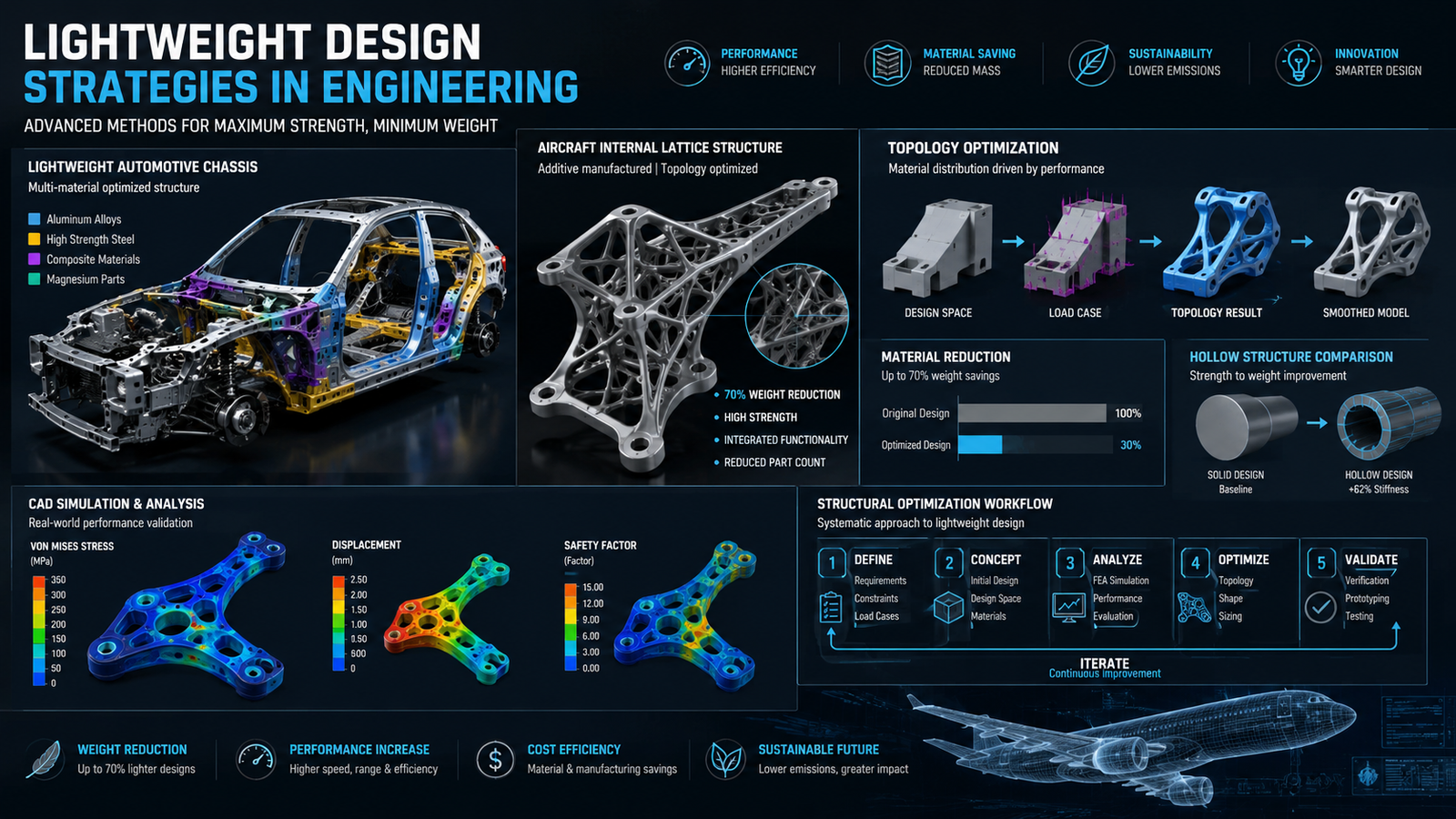
At 4Dimensions Infotech, students learning modern mechanical design quickly realize that engineering is no longer only about making products stronger.
Today, industries expect engineers to create products that are strong, efficient, lightweight, and optimized for performance.
Modern engineering companies constantly focus on reducing product weight because lighter systems improve efficiency, reduce operational cost, and enhance overall performance.
This is why lightweight design strategies have become one of the most important concepts in modern mechanical engineering and product development.
Whether it is automotive engineering, aerospace systems, robotics, or industrial machinery, engineers are continuously challenged to reduce weight without compromising structural strength or safety.
As a result, lightweight design is now deeply connected with modern cad design course in Pune, SolidWorks course, and simulation-based engineering workflows.
Reducing weight directly improves engineering performance across multiple industries.
In automotive engineering, lightweight components improve fuel economy, acceleration, and energy efficiency.
In aerospace engineering, every kilogram of weight reduction significantly affects fuel consumption and operational cost.
Similarly, lightweight products improve efficiency in robotics, consumer products, electric vehicles, and industrial equipment.
Because of this, companies invest heavily in design optimization and material reduction strategies during product development.
Modern engineering workflows explained in real CAD industry workflows show how optimization now plays a major role before manufacturing begins.

One of the biggest engineering challenges is reducing weight while maintaining structural reliability.
Engineers cannot simply remove material randomly because doing so may weaken the product and create safety risks.
Therefore, lightweight engineering depends on intelligent optimization strategies.
One common approach is material optimization.
Instead of using traditional heavy materials, engineers use lightweight high-strength materials that provide better strength-to-weight ratios.
Another major strategy is geometry optimization.
Using advanced CAD and simulation tools, engineers redesign components to remove unnecessary material while maintaining structural performance.
Simulation-based workflows taught in a cad course or engineering software course help engineers identify areas where weight can safely be reduced.
This approach improves efficiency while ensuring that the final design remains safe and durable.
Modern lightweight engineering would not be possible without CAD and CAE technologies.
Today, engineers use advanced simulation tools to study:
Software used in SolidWorks course, CATIA training, and simulation workflows allows engineers to test multiple design variations before manufacturing begins.
As a result, engineers can optimize products based on actual engineering data rather than assumptions.
This simulation-driven workflow is also connected with concepts explained in CAE-based engineering design processes.
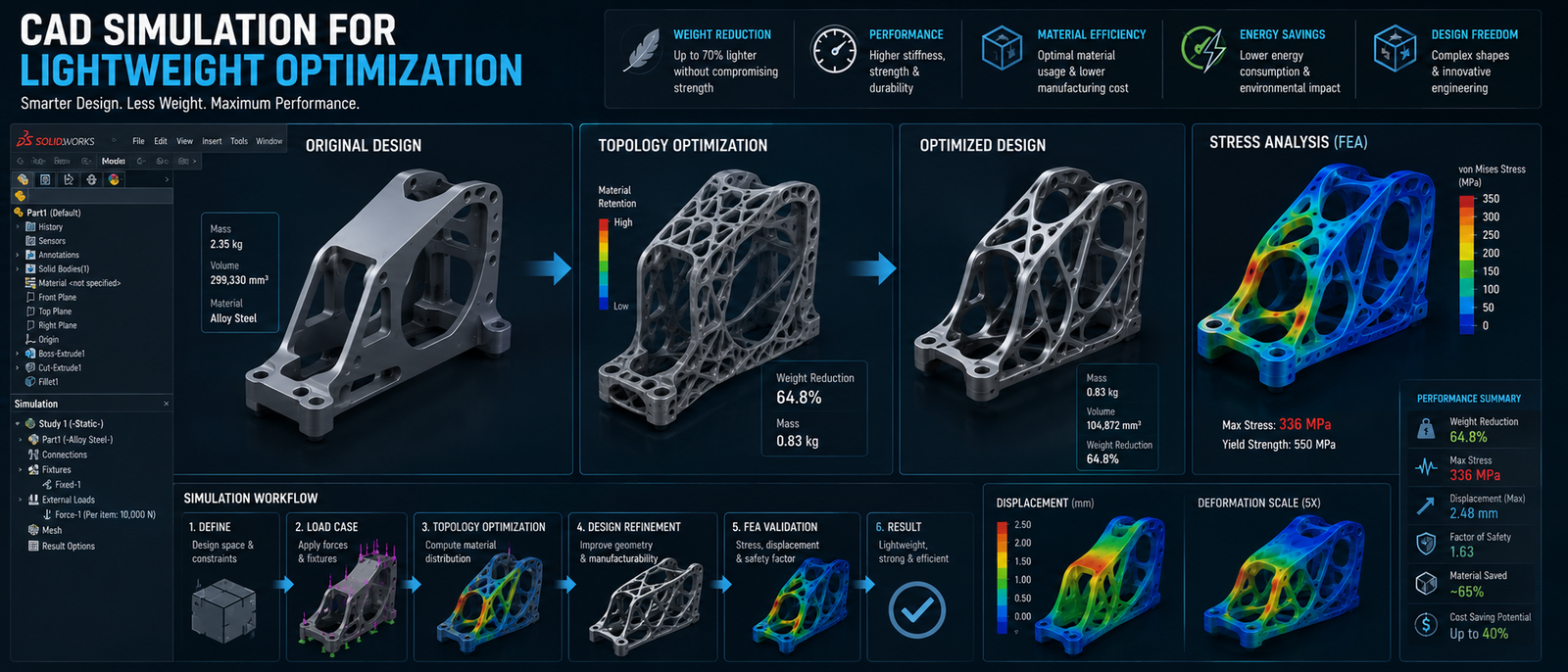
Modern industries use several advanced lightweight engineering techniques during product development.
One widely used method is hollow structure design.
Instead of using solid components, engineers create internal hollow sections that reduce material usage while maintaining strength through geometry.
Another technique is rib reinforcement.
Ribs help distribute stress efficiently while keeping the overall component lightweight.
Topology optimization is another advanced method becoming increasingly popular.
In this process, software algorithms automatically suggest the most efficient material layout based on loading conditions.
This allows engineers to create highly optimized structures with minimal unnecessary material.
These optimization techniques are commonly used in:
This concept also connects closely with stress concentration and structural optimization strategies.
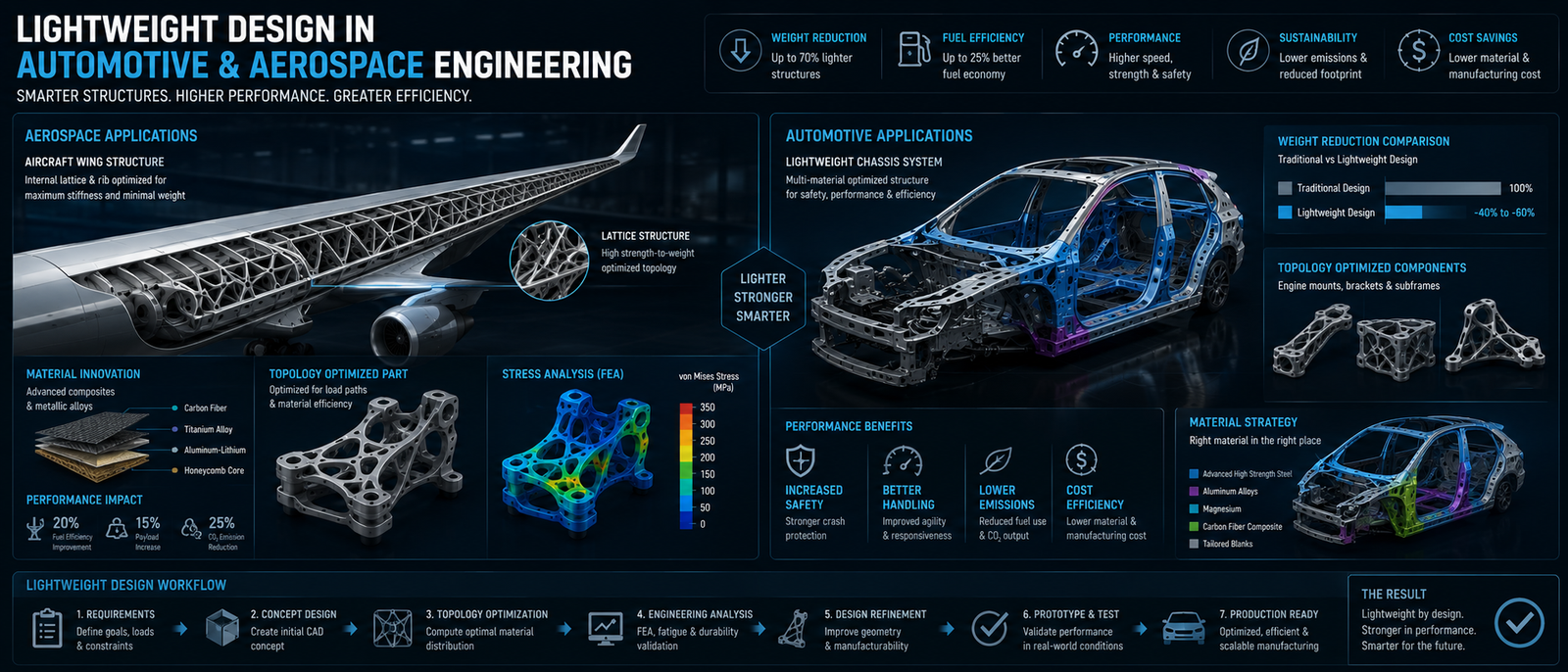
One of the best examples of lightweight engineering can be seen in modern aircraft design.
Aircraft wings are no longer built using fully solid metal structures.
Instead, engineers use internal lattice frameworks and optimized structural patterns that reduce weight while maintaining strength.
Similarly, automotive companies continuously optimize vehicle chassis systems to improve fuel efficiency without reducing crash safety performance.
Electric vehicle manufacturers also rely heavily on lightweight design because reduced weight directly improves battery efficiency and driving range.
Although lightweight engineering offers major advantages, it also introduces several design challenges.
If engineers remove too much material, structural reliability may decrease significantly.
This can create deformation issues, vibration problems, fatigue failure, or reduced safety.
Therefore, engineers must carefully balance:
In some cases, advanced lightweight materials can also increase manufacturing complexity and production cost.
Because of this, engineers rely heavily on CAD simulation and validation before finalizing optimized designs.
Modern optimization strategies also relate closely with design validation before manufacturing.
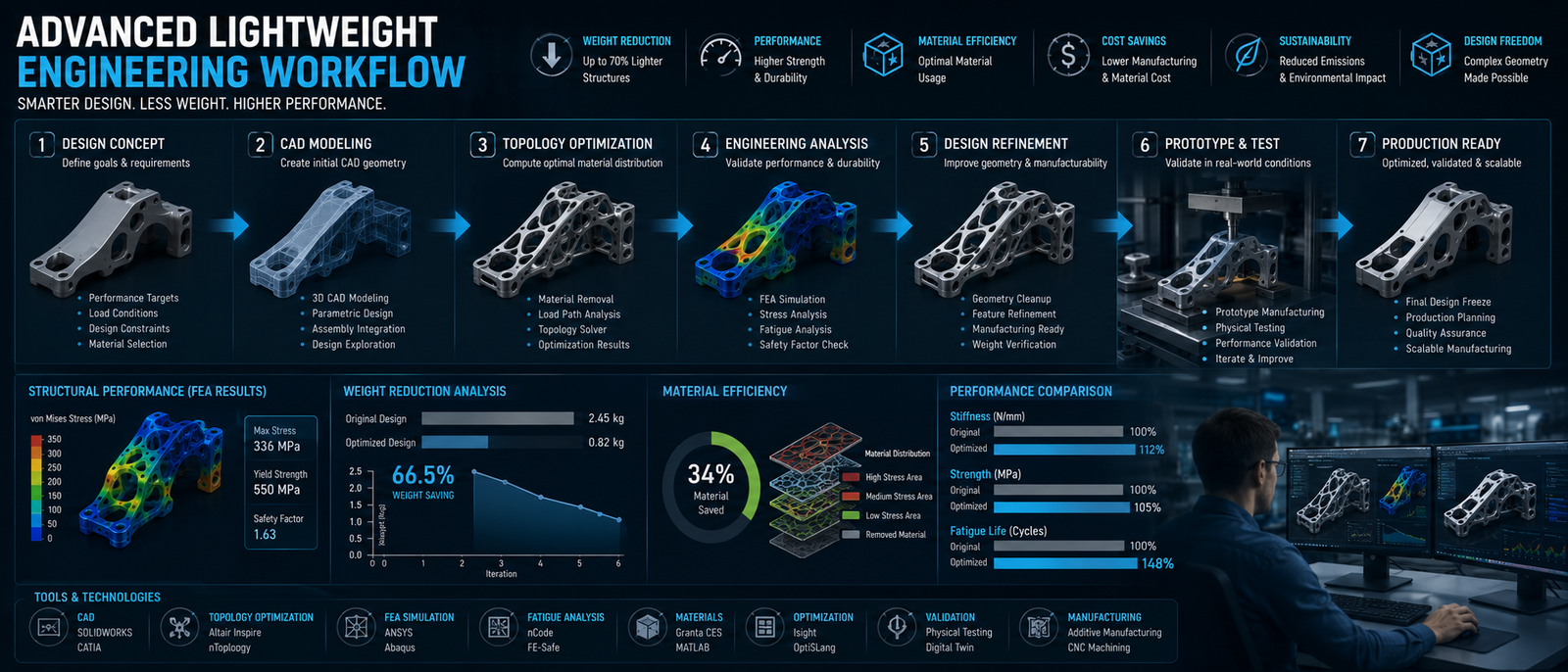
Lightweight design strategies have become one of the most important areas of modern engineering innovation.
They help improve efficiency, reduce operational cost, enhance performance, and support sustainable engineering practices.
However, successful lightweight engineering requires more than simply reducing material.
It requires intelligent optimization, CAD simulation, stress analysis, and practical engineering understanding.
Engineers who understand these concepts gain a strong advantage in automotive, aerospace, product design, and advanced manufacturing industries.
Real engineering learning happens when students understand how to optimize products using practical workflows and simulation tools.
The focus is not only on software learning — it is on building engineers who can create efficient, reliable, and industry-ready products.
1. What is lightweight design in engineering?
Lightweight design is the process of reducing product weight while maintaining structural strength and performance.
2. Why is lightweight design important?
It improves fuel efficiency, product performance, and operational efficiency across industries.
3. Which industries use lightweight design?
Automotive, aerospace, robotics, consumer products, and manufacturing industries use lightweight optimization extensively.
4. Which software is used for lightweight optimization?
SolidWorks, CATIA, Creo, and CAE simulation tools are commonly used.
5. What is topology optimization?
Topology optimization is a simulation-based method that identifies the most efficient material distribution for a product design.
© 2025 4Dimensions Infotech. All rights reserved. | Best Design Engineering Training Institute in Pune
Start your journey with the best design engineering training institute in Pune.