
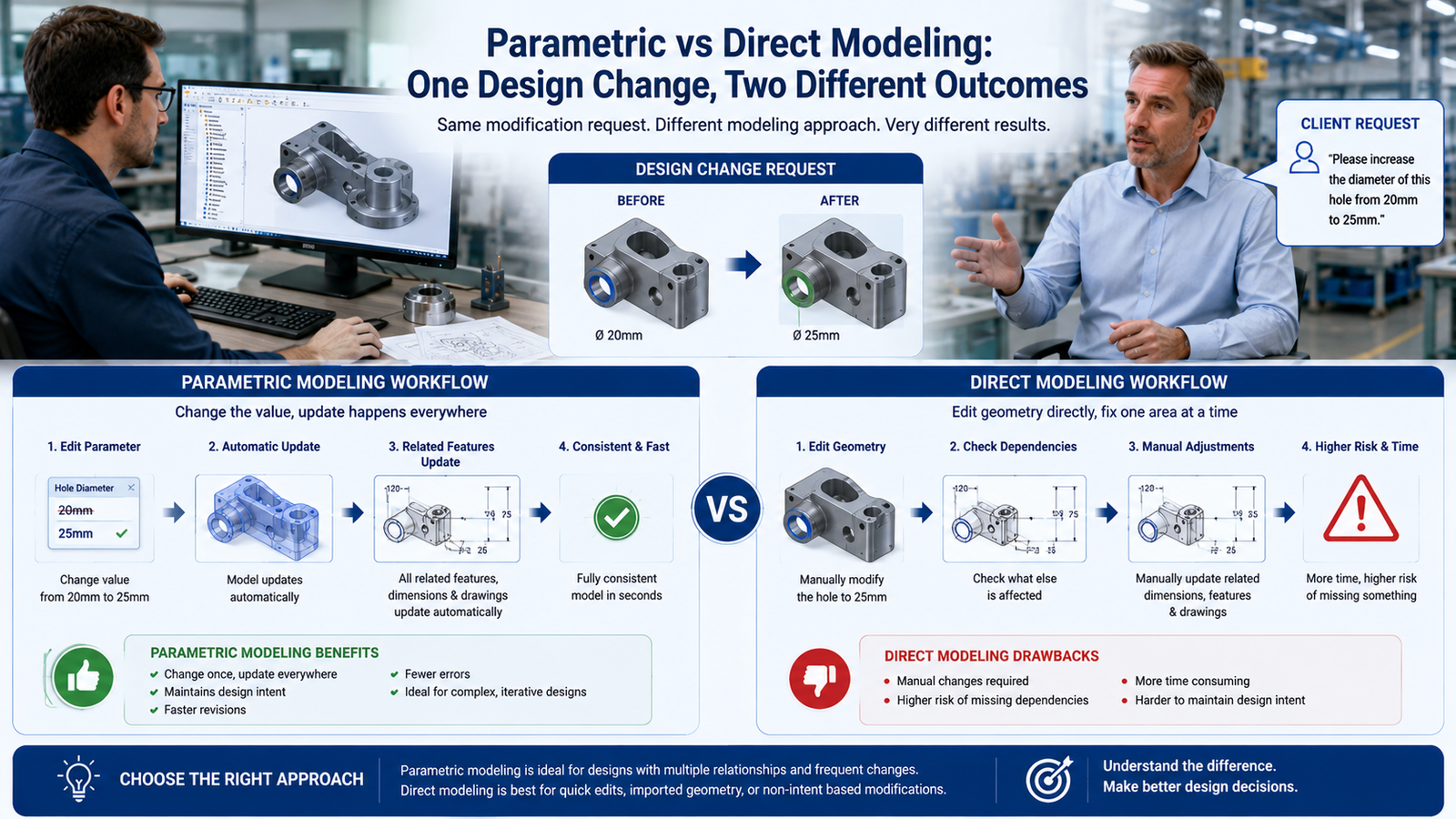
Imagine spending several days designing a mechanical component. The CAD model is complete, the drawings are ready, and the project is about to move into manufacturing.
Then the client requests a small change.
Perhaps a hole needs to move, a bracket requires additional clearance, or the overall dimensions must be modified to fit another assembly.
At this point, the speed and efficiency of the change depend heavily on the modeling method used during design.
Can you simply update one dimension and allow the entire model to adjust automatically? Or do you need to manually modify geometry and rebuild sections of the model?
The answer depends on whether you are using parametric modeling or direct modeling.
Today, engineers working in manufacturing, product development, automotive design, industrial machinery, and mechanical engineering are expected to understand both approaches. Students joining a CAD Course in Pune, SolidWorks Course, CATIA Course, or Mechanical Design Course are increasingly introduced to these workflows because they are widely used in real engineering environments.
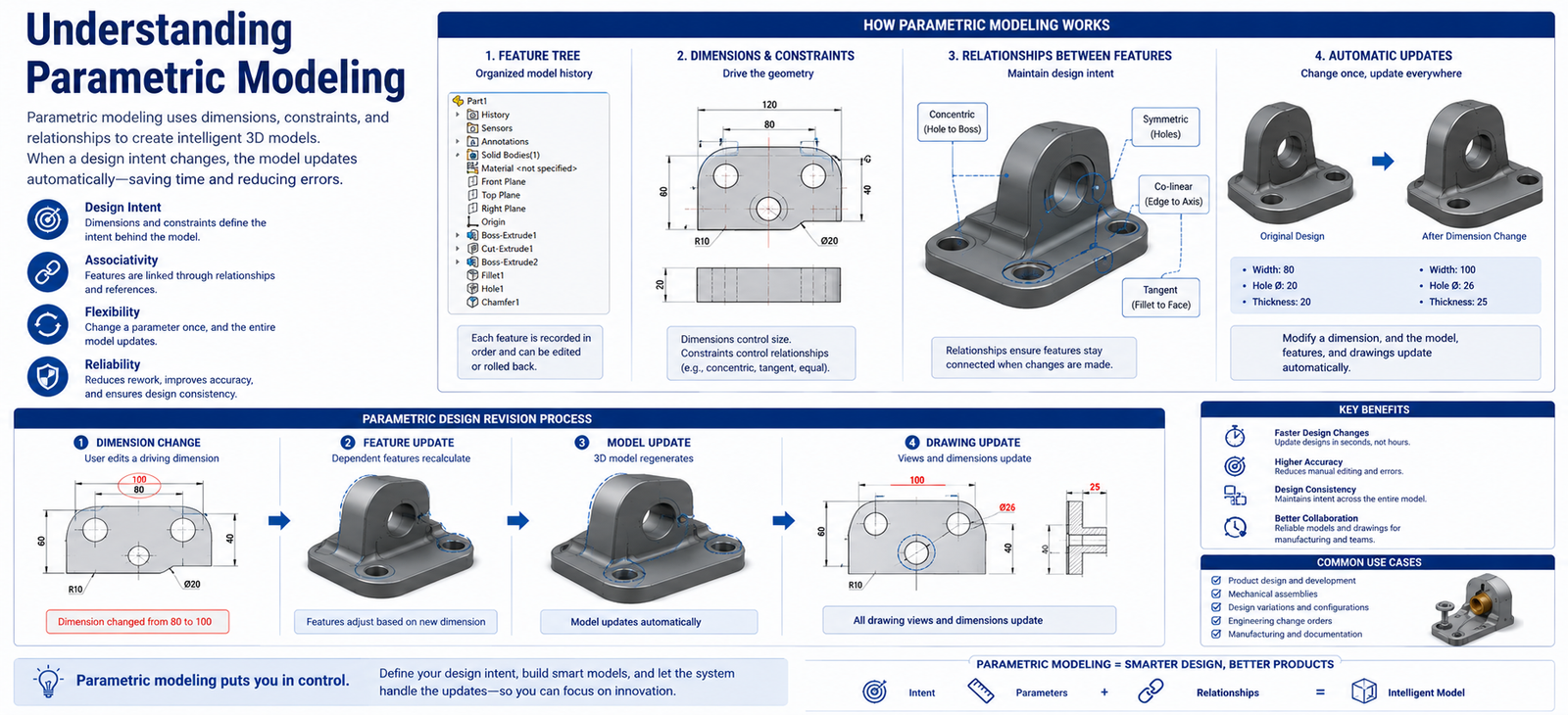
Parametric modeling is a structured design method where dimensions, constraints, and relationships control the geometry of a CAD model.
In simple terms, the software remembers how the model was created.
Every sketch, feature, hole, fillet, extrusion, and dimension becomes part of a feature history that can be modified later.
If one dimension changes, related features automatically update throughout the model.
This ability makes parametric modeling extremely useful in mechanical design, manufacturing, product development, and engineering projects that require multiple revisions.
For example, if a designer changes the diameter of a shaft, associated bearings, holes, and mating components can update automatically based on predefined relationships.
This improves consistency, reduces manual work, and helps maintain design intent throughout the development process.
Parametric modeling plays a major role in modern product design engineering workflows.
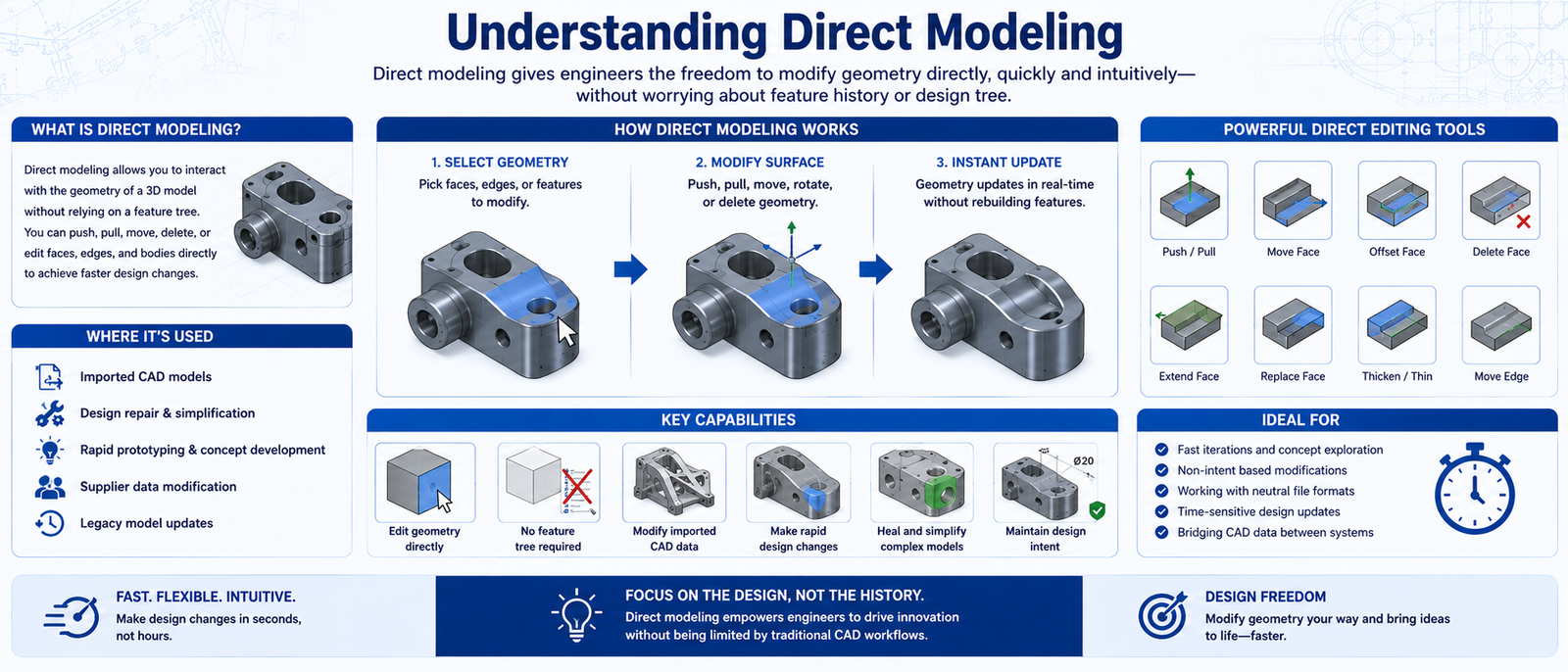
Direct modeling focuses on speed and flexibility rather than feature history.
Instead of editing sketches and dimensions, engineers directly manipulate geometry by pushing, pulling, rotating, or modifying surfaces.
As a result, changes can often be made faster.
Direct modeling is especially useful when working with imported CAD files where the original feature history is unavailable.
Engineers can modify geometry without rebuilding the model from scratch.
This approach is widely used during concept development, design exploration, client revisions, and rapid product modifications.
Many students taking a CAD Software Course or SolidWorks Training first encounter direct modeling while experimenting with concept-based projects and design changes.
The main advantage is flexibility. Engineers can make quick modifications without worrying about complex feature relationships.
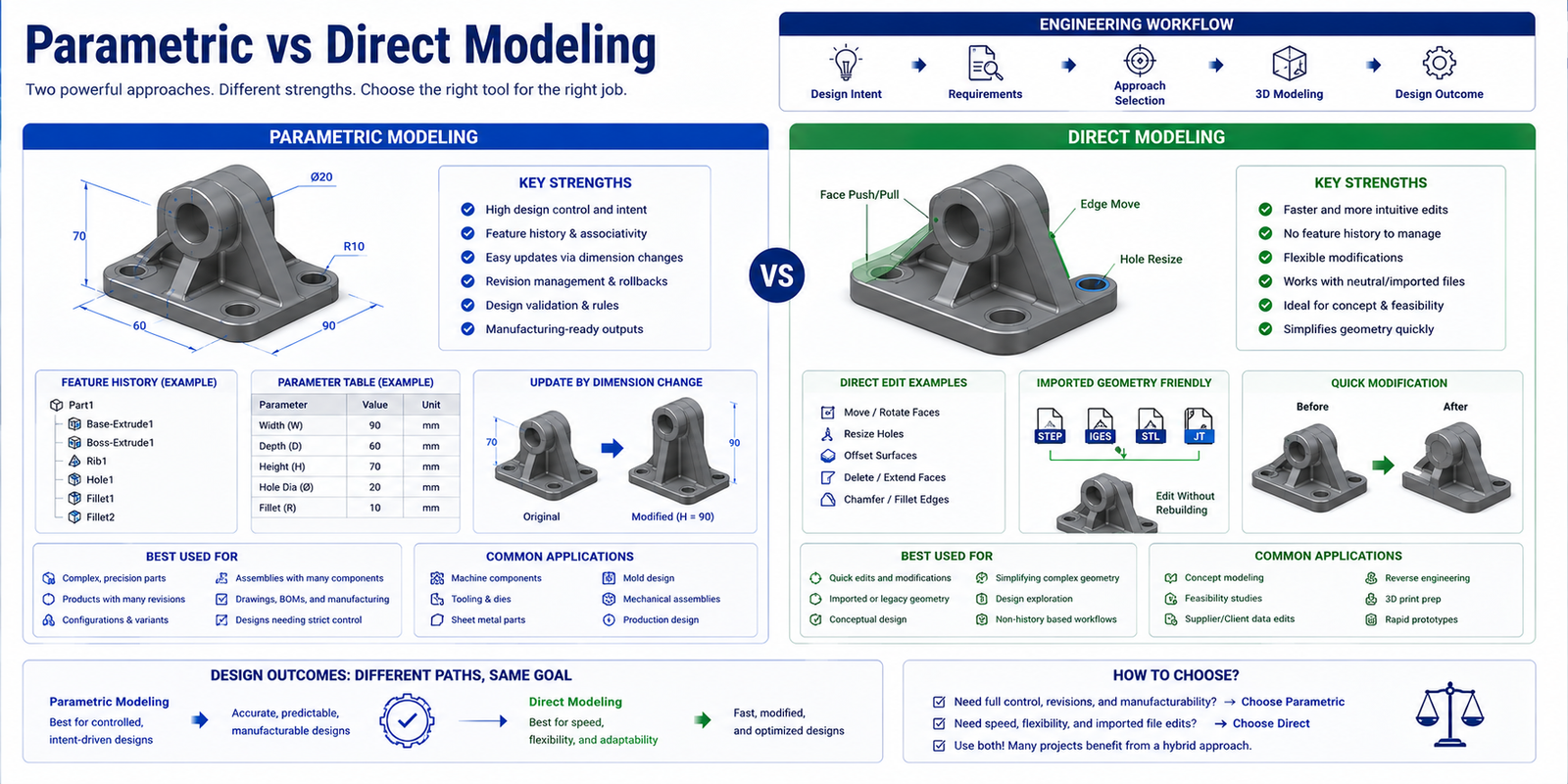
Many beginners assume one method is better than the other. In reality, both have advantages depending on the project requirements.
Parametric modeling offers greater control and is ideal for projects that require design consistency, revision management, and manufacturing accuracy.
Direct modeling provides faster modifications and greater flexibility, making it useful during concept development and rapid design iterations.
For production-ready components, parametric modeling is often preferred because dimensions and relationships remain controlled.
For concept development, customer revisions, and imported CAD file modifications, direct modeling is often the faster solution.
Most engineering companies do not choose one approach exclusively.
A product may begin as a direct model during concept exploration. Once the concept is finalized, engineers often transition to a parametric workflow for detailed design, documentation, and manufacturing preparation.
This combination helps companies balance flexibility with engineering control.
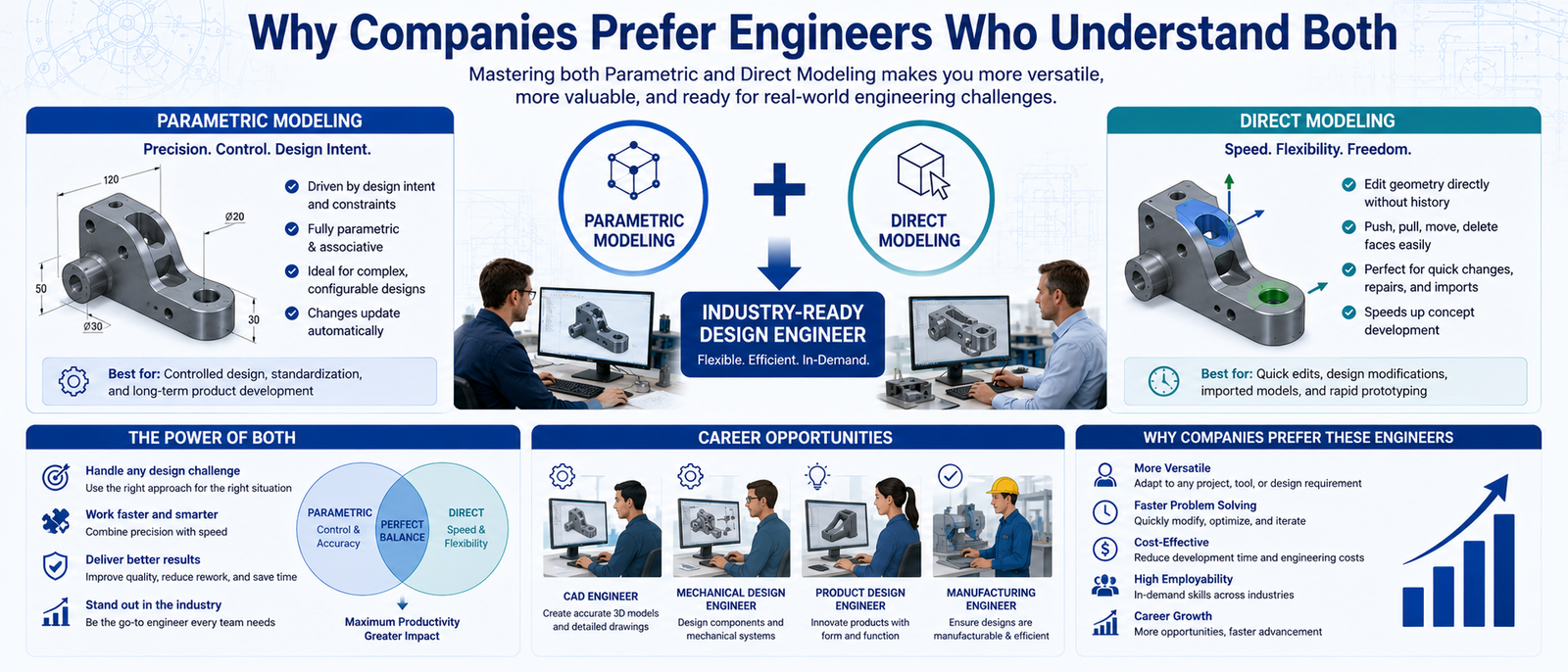
Modern industries do not simply hire engineers who know software commands.
Companies look for professionals who understand design logic, revision management, manufacturing workflows, and efficient CAD practices.
During interviews for CAD Engineer, Design Engineer, and Mechanical Design Engineer roles, recruiters often ask candidates how they would handle design modifications and engineering revisions.
Engineers who understand both parametric and direct modeling can explain multiple solutions and adapt to different project requirements.
This flexibility makes them more valuable in manufacturing, automotive, industrial equipment, and product development industries.
Knowing both approaches also improves productivity, reduces design time, and helps engineers work more effectively in real-world design environments.
Parametric modeling and direct modeling are not competing technologies. They are complementary tools that solve different engineering challenges.
Parametric modeling provides structure, design intent, and revision control. Direct modeling provides flexibility, speed, and rapid geometry modification.
The most effective engineers understand both approaches and know when to use each one during the product development process.
This ability improves design quality, increases productivity, and helps engineers adapt to real-world project requirements.
At 4Dimensions Infotech Pune, students learn practical CAD workflows used by design engineers in manufacturing industries.
Our programs combine AutoCAD, SolidWorks, CATIA, and mechanical design concepts through real-world engineering projects.
Whether you are searching for CAD Courses in Pune, a SolidWorks Course, a CATIA Course, or a complete Mechanical Design Course, understanding both parametric and direct modeling will help you become industry-ready.
👉 Learn how to design faster, smarter, and more efficiently using industry-standard CAD workflows.
1. What is the difference between parametric and direct modeling?
Parametric modeling uses dimensions and feature relationships, while direct modeling allows geometry to be edited directly.
2. Which modeling method is better for manufacturing?
Parametric modeling is generally preferred because it maintains design intent and controlled revisions.
3. Is direct modeling faster?
Yes. Direct modeling is often faster for concept development and quick design changes.
4. Which CAD software supports both methods?
SolidWorks, CATIA, Creo, Solid Edge, and Fusion 360 support both workflows.
5. Why should engineers learn both?
Understanding both approaches improves productivity, flexibility, and employability in modern engineering industries.
© 2025 4Dimensions Infotech. All rights reserved. | Best Design Engineering Training Institute in Pune
Start your journey with the best design engineering training institute in Pune.