
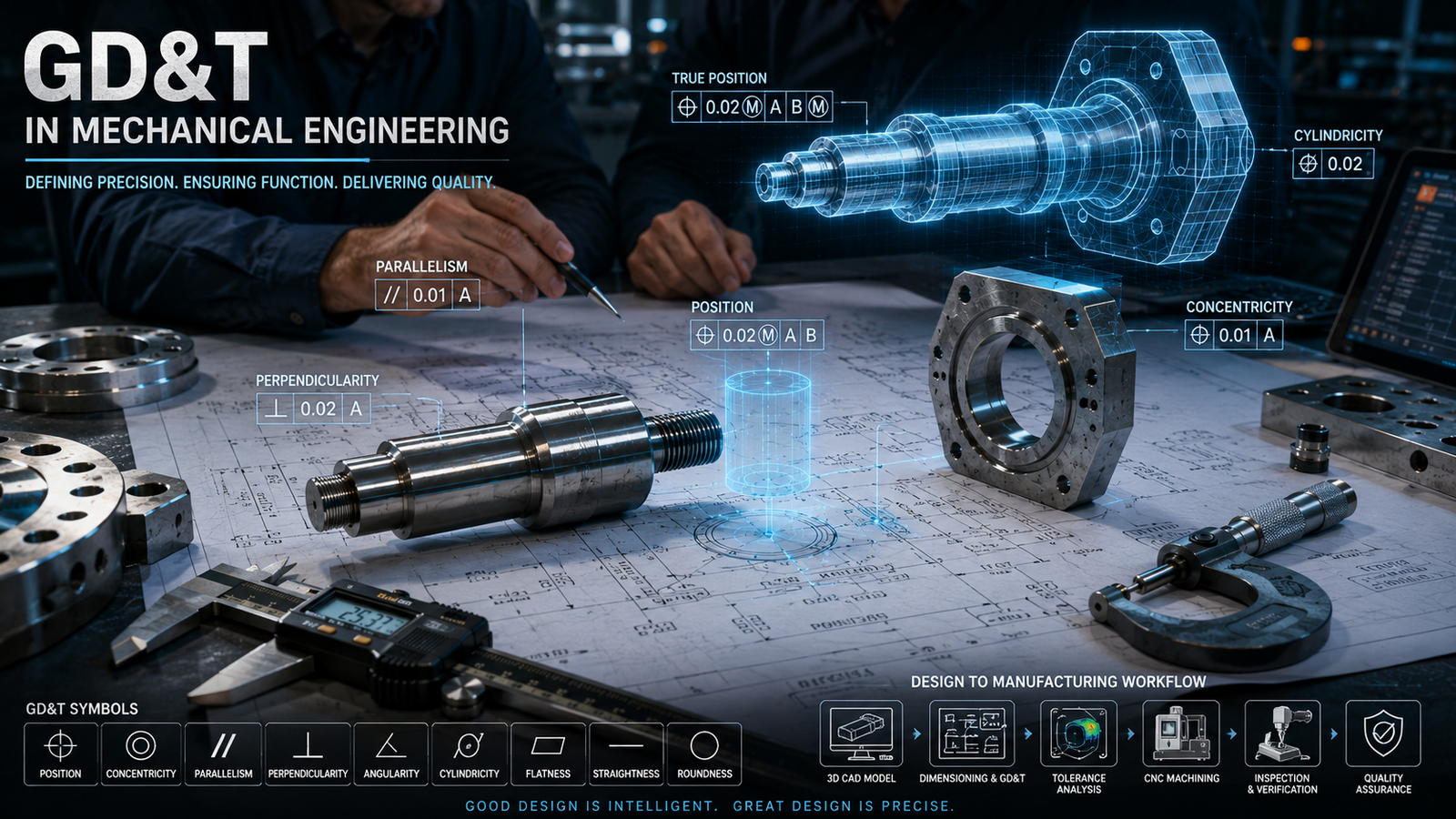
At 4Dimensions Infotech, students learning modern CAD and mechanical design workflows quickly realize that engineering is not only about creating models — it is about ensuring those designs can actually be manufactured accurately.
In real industries, even a small dimensional variation can create major assembly problems, reduce product quality, or cause complete mechanical failure.
This is exactly why Geometric Dimensioning and Tolerancing (GD&T) has become one of the most important concepts in modern engineering design and manufacturing.
GD&T helps engineers communicate manufacturing requirements clearly using internationally accepted engineering standards.
Instead of relying only on simple dimensions, engineers define how components should fit, align, rotate, and function under real-world operating conditions.
This makes GD&T an essential skill for students learning through a CAD course, SolidWorks course, CATIA course, or advanced engineering software course.
Modern manufacturing companies actively prefer engineers who understand tolerancing, design validation, CAD workflows, and precision engineering systems.
GD&T also plays an important role in workflows explained in the complete engineering product design lifecycle.
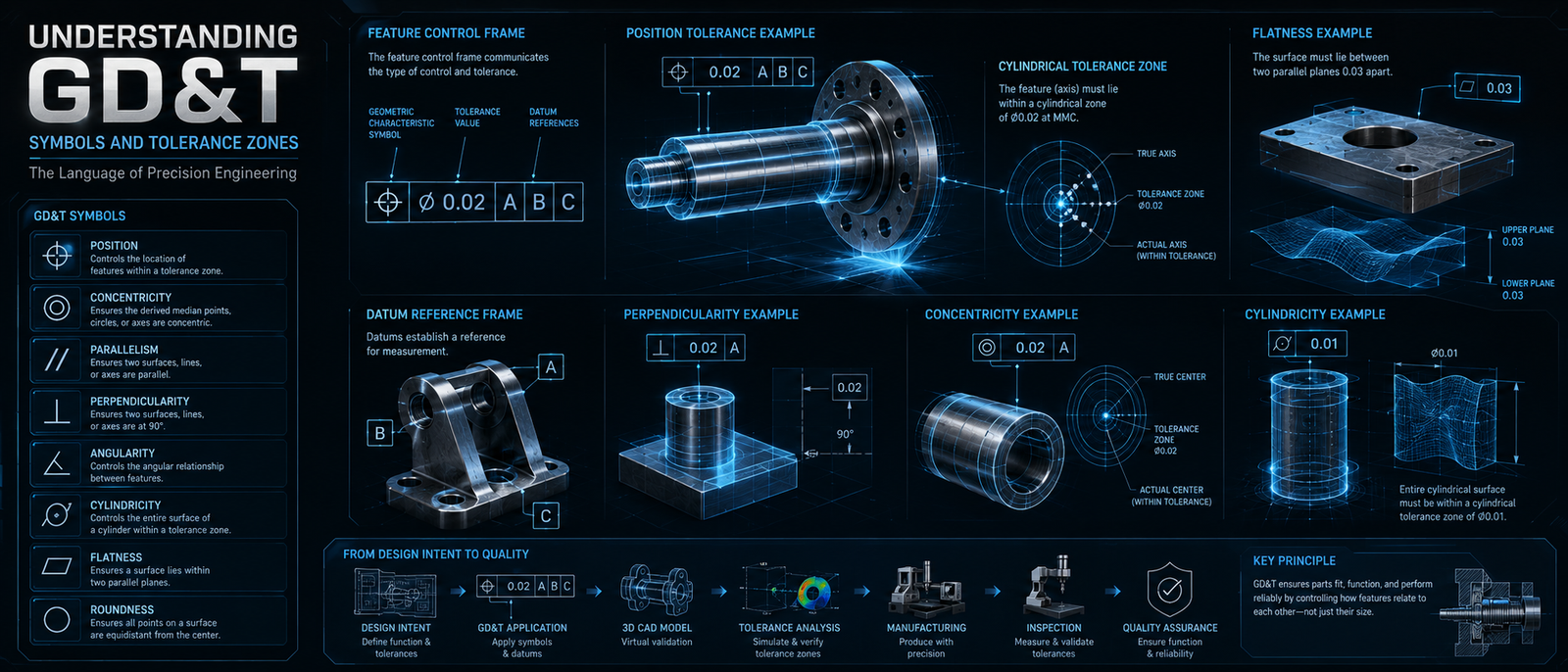
Geometric Dimensioning and Tolerancing (GD&T) is a standardized engineering system used to define the geometry, orientation, size, and allowable variation of mechanical features.
Unlike traditional dimensioning methods, GD&T focuses not only on size but also on how different features relate to each other functionally.
This allows engineers and manufacturers to clearly understand the design intent without confusion.
GD&T defines critical engineering characteristics such as:
Because of this, GD&T improves communication between design engineers, manufacturing teams, quality inspection departments, and assembly engineers.
In modern manufacturing, precision is critical.
Mechanical components must fit together correctly, rotate smoothly, maintain alignment, and perform consistently under operating conditions.
Without proper tolerancing systems, even perfectly manufactured parts may fail during assembly because their positional relationships are incorrect.
GD&T solves this problem by defining how much variation is actually acceptable while still maintaining proper function.
Because of this, companies can:
GD&T also supports processes explained in design validation before manufacturing, where precision engineering and dimensional accuracy become extremely important.
One of the biggest advantages of GD&T is consistent product quality.
Instead of depending on overly tight dimensions everywhere, engineers apply tolerances intelligently based on functional requirements.
This ensures that critical features receive higher precision while non-critical areas allow more manufacturing flexibility.
As a result, products maintain functionality without unnecessarily increasing production cost.
This balance between engineering accuracy and manufacturing efficiency is extremely important in industries such as:
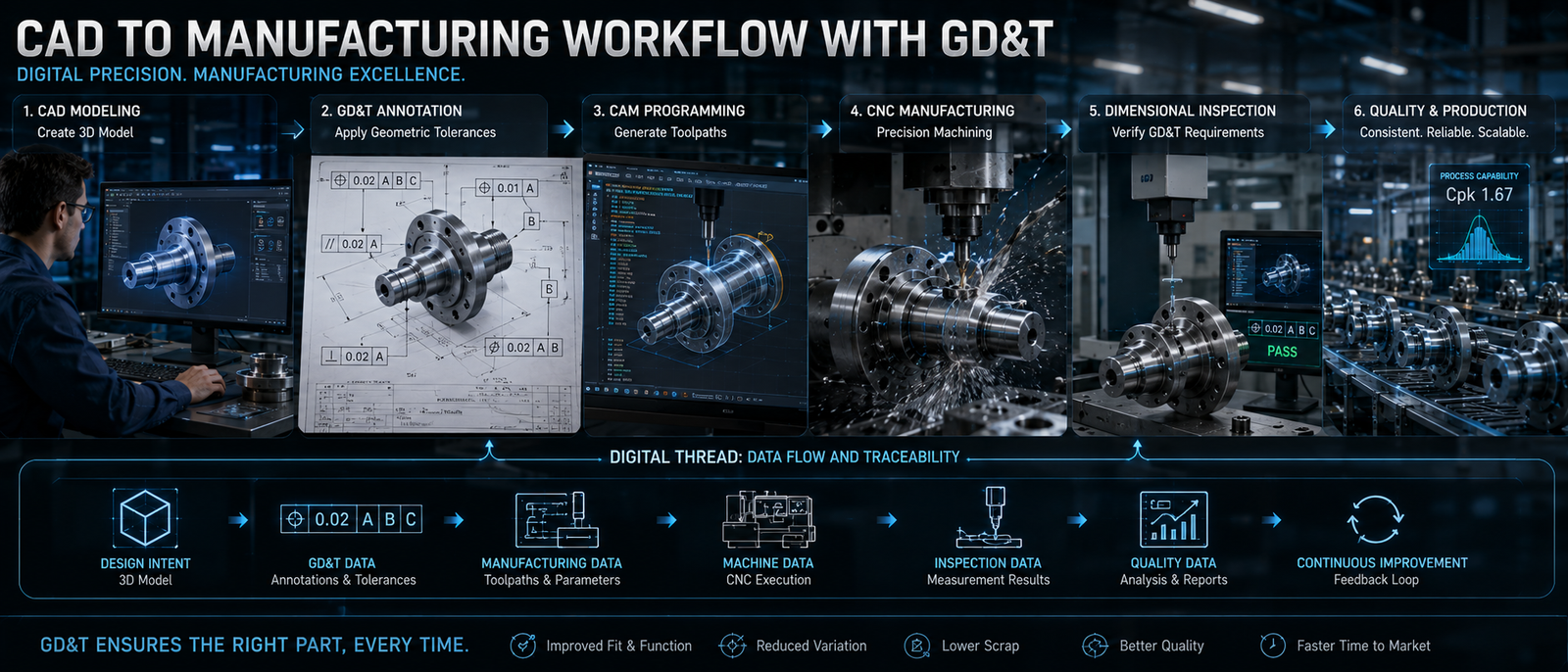
Modern engineering workflows depend heavily on integration between design and manufacturing systems.
Engineers first create product geometry using CAD tools such as AutoCAD, SolidWorks, CATIA, or Creo.
After the design is completed, GD&T specifications define how those components should be manufactured and inspected.
This connection becomes extremely important in workflows explained in how CAD and CAM work together in manufacturing.
Without GD&T, manufacturing teams may interpret engineering drawings differently, leading to inconsistent results.
Modern CAD software now allows engineers to apply GD&T directly inside 3D models and engineering drawings.
Students learning through a CAD training institute often gain hands-on exposure to these professional manufacturing workflows.
GD&T also supports Design for Manufacturing (DFM) principles.
Instead of creating unrealistic tolerances that increase machining complexity, engineers define tolerances strategically based on functionality.
This helps manufacturers produce components more efficiently while maintaining product quality.
This engineering philosophy is closely connected with design for manufacturing concepts.
As industries become more competitive, engineers who understand manufacturing optimization gain a major advantage.
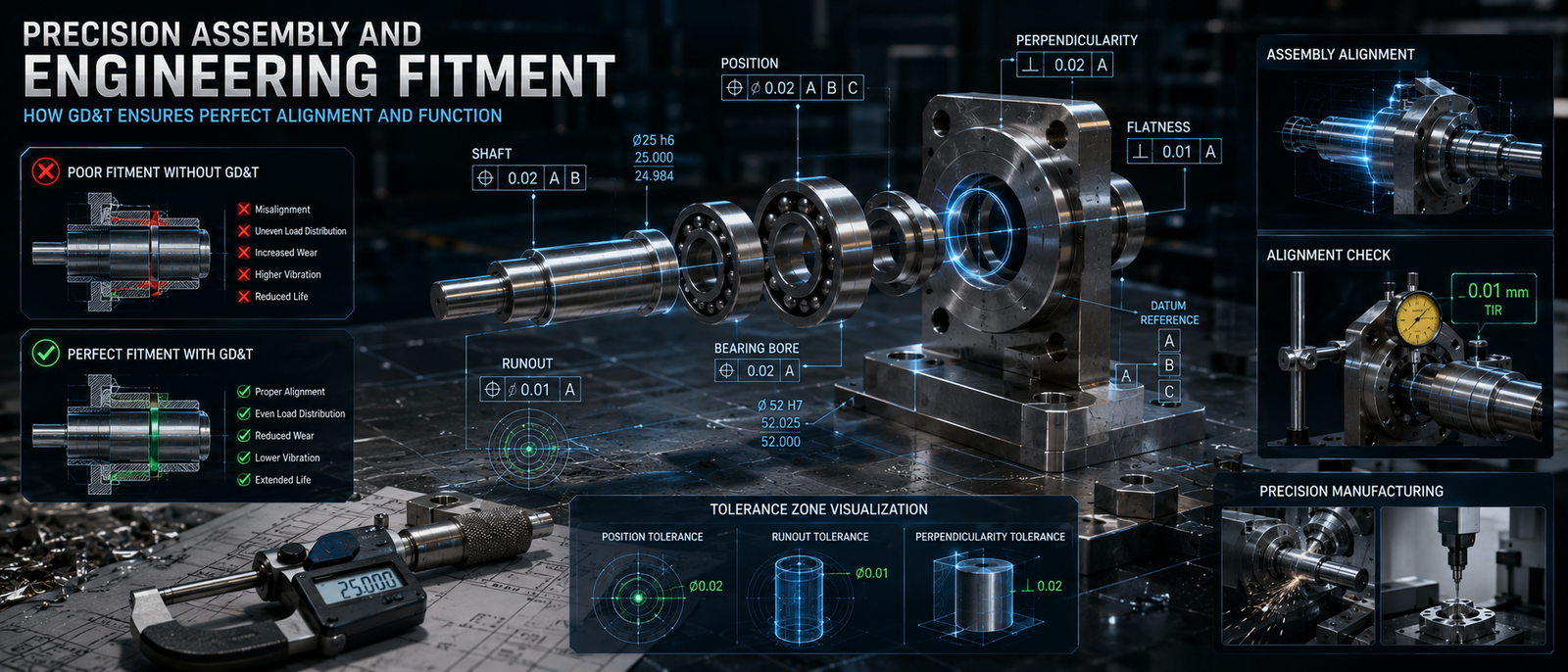
Consider a shaft and hole assembly used inside industrial machinery.
Even if both parts are manufactured to the correct diameter, improper alignment or positional error can still cause failure.
The shaft may create excessive friction, vibration, or looseness during operation.
GD&T ensures that these features maintain the correct positional relationship for smooth operation.
Material behavior also affects tolerancing decisions, which is why engineers must understand concepts explained in material selection in mechanical design.
One common mistake beginners make is applying extremely tight tolerances everywhere.
Although this may appear safer, it actually increases:
GD&T helps engineers apply tolerances intelligently instead of unnecessarily.
This creates a better balance between quality, manufacturing efficiency, and production cost.
Companies today actively prefer engineers who understand both CAD design and manufacturing practicality.
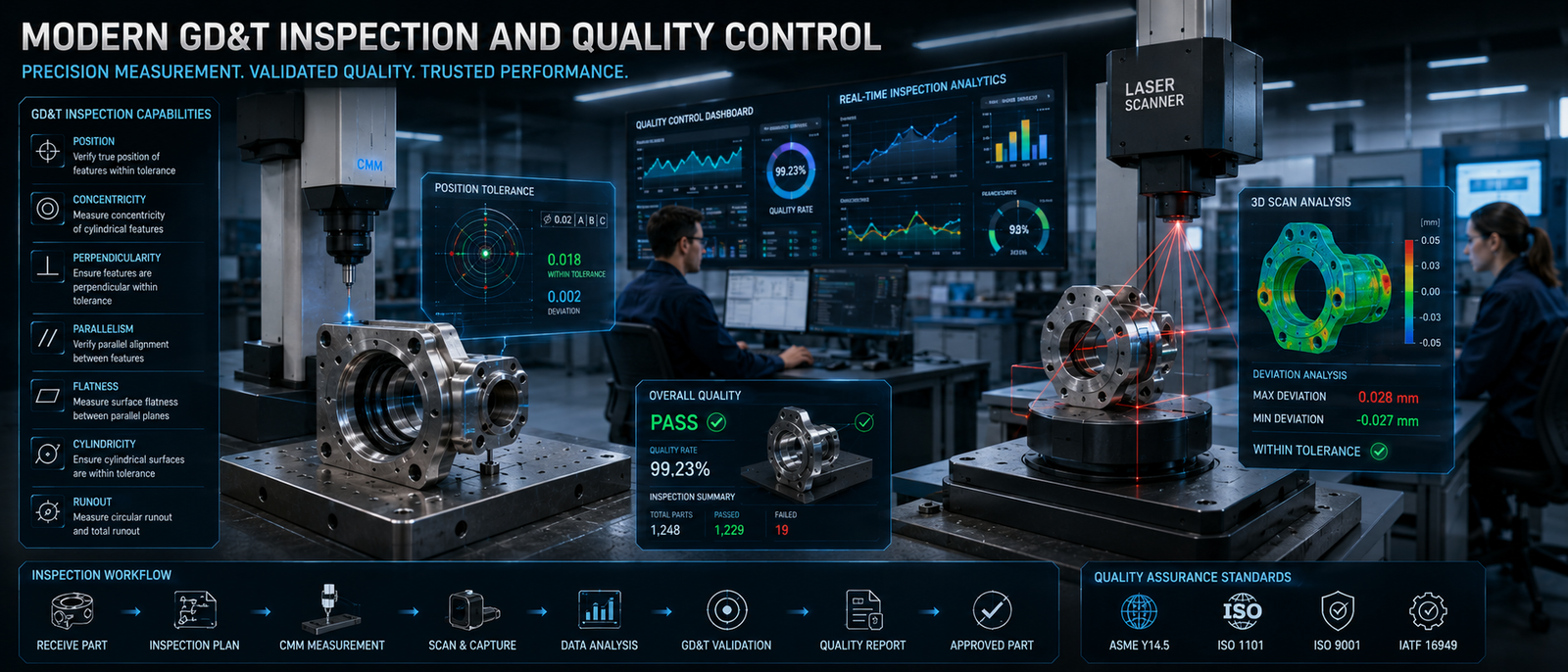
GD&T in Mechanical Engineering has become an essential part of modern product design and manufacturing.
It improves communication between engineering and manufacturing teams, increases dimensional accuracy, reduces production errors, and ensures reliable product performance.
Modern engineering companies now depend heavily on GD&T because manufacturing precision directly affects product quality, efficiency, and safety.
As industries move toward advanced manufacturing and automation systems, engineers who complete a professional SolidWorks course in Pune and understand tolerancing, CAD workflows, and precision engineering gain a major career advantage.
Understanding GD&T becomes much easier when students apply it in real engineering workflows.
At 4Dimensions Infotech, our SolidWorks course in Pune teaches GD&T concepts through practical CAD projects, manufacturing workflows, and industry-oriented engineering training programs.
The goal is to develop engineers who understand not only the SolidWorks software — but also real manufacturing precision and engineering standards. Enroll in our SolidWorks course in Pune to build these skills through hands-on, project-based training.
1. What is GD&T?
It is a standardized engineering system used to define geometry, tolerances, and feature relationships in mechanical designs.
2. Why is GD&T important in manufacturing?
It improves dimensional accuracy, product quality, assembly reliability, and manufacturing communication.
3. Which industries use GD&T?
Automotive, aerospace, manufacturing, heavy engineering, and precision engineering industries use GD&T extensively.
4. Which software supports GD&T?
SolidWorks, CATIA, AutoCAD, Creo, and other CAD systems support GD&T features — with SolidWorks being one of the most widely used for GD&T-based design and dimensioning.
5. Can beginners learn GD&T?
Yes. With the right SolidWorks course in Pune and hands-on practical projects, students can understand and apply GD&T effectively.
© 2025 4Dimensions Infotech. All rights reserved. | Best Design Engineering Training Institute in Pune
Start your journey with the best design engineering training institute in Pune.