
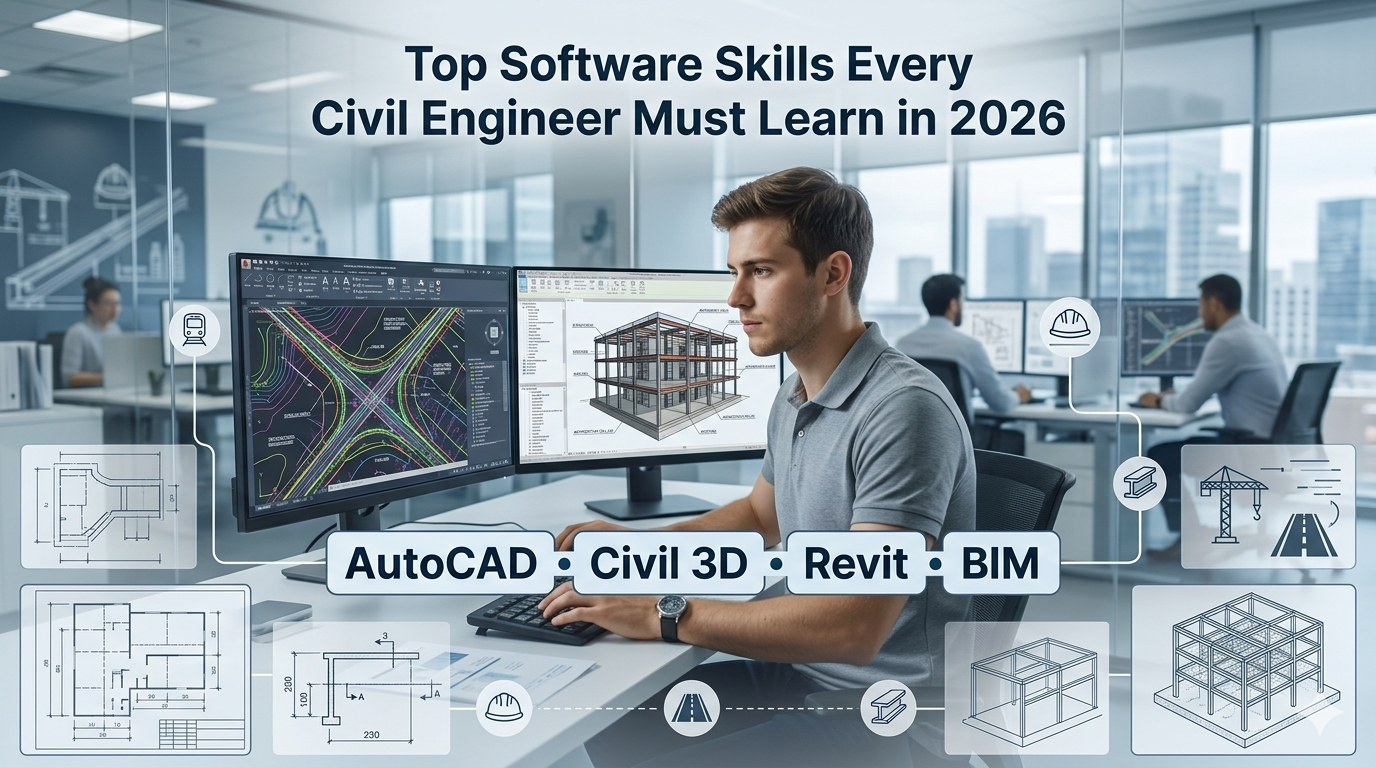
The civil engineering industry is going through a major transformation, and the expectations from engineers are very different compared to the past. Today, companies are no longer satisfied with only theoretical knowledge or manual drafting skills. Instead, they expect engineers to be comfortable with modern digital tools, intelligent design workflows, and real-world project execution systems.
Because of this shift, software skills have become one of the most important factors in building a successful civil engineering career in 2026. At 4Dimensions Infotech, we see that students who focus on practical tools like CAD and BIM are much better prepared for industry requirements compared to those who rely only on academic learning.
Modern companies now prefer candidates who can directly work on live projects using tools such as AutoCAD, Civil 3D, and Revit. If you are searching for an autocad course, civil 3d course, revit course, or a complete cad training Pune program, understanding these tools deeply can help you choose the right direction for your career.
Civil engineering today is highly dependent on digital workflows. From the initial planning stage to final construction, almost every step is now handled using software-based systems. Engineers are expected to design, analyze, visualize, and manage projects using advanced tools rather than traditional manual methods.
Software like AutoCAD and Revit is used for creating precise 2D drawings and intelligent 3D models, while Civil 3D is widely used for infrastructure planning and terrain analysis. Along with this, project data, cost estimation, and structural planning are also handled digitally, making software knowledge essential for every civil engineer.
This is why students who complete a structured cad software course or civil cad training program are more confident during interviews and have better chances of securing job opportunities in construction and infrastructure companies. Employers prefer candidates who already understand real-world workflows instead of those who only know theoretical concepts.
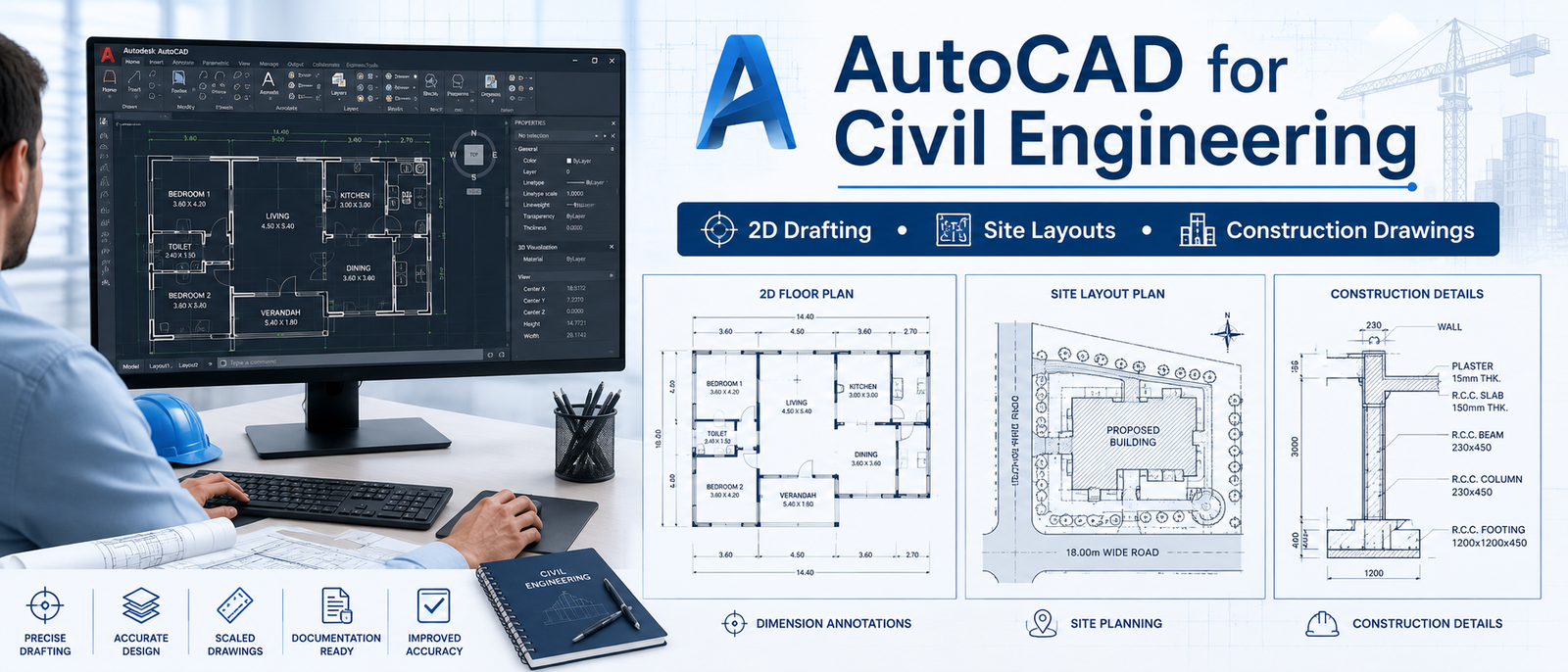
AutoCAD is considered the starting point for almost every civil engineering student because it builds the foundation of drafting and design understanding. It is widely used in the industry for creating 2D drawings, construction layouts, site plans, floor plans, and technical detailing work.
Whether it is a residential building, commercial structure, or infrastructure project, AutoCAD plays a key role in preparing accurate drawings that guide the entire construction process. This is why most students begin their journey with an autocad course or autocad software course to develop strong basic skills.
As students gain confidence in AutoCAD, they are able to understand design logic, measurement accuracy, and construction documentation more effectively. This makes AutoCAD not just a software tool, but a foundation for all advanced civil engineering software learning.
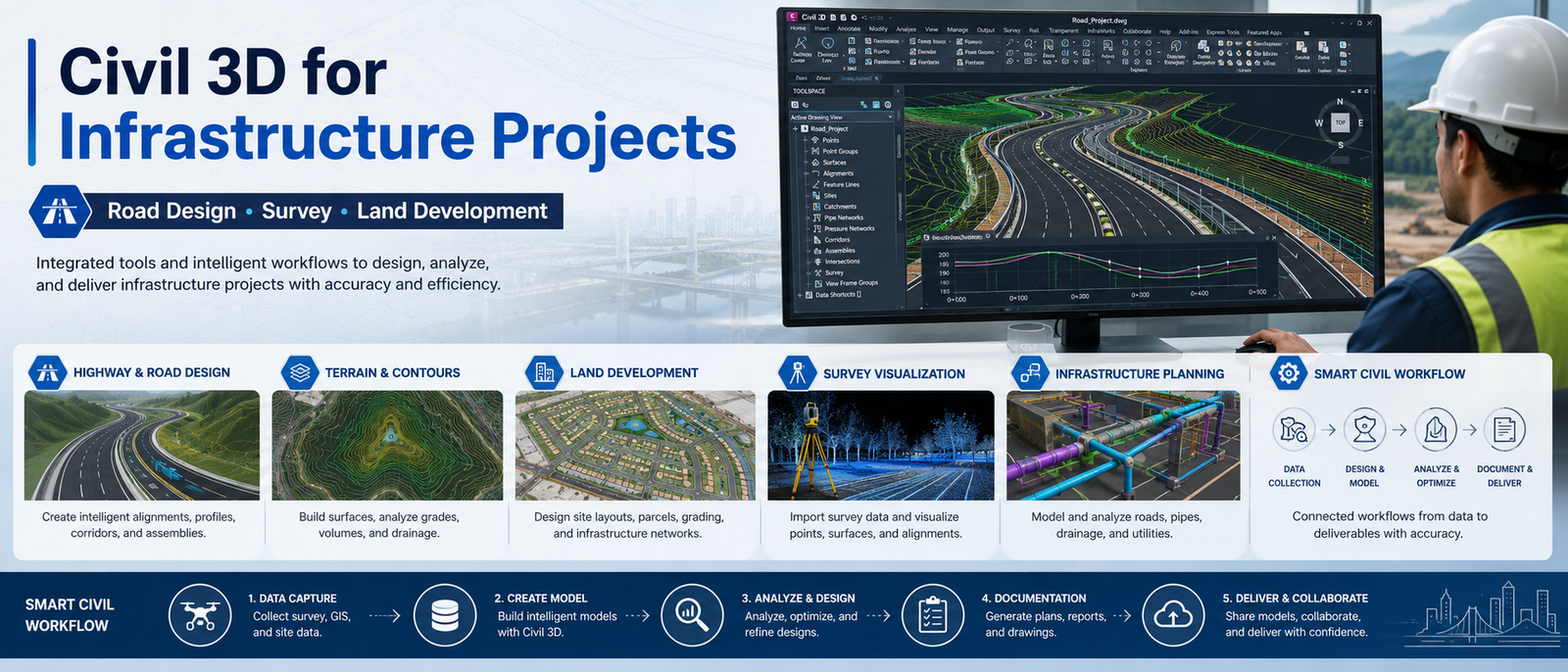
After gaining basic drafting knowledge through AutoCAD, many civil engineers move toward Civil 3D, which is specifically designed for infrastructure and large-scale civil projects. Civil 3D is widely used in road design, land development, drainage systems, and survey-based planning.
Unlike traditional drafting software, Civil 3D works with real-world engineering data, allowing engineers to create intelligent models that represent actual terrain and infrastructure conditions. This makes project planning more accurate and efficient.
Students who enroll in a civil 3d course or civil 3D training program often find better opportunities in infrastructure companies, urban development projects, and highway construction sectors. With the rapid growth of smart cities and infrastructure development in India, Civil 3D skills are becoming increasingly valuable for career growth.
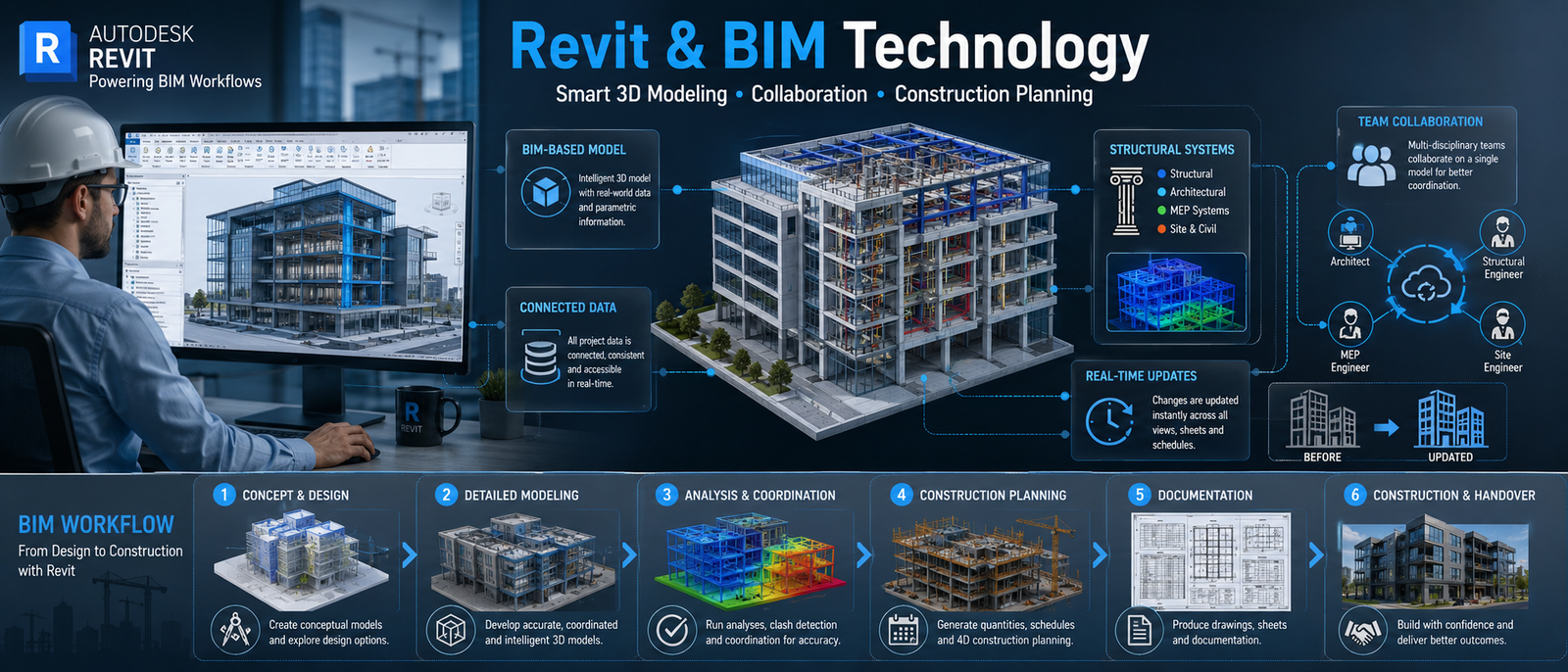
Revit has become one of the most important software tools in modern construction because it is based on Building Information Modeling (BIM). Unlike traditional design tools, Revit allows engineers to create intelligent 3D building models that include real project data and structural information.
This helps in improving coordination between architects, civil engineers, and construction teams. It also reduces design errors, improves accuracy, and enhances overall project efficiency.
Because of these advantages, companies are increasingly hiring candidates who have completed a revit course or revit software training. BIM-based workflows are now widely used in construction projects, making Revit one of the most in-demand skills in civil engineering.
Structural analysis software plays a crucial role for students who are interested in structural engineering. These tools help engineers evaluate how buildings, bridges, and other structures will behave under different loads and conditions.
By using these tools, engineers can calculate strength, stability, and safety before actual construction begins. This ensures that structures meet safety standards and perform well under real-world conditions.
Engineers who combine AutoCAD, Revit, and structural analysis knowledge are often considered highly skilled because they understand both design and engineering validation processes.
While most students focus on CAD tools, Excel and project management software also play a very important role in civil engineering careers. These tools are used for cost estimation, quantity calculation, project scheduling, and progress tracking.
On construction sites and in offices, engineers regularly use Excel to manage data, prepare reports, and track project performance. Even basic knowledge of these tools can significantly improve efficiency and job performance.
Project management skills also help engineers understand timelines, resource planning, and coordination between different teams working on a project.
One of the most common mistakes students make is trying to learn too many software tools at the same time without a clear direction. Instead of becoming experts in one area, they end up with incomplete knowledge of multiple tools.
A better approach is to choose your software path based on your career goal. If your interest lies in site engineering, then AutoCAD Course and Civil 3D Course should be your focus. If you want to work in design roles, AutoCAD and Revit are more suitable. For structural engineering careers, combining AutoCAD with analysis software is the right approach.
Following a structured learning path through civil cad courses helps students stay focused and build strong expertise step by step.
Many students make the mistake of treating software learning as a shortcut to getting a job. They often focus only on certificates without practicing real projects. Others try to learn multiple tools simultaneously, which leads to confusion and weak fundamentals.
In reality, companies are not looking for software knowledge alone. They want engineers who can apply software skills to solve real engineering problems effectively. That is why consistent practice and project-based learning are extremely important.
There is a clear gap between academic learning and industry expectations in civil engineering. Colleges often focus on theory, while companies expect practical skills and real project experience.
This is where practical CAD training becomes important. A good cad institute helps students understand industry workflows, work on live projects, and build confidence in using professional tools.
Such training improves technical skills, communication ability, and job readiness, which are essential for placements and career growth.
At 4Dimensions Infotech, civil engineering students are trained through practical, industry-oriented programs designed to match real job requirements. Instead of only focusing on software commands, the training emphasizes how these tools are used in real construction and infrastructure projects.
Students gain hands-on experience in AutoCAD, Civil 3D, Revit, and other civil engineering tools through structured projects and guided learning. This helps them understand how professionals actually work in the industry.
Along with technical training, students also receive placement assistance and exposure to real-world workflows, which prepares them for interviews and job roles in the construction sector.
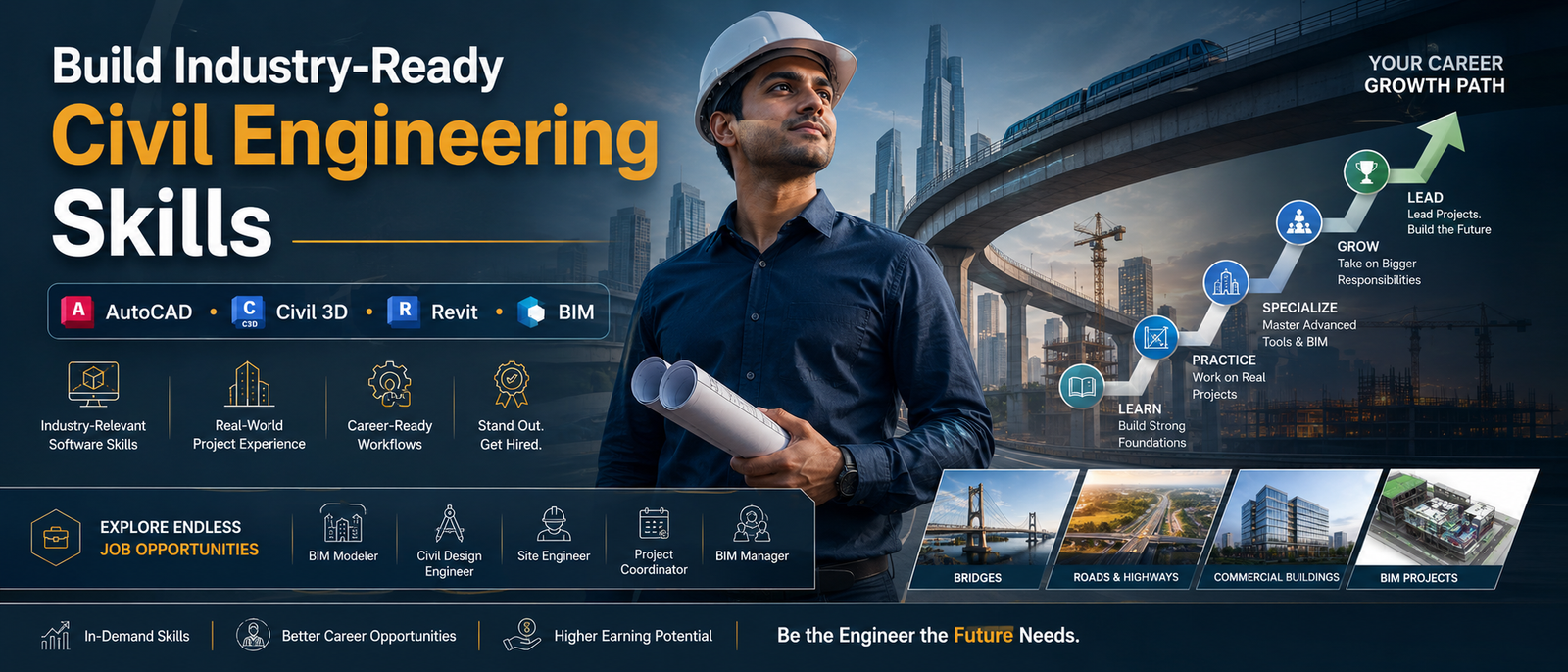
Civil engineering is becoming more technology-driven every year, and software skills are now a key requirement for career success. Engineers who understand AutoCAD, Civil 3D, Revit, and BIM workflows have a clear advantage in today’s job market.
However, true success does not come from software alone. It comes from understanding how to apply these tools in real engineering projects and solving practical problems efficiently.
1. Which software is most important for civil engineers?
AutoCAD, Civil 3D, and Revit are the most essential software tools for civil engineering careers.
2. Is AutoCAD enough for getting a job in civil engineering?
AutoCAD is important, but learning Civil 3D and Revit improves job opportunities and technical knowledge significantly.
3. What is BIM in civil engineering?
BIM (Building Information Modeling) is a digital process used for planning, designing, and managing construction projects using intelligent 3D models.
4. How long does it take to learn civil engineering software?
Basic software skills can be learned in a few months, but professional expertise comes through consistent practice and real projects.
5. Can I learn civil software online?
Yes, online learning is possible, but practical project experience is very important for becoming industry-ready
© 2025 4Dimensions Infotech. All rights reserved. | Best Design Engineering Training Institute in Pune
Start your journey with the best design engineering training institute in Pune.