
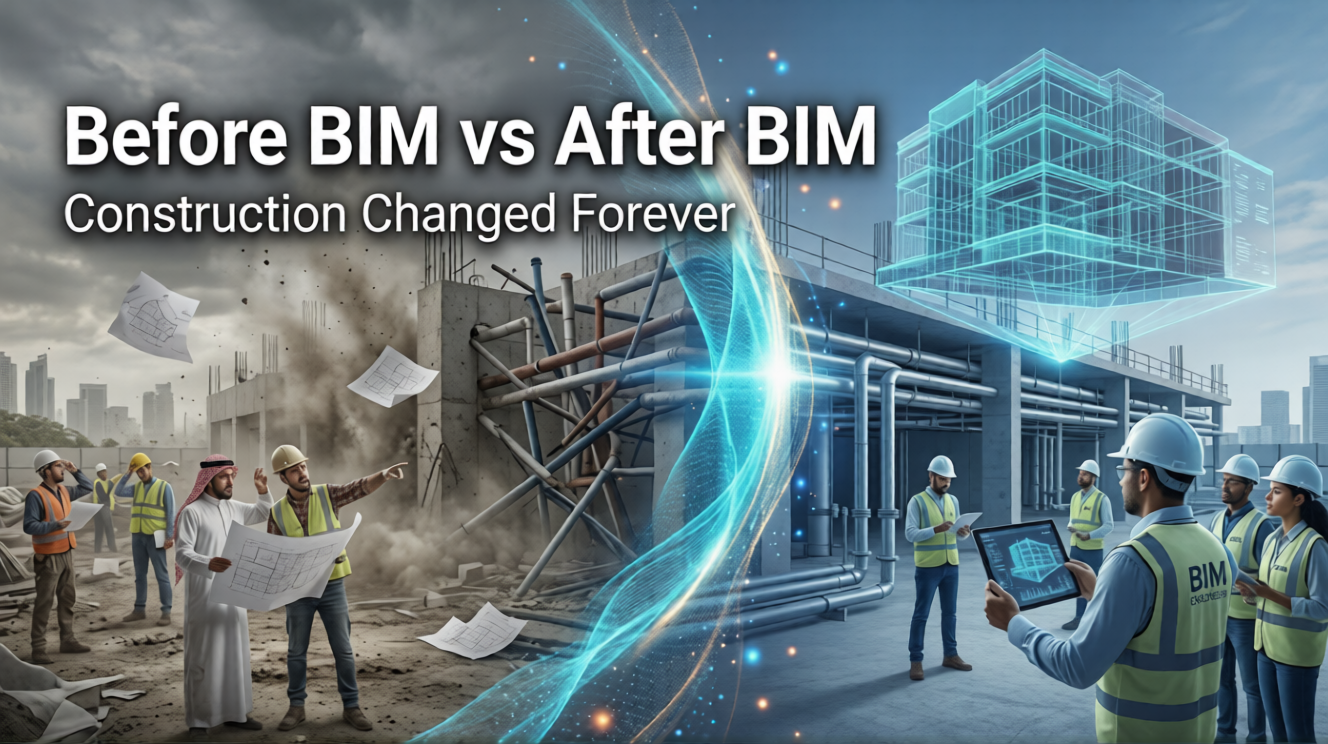
A construction project once started with stacks of drawings, endless revisions, and constant coordination issues.
Architects created designs, engineers modified them, and contractors interpreted them differently.
As a result, mistakes became inevitable.
Walls clashed with pipes. Structures didn’t align. Delays became normal.
That was construction before BIM.
Now, imagine a completely different approach.
Instead of multiple drawings, teams work on one intelligent digital model.
A building exists virtually before it is constructed physically.
Every wall, beam, pipe, and system is already placed, tested, and coordinated.
This is Building Information Modeling (BIM).
As a result, modern construction projects have become faster, more accurate, and far more efficient.
Many students assume BIM is just about learning tools like Revit.
However, BIM is much more than software.
It is a complete workflow that connects design, planning, execution, and maintenance into one system.
Therefore, when you enroll in a revit course or revit architecture course, you are learning an entire process—not just a tool.
Traditionally, construction teams worked separately.
Architects, structural engineers, and MEP teams created different drawings.
Consequently, this caused miscommunication, errors, and rework.
BIM eliminates this gap.
Everyone works on a shared model, ensuring better coordination.
As a result, problems are identified and solved before construction even begins.
A BIM model is far more than a visual representation.
It contains detailed information such as dimensions, materials, structural data, cost estimates, and time schedules.
Because of this, a single model can answer critical project questions:
This level of clarity makes BIM extremely powerful.
Construction is no longer just about building structures.
Instead, it focuses on speed, accuracy, and efficiency.
BIM helps achieve these goals by reducing errors, minimizing delays, and improving planning.
In addition, it enhances coordination and decision-making across teams.
To work with BIM effectively, engineers use advanced tools.
Revit is widely used for building design, architectural modeling, and structural coordination.
That’s why revit classes in Pune and revit software training are in high demand.
On the other hand, Civil 3D is used for infrastructure projects such as road design and land development.
Students who take civil 3d training or civil cad courses become part of modern construction workflows.
Earlier, civil engineers mainly focused on drawings and site execution.
However, today companies expect much more.
They look for professionals who can work with digital models, understand BIM workflows, and coordinate across teams.
As a result, students searching for revit software classes in Pune and practical BIM training are preparing for future-ready careers.
Pune is growing rapidly with high-rise buildings, smart infrastructure, and large-scale construction projects.
Therefore, efficient planning has become essential.
BIM helps manage complex projects with better accuracy and coordination.
This is why the demand for revit classes in Pune and skilled BIM professionals is increasing quickly.
Students who learn BIM gain more than just technical skills.
They understand the entire project lifecycle, collaborate with multiple teams, and solve real construction challenges.
Because of this, they become far more valuable in the job market.
Start with the basics by learning drafting through an autocad course.
Then, upgrade your skills by moving to a revit course and BIM tools.
Finally, specialize by working on real-world projects and coordination workflows.
Construction is no longer just physical it is digital first and physical later.
BIM is not the future; it is the present.
If you understand BIM, you won’t just follow projects you will control how they are built.
👉 Start your journey with revit classes in Pune and become a job-ready civil design professional.
BIM (Building Information Modeling) is a digital process that allows engineers to design, plan, and manage construction projects using intelligent 3D models.
Yes, Revit is one of the most widely used tools for BIM, especially for architectural and structural design.
You can work as a BIM Engineer, Revit Modeler, Civil Design Engineer, or Project Coordinator.
Basic BIM skills can be learned in 2–3 months, while advanced expertise may take 4–6 months with practice.
Yes, BIM is highly in demand in Pune due to rapid infrastructure growth and modern construction projects.
© 2025 4Dimensions Infotech. All rights reserved. | Best Design Engineering Training Institute in Pune
Start your journey with the best design engineering training institute in Pune.