
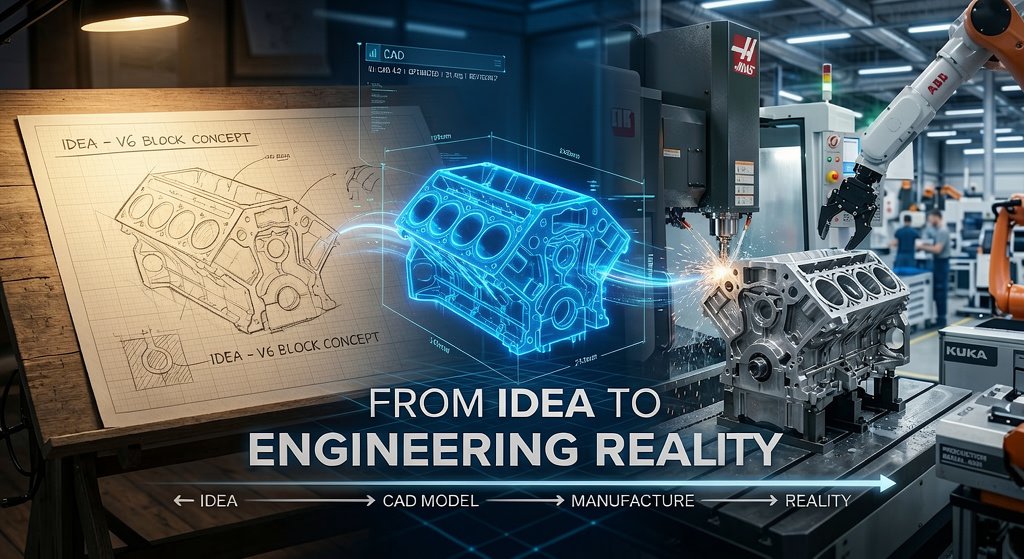
Walk into any modern factory today, and you will immediately notice a major shift.
Machines don’t just run anymore they actively think, analyze, and optimize production in real time.
This transformation is called Industry 4.0, and it is completely reshaping how engineering works.
Amid this rapid change, one role is becoming more important than ever:
👉 The design engineer.
Earlier, design engineers mainly focused on creating drawings and basic models.
However, that approach no longer works in today’s industry.
Now, engineers go beyond software commands. They actively think about manufacturing, cost efficiency, and system integration while designing.
Instead of asking “Will this work?”, they now ask:
👉 Can we manufacture this efficiently?
👉 Will this reduce production cost?
👉 Does this fit into automated systems?
👉 Will it perform in real-world conditions?
As a result, the design role has evolved into a more strategic engineering function.
Every product still begins with a design, but the process is now fully digital and far more advanced.
Therefore, learning through a cad course or enrolling in cad courses in Pune becomes the first essential step for students.
Moreover, CAD is no longer just about drafting it now connects directly to manufacturing and simulation systems.
Although CAD creates the design, CAM brings it to life.
Many students assume that design work ends once the model is ready. However, that is only half the process.
CAM (Computer-Aided Manufacturing) converts designs into machine instructions that factories can execute.
Through a cad cam course or mastercam training, engineers learn how toolpaths are generated and how machines interpret digital models.
Consequently, engineers gain a complete understanding of how products are actually manufactured.
Today’s companies no longer hire software operators. Instead, they look for engineers who understand systems and solve real problems.
In fact, two candidates may learn the same solidworks course, yet perform very differently in their careers.
One simply knows the software. The other understands how industry workflows function.
Naturally, the second candidate becomes more valuable and gets hired faster.
Industry 4.0 is impacting both mechanical and civil engineering in different ways.
In mechanical design, engineers now build smarter products and focus heavily on automation and manufacturability.
Therefore, skills like catia course, creo software course, and automation tools have become essential.
In contrast, civil engineering now relies on digital planning, smart infrastructure design, and BIM technology.
As a result, tools like revit course and civil 3d training are widely used.
Pune is rapidly adapting to Industry 4.0 due to its strong automotive, manufacturing, and infrastructure sectors.
Therefore, companies now demand engineers with multi-software skills and practical experience.
This is why searches for cad training Pune and advanced technical courses are increasing quickly.
Many students believe the gap lies in degrees. However, the real gap exists in practical understanding.
Students often learn tools, but industries expect them to understand complete systems and real-world applications.
This gap creates a strong opportunity for students who focus on practical learning and project-based training.
Instead of asking which course to choose, start asking how you can become industry-ready.
First, learn CAD for design fundamentals. Next, understand CAM for manufacturing processes. Finally, explore automation and real project work.
When you combine these skills, you align directly with Industry 4.0 requirements.
Industry 4.0 does not replace design engineers it transforms them.
Today, successful engineers think beyond software. They understand systems, solve problems, and build real solutions.
If you develop this mindset, you will not just adapt to change you will lead it.
At 4Dimensions Infotech, you can build these skills through practical programs like cad course, solidworks course, catia course, revit course, and cad cam course.
👉 Start your journey with cad training in Pune and prepare for the future of engineering.
© 2025 4Dimensions Infotech. All rights reserved. | Best Design Engineering Training Institute in Pune
Start your journey with the best design engineering training institute in Pune.