
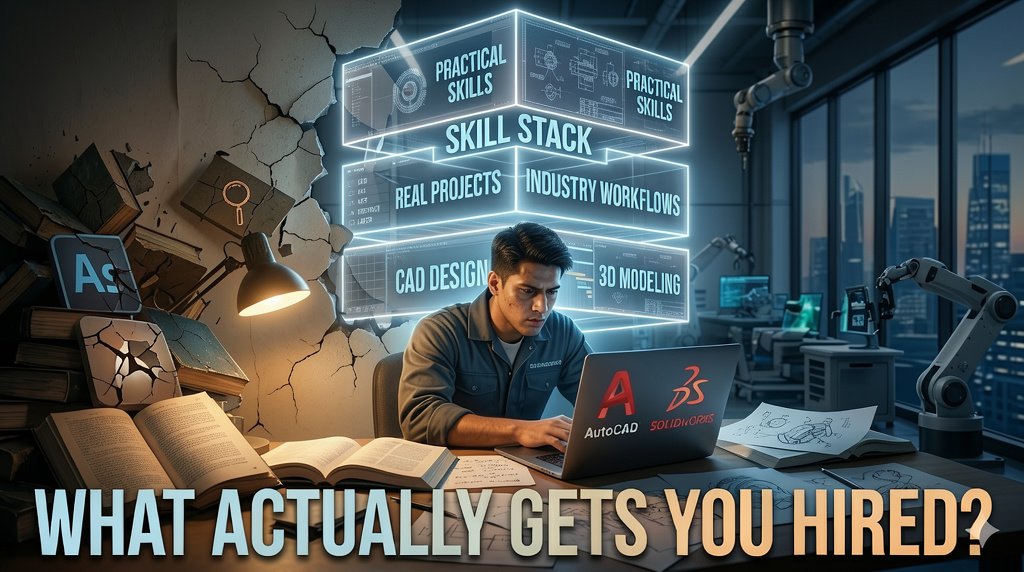
The engineering world is changing faster than ever. Earlier, a degree was enough to build a career. However, that is no longer the case today.
In fact, even knowing just one software is not enough anymore. The engineers who succeed in 2026 will not rely on a single skill they will build a complete skill stack.
So, instead of asking:
👉 “Which course should I do?”
You should start asking:
👉 “What combination of skills will make me unstoppable?”
A skill stack is a combination of multiple complementary skills that work together. As a result, it makes you more valuable, more adaptable, and more employable in today’s competitive market.
Instead of learning just one tool, you build a layered skill set that helps you grow faster and perform better in real-world roles.
Earlier, learning one tool could help you get a job. However, today the situation has changed significantly.
Now, most candidates already know basic software. Therefore, companies expect more depth, more versatility, and practical knowledge.
For example, completing an AutoCAD course alone is no longer enough to stand out. You need to combine it with other skills to stay competitive.
To understand this better, let’s break it down into a simple and practical structure.
First, you need a strong foundation. This includes drafting concepts, engineering basics, and design principles.
Most students begin with a cad course or a structured cad software course to build this base properly.
Next comes the execution layer. This is where you learn tools that help you create designs.
Popular options include AutoCAD for drafting, SolidWorks for 3D modeling, CATIA for advanced design, Creo for parametric modeling, and Revit for BIM workflows.
Students enrolling in cad courses in Pune often combine multiple tools to improve their job opportunities.
This is where most students struggle. Knowing software is one thing, but applying it in real situations is what truly matters.
You should work on projects, solve design problems, and understand how industries actually function. This step builds real confidence.
In addition, you must understand how companies operate. This includes design standards, file management, and team collaboration.
Students who take proper cad training Pune gain this exposure much faster.
Once your basics are strong, you should move toward specialization. For example, you can explore Civil 3D training, CAM for manufacturing, or CAE for analysis.
This step increases your value and opens better career opportunities.
Finally, soft skills play a major role. Many students ignore this, but companies value communication, confidence, and problem-solving ability.
Even skilled candidates fail interviews without these qualities.
Each layer of the skill stack supports the other. For instance, software without thinking leads to weak output, while thinking without tools remains incomplete.
Similarly, skills without application have no real value. However, when all layers combine, they create a powerful and job-ready engineer.
Pune has become a major hub for automotive, manufacturing, and construction industries. Because of this, companies prefer candidates who have multi-skill capabilities and practical experience.
That is why demand for cad courses in Pune and multi-skill training programs is increasing rapidly.
Many students still focus on choosing a single course. However, this approach limits growth.
Instead, you should focus on building a complete skill stack that includes multiple layers of knowledge and application.
You can follow a simple and effective path. First, start with a strong foundation like an AutoCAD course or beginner design training.
Next, move to 3D tools such as SolidWorks or Creo. After that, focus on real-world projects and applications.
Then, advance toward specialization like CATIA or Civil 3D. Finally, continue upgrading your skills to stay relevant.
At 4Dimensions Infotech, the focus is not on single courses but on building complete engineers. Students receive multi-software training, real-world project experience, industry exposure, and placement support.
This approach helps you build a strong skill stack instead of just earning a certificate.
The future does not belong to engineers with only degrees. Instead, it belongs to those who build strong and practical skill stacks.
If you want to stay relevant in 2026, stop thinking in terms of courses and start thinking in terms of skills. That is how you become truly unstoppable.
A skill stack is a combination of technical, practical, and soft skills that make an engineer job-ready and valuable.
No, companies prefer candidates who have multiple skills along with practical experience.
Skills like CAD design, BIM, CAM, CAE, and project-based experience are highly in demand.
Start with fundamentals, learn multiple tools, work on projects, and upgrade your skills regularly.
Yes, CAD and design-related skills continue to be highly valuable across industries.
© 2025 4Dimensions Infotech. All rights reserved. | Best Design Engineering Training Institute in Pune
Start your journey with the best design engineering training institute in Pune.