
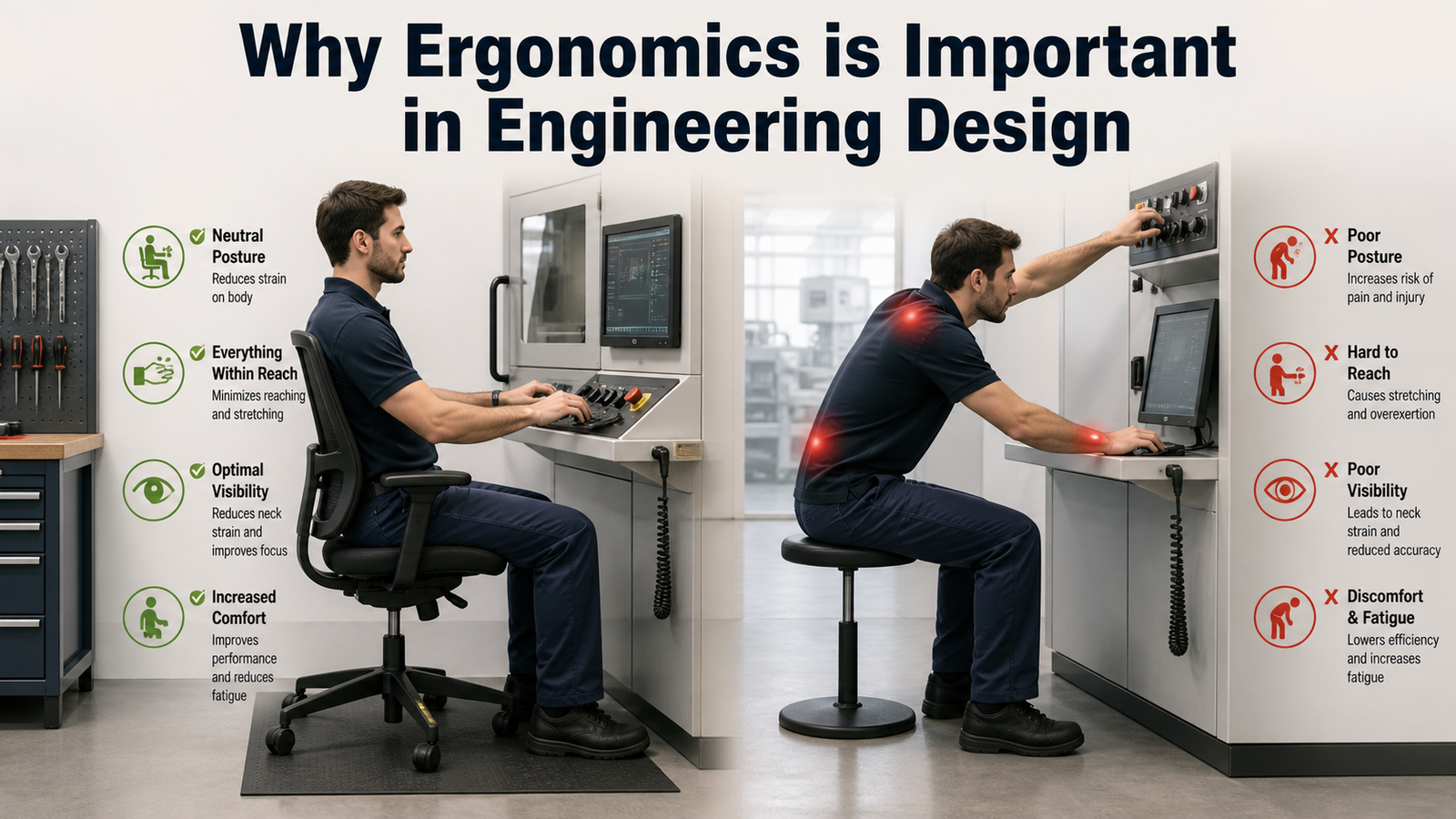
When engineers design products, they often focus on performance, strength, and efficiency.
However, one critical factor is often overlooked how the product interacts with humans. This is where ergonomics in design becomes important.
Ergonomics ensures that products are not only functional but also comfortable, safe, and easy to use.
Ergonomics refers to designing products, systems, or environments based on human needs and capabilities.
Instead of forcing users to adapt to a product, engineers design the product to fit the user.
As a result, the overall user experience improves significantly.
In real-world applications, even a well-designed product can fail if it is uncomfortable or difficult to use.
For example, a machine with excellent performance may still cause fatigue or errors if it is not user-friendly.
Therefore, engineers must consider ergonomics alongside technical design.
This approach is a key part of human-centered design in engineering.
One of the biggest benefits of ergonomic design is improved safety.
When products are designed according to human capabilities, the chances of accidents and injuries are reduced.
For instance, proper handle design, control placement, and posture support can prevent long-term health issues.
Because of this, ergonomics plays a major role in industrial and mechanical design.
Comfort directly affects productivity.
If a product is easy to use and comfortable, users can perform tasks more efficiently and with fewer errors.
On the other hand, poor ergonomic design can lead to fatigue, frustration, and reduced performance.
Therefore, engineers must focus on both function and user experience.
Today, engineers use digital tools to evaluate ergonomic factors during the design stage.
For example, they can simulate human interaction with products and identify potential issues early.
This is similar to how engineers use digital tools in design software workflows to improve overall design quality.
Although ergonomics is important, it must be balanced with other design requirements.
Engineers often need to consider cost, materials, and manufacturing constraints.
As a result, they make trade-offs to achieve the best possible design.
This balance is similar to decisions discussed in risk and reward in engineering projects.
Ergonomics is an essential part of modern engineering design.
It ensures that products are not only efficient but also safe and comfortable for users.
Therefore, engineers who understand ergonomics can create better and more successful designs.
To design products that people actually use and appreciate, you need to understand ergonomics in real-world applications.
At 4Dimensions Infotech, students learn how to combine technical design with user-focused thinking.
You gain practical knowledge that helps you create designs that are both functional and user-friendly.
👉 Start learning ergonomic design and build better engineering solutions.
1. What is ergonomics in design?
It is the process of designing products based on human comfort, safety, and usability.
2. Why is ergonomics important?
It improves safety, reduces fatigue, and enhances user experience.
3. Where is ergonomics used?
It is used in product design, machinery, workplaces, and consumer products.
4. Can ergonomics improve productivity?
Yes, comfortable and user-friendly designs increase efficiency.
5. How do engineers study ergonomics?
By analyzing human behavior and using simulation tools.
6. How can I learn ergonomic design?
By studying real applications and working on practical projects.
© 2025 4Dimensions Infotech. All rights reserved. | Best Design Engineering Training Institute in Pune
Start your journey with the best design engineering training institute in Pune.