
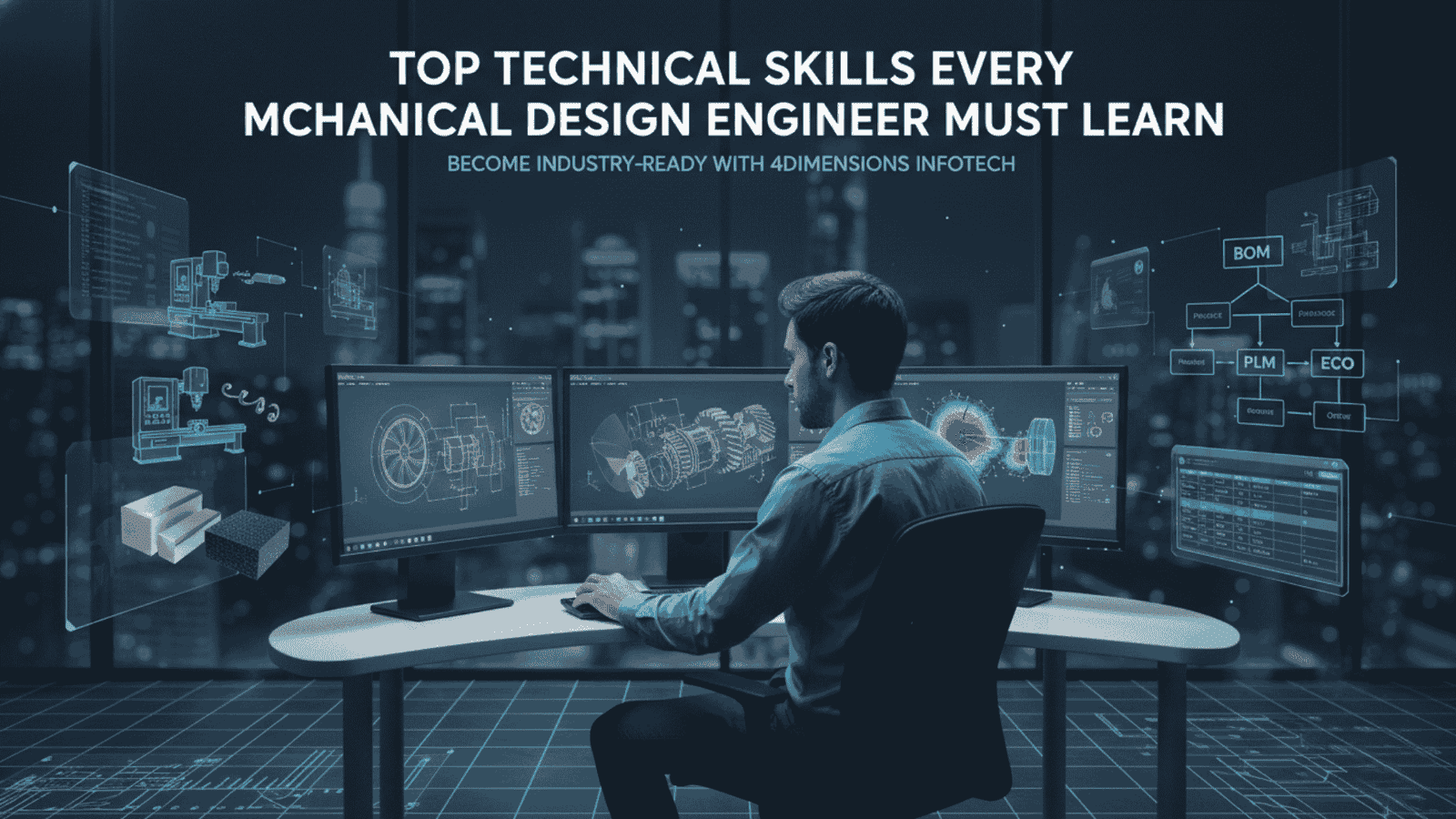
Mechanical design engineering is no longer limited to drawing parts in CAD software. Today’s industries expect design engineers to understand design logic, manufacturing, analysis, quality, and product lifecycle. Companies want engineers who can convert ideas into manufacturable, reliable, and cost-effective products.
To build a strong and long-term career, every mechanical design engineer must develop a set of core technical skills that industry truly values. These skills help engineers get jobs faster, grow quickly, and remain relevant even as technology changes.
At 4Dimensions Infotech, we focus on building these exact industry-required skills. This article explains in simple language the top technical skills every mechanical design engineer must learn, especially if they want to succeed in today’s competitive market.
Before software and tools, fundamentals matter most.
Strength of Materials
Engineering Mechanics
Theory of Machines
Manufacturing Processes
Machine Design Concepts
Material Science
These subjects help engineers understand why a design works or fails. Without fundamentals, CAD modeling becomes guesswork.
👉 A strong design engineer always knows why a feature exists, not just how to model it.
CAD is the backbone of mechanical design.
2D drafting and detailing
3D part modeling
Assembly creation
Surface modeling (basic to advanced)
Parametric design
Drawing creation with proper standards
CATIA
SolidWorks
Siemens NX
Creo
AutoCAD
Learning CAD properly means learning design intent, not just commands.
Many engineers can create drawings, but few can read drawings accurately.
Understanding orthographic views
Reading dimensions and tolerances
GD&T symbol interpretation
Sectional and detail views
Surface finish symbols
Material and manufacturing notes
This skill is critical because drawings are the language of manufacturing.
This is one of the most important and most ignored skills by freshers.
Dimensional tolerances
Geometric tolerances (GD&T)
Clearance, transition, and interference fits
Tolerance stack-up
Functional tolerancing
Good tolerancing ensures:
✔ Proper assembly
✔ Less rejection
✔ Lower cost
✔ Better performance
Companies highly value engineers who know GD&T properly.
A design is useless if it cannot be manufactured easily.
Designing for machining
Designing for casting
Designing for sheet metal
Designing for welding and fabrication
Avoiding unnecessary complexity
Using standard sizes and tools
DFM helps reduce:
✔ Manufacturing cost
✔ Production time
✔ Rework and scrap
At industry level, DFM knowledge separates CAD operators from real design engineers.
Design engineers must know how parts are actually made.
CNC machining (milling, turning, drilling)
Casting and forging
Sheet metal operations
Welding techniques
Injection molding
3D printing (additive manufacturing)
This knowledge helps engineers design realistic and practical components.
Choosing the right material is as important as designing the shape.
Mechanical properties (strength, hardness, ductility)
Thermal behavior
Corrosion resistance
Wear and fatigue resistance
Cost and availability
Manufacturability
Wrong material choice can destroy even the best design.
FEA is used to validate designs before manufacturing.
Stress and strain concepts
Boundary conditions
Meshing basics
Deformation and safety factor interpretation
Static and basic fatigue analysis
Even basic FEA knowledge increases confidence in design decisions.
Modern companies work with PLM systems to manage data.
BOM creation and management
Revision control
Engineering change requests (ECR/ECN)
Document control
Workflow approvals
PLM skills help engineers work smoothly in real industry environments.
Reverse engineering improves design thinking.
Measuring existing components
Creating CAD models from physical parts
Understanding design logic of existing products
Improving or modifying designs
Creating drawings when original data is missing
This skill is widely used in automotive, tooling, maintenance, and R&D industries.
A design engineer must think beyond single parts.
Designing assemblies
Understanding motion and constraints
Checking interference and clearance
Fastener selection
Assembly sequence understanding
Good assembly design reduces errors and improves product reliability.
Mechanical design is evolving with automation.
Automation systems
Robotics basics
Sensors and actuators
Industry 4.0 concepts
Digital manufacturing
This knowledge increases career scope in future-oriented industries.
Designs must fit humans, not just machines.
Human reach and posture considerations
Tool and control placement
Safety and comfort design
Anthropometric data usage
Ergonomic design improves usability, safety, and customer satisfaction.
Technical skills alone are not enough.
Analyze problems logically
Identify root causes
Propose multiple solutions
Optimize design based on cost, performance, and manufacturability
This is what makes an engineer valuable in industry.
Design engineers must communicate clearly.
Writing clear design notes
Creating professional drawings
Explaining designs to manufacturing teams
Participating in design reviews
Clear communication prevents costly mistakes.
At 4Dimensions Infotech, we focus on industry-ready mechanical design training.
✔ CAD training in CATIA, NX, Creo, SolidWorks, AutoCAD
✔ GD&T, tolerance, and fit mastery
✔ Manufacturing and DFM-focused learning
✔ FEA basics and design validation
✔ PLM, BOM, and industry workflows
✔ Reverse engineering and real projects
✔ Placement guarantee / assistance (as per course)
✔ Online and offline learning options
We don’t just teach software — we build complete design engineers.
Mechanical design engineering is a skill-based profession. Engineers who master the right technical skills build strong, stable, and high-growth careers.
If you focus on:
✔ Fundamentals
✔ CAD + GD&T
✔ Manufacturing & DFM
✔ Analysis & validation
✔ Industry workflows
You will always stay in demand.
Start your journey with 4Dimensions Infotech and become a mechanical design engineer that industries truly need.
Learn smart. Design better. Build your future.
© 2025 4Dimensions Infotech. All rights reserved. | Best Design Engineering Training Institute in Pune
Start your journey with the best design engineering training institute in Pune.