
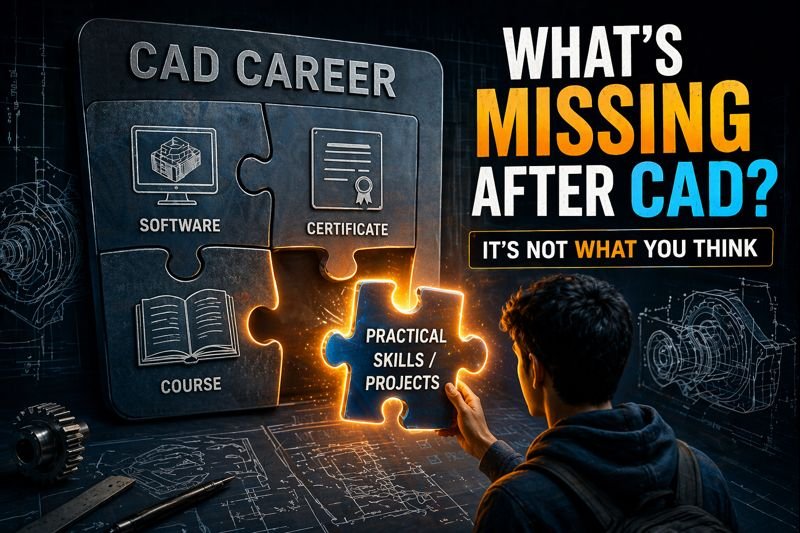
Most students join a CAD course with a simple expectation:
👉 “Learn software → Get a job”
At first, it sounds logical and straightforward. However, somewhere between learning and applying for jobs, things don’t go as planned.
Resumes don’t get shortlisted.
Interviews don’t convert.
Confidence starts dropping.
Eventually, a common question arises:
👉 “Did I choose the wrong course… or is something missing?”
This situation is very common among students not because CAD is a bad choice, but because most learners are not shown the complete picture.
Almost every institute promises the same thing:
However, here’s the reality:
Knowing software is only the starting point.
Companies don’t hire you because you know commands.
Instead, they hire you because you can use those tools to solve real problems.
This gap is where most students struggle.
At first glance, every CAD course looks similar:
Same software.
Same duration.
Same promises.
However, the real difference is not what is taught
👉 It’s how it is taught.
Some courses focus only on completing the syllabus, while others focus on making you industry-ready.
This difference determines whether you struggle after the course or move forward with confidence.
This is something many institutes don’t clearly explain.
👉 Placement is not automatic.
Even if support is provided, your outcome depends on:
For example, a student who actively works on designs during a CAD or SolidWorks course will always have an advantage over someone who only attends classes.
Certificates may look impressive on paper. However, they don’t carry much weight in interviews.
Recruiters want to see:
👉 What you have actually built
If you have:
👉 You instantly stand out.
That’s why practical exposure especially in structured CAD training makes a significant difference.
Many students stop at design. However, industry expectations go beyond that.
A design is valuable only if it can be manufactured.
Therefore, students who explore manufacturing concepts through a CAD CAM course or tools like Mastercam often gain better career opportunities.
Students often ask:
“Is a 2-month course enough?”
“Should I choose a longer program?”
The answer is simple:
👉 Duration matters less than depth.
A shorter course with strong practical training can be far more valuable than a longer course focused only on theory.
Two students can join the same course but their results can be completely different.
One treats it as:
👉 “Just another class”
The other treats it as:
👉 “The start of my career”
As a result, the second student:
Naturally, this leads to better outcomes.
In a city like Pune, opportunities in design and engineering are growing rapidly.
Companies are actively hiring for:
However, they are highly selective.
They don’t just look for course completion. Instead, they look for:
This is why students who combine learning with real-world application perform better in the job market.
Instead of asking:
👉 “Which is the best CAD course?”
Start asking:
Because these are the factors that truly matter.
CAD courses are not the problem expectations are.
If you expect a course to deliver everything automatically, you may feel stuck.
However, if you treat it as a tool to build real skills:
It becomes one of the strongest career paths you can choose.
👉 Focus on practical learning, real projects, and industry understanding to unlock real opportunities.
No, you also need practical experience, projects, and problem-solving skills to stand out.
Yes, projects demonstrate your practical skills and are highly valued by recruiters.
Yes, understanding manufacturing gives you a strong advantage in real-world design roles.
Not as much as practical exposure. A shorter, hands-on course can be more effective than a long theoretical one.
Look for programs that offer real projects, practical training, and industry-relevant learning.
© 2025 4Dimensions Infotech. All rights reserved. | Best Design Engineering Training Institute in Pune
Start your journey with the best design engineering training institute in Pune.