
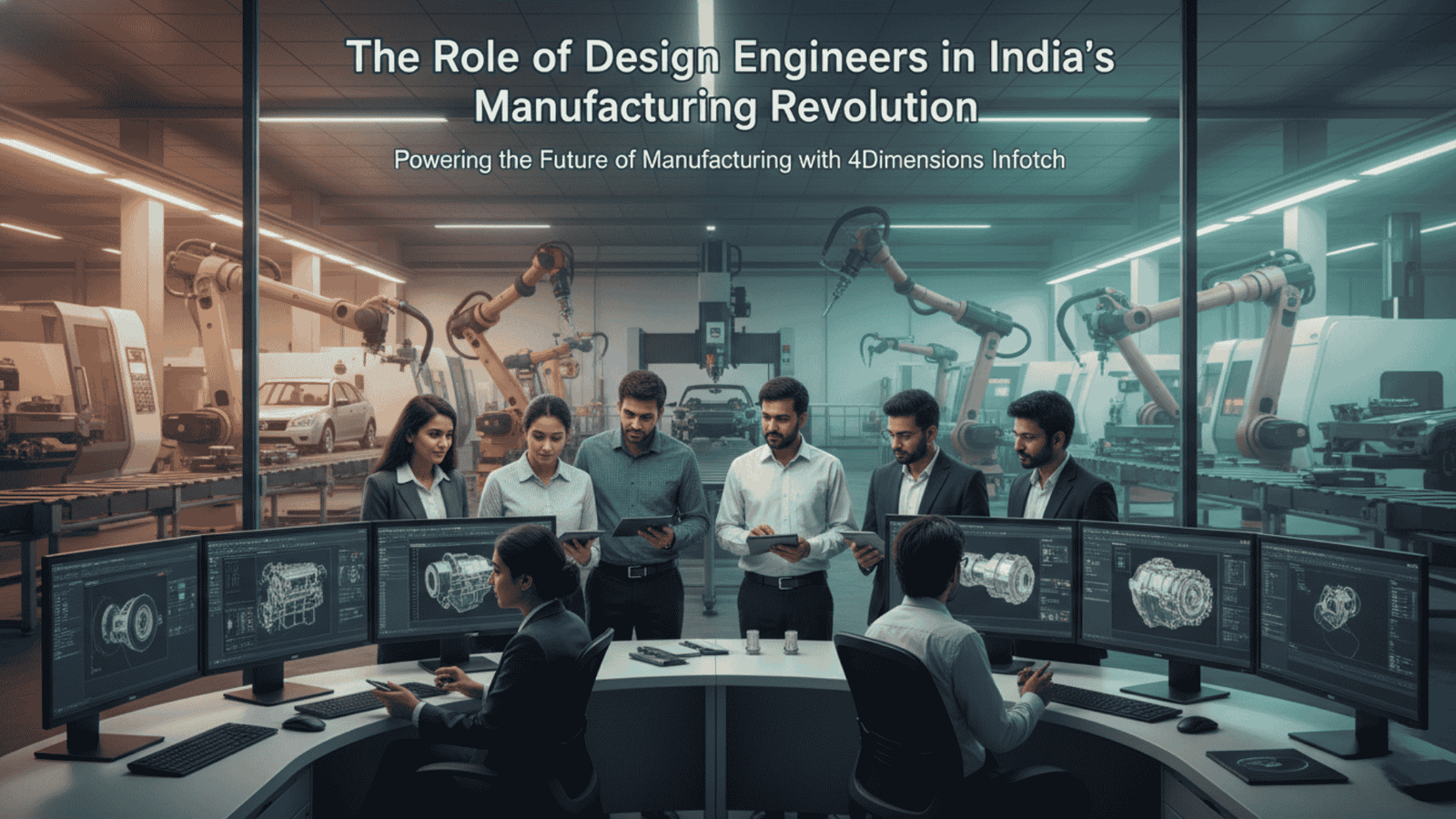
India is witnessing a strong transformation in the manufacturing sector. From automobiles and aerospace to consumer products and industrial machinery, Indian manufacturing is moving toward innovation, automation, and global quality standards. Behind this change, Design Engineers play a major role.
At 4Dimensions Infotech, we believe that design engineers are the real creators of India’s modern manufacturing story. They are the link between ideas and real products. This article explains in detail how design engineers are driving India’s manufacturing revolution, what skills are needed, and how you can build a successful career in this field.
India’s manufacturing revolution is the movement from traditional manual production to modern, technology-driven manufacturing. It is powered by programs like “Make in India”, Digital India, and the Production Linked Incentive (PLI) schemes.
Government initiatives: India is encouraging domestic production through Make in India, promoting industries like automotive, defense, electronics, and renewable energy.
Global investments: Many global companies are setting up plants in India, increasing demand for design and development talent.
Technological advancements: CAD, CAM, CAE, 3D printing, automation, and Industry 4.0 are changing the way products are designed and manufactured.
Skilled engineers: Design engineers are now in high demand for turning concepts into manufacturable products.
In short, manufacturing in India is not just about producing; it’s about designing smarter and building better.
Design engineers are professionals who create and improve mechanical systems, products, and tools. They convert ideas into detailed 3D designs using software tools and engineering knowledge.
Creating 3D models and drawings using CAD software (like SolidWorks, CATIA, AutoCAD, or NX).
Performing simulation and analysis to test strength, performance, and efficiency.
Working with production teams to ensure that designs are manufacturable and cost-effective.
Modifying and improving existing designs for better performance or cost savings.
Collaborating with quality, purchasing, and manufacturing departments.
Design engineers form the foundation of manufacturing innovation—they design what factories produce.
Every product starts as an idea. Design engineers turn that idea into a real working model. They:
Design automotive components, aerospace structures, industrial machines, and consumer goods.
Optimize products for strength, weight, cost, and efficiency.
Use simulation and analysis tools to reduce trial and error in production.
This helps Indian manufacturers design world-class products faster and cheaper.
India’s manufacturing push aims to make products locally. Design engineers play a key role by developing indigenous designs instead of depending on imported blueprints.
They help Indian companies design everything — from electric vehicle components to smart appliances — within the country.
Modern design engineering is powered by digital tools such as:
CAD (Computer-Aided Design) for creating 3D models.
CAE (Computer-Aided Engineering) for analysis and simulation.
CAM (Computer-Aided Manufacturing) for tool paths and machining.
Additive Manufacturing (3D Printing) for rapid prototyping.
By mastering these technologies, design engineers make India’s manufacturing more accurate, faster, and cost-effective.
Good design reduces waste, minimizes errors, and speeds up production.
For example:
A well-designed jig or fixture can reduce production time.
A lightweight component can improve energy efficiency.
An optimized layout can save materials and costs.
Design engineers directly impact manufacturing performance through design for manufacturing (DFM) and design for assembly (DFA) techniques.
India’s industries are moving towards Industry 4.0, which combines automation, robotics, data, and smart manufacturing.
Design engineers create products and systems that are compatible with these technologies. They design robots, automated machinery, and IoT-enabled components that make factories smarter.
To contribute to India’s manufacturing revolution, design engineers need a mix of technical and practical skills.
Proficiency in CAD/CAE/CAM tools such as:
SolidWorks
CATIA V5
Siemens NX
Creo (Pro-E)
AutoCAD
These tools help create accurate designs, analyze performance, and prepare parts for production.
Knowing how parts are made — casting, machining, welding, sheet metal fabrication, etc. — is essential. It helps engineers design components that are practical and cost-effective to produce.
Every design must follow industrial standards (ISO, ASME, DIN).
Knowledge of Geometric Dimensioning & Tolerancing (GD&T) helps ensure that designs can be manufactured with accuracy.
Design engineers must think critically about:
How to improve design performance
How to reduce cost
How to simplify manufacturing
Communication, teamwork, and time management are equally important. Design engineers often coordinate with multiple departments — so clarity and collaboration are key.
India’s industrial growth has opened multiple job roles for design engineers across sectors.
Automotive and EV (Electric Vehicles)
Aerospace and Defense
Industrial Machinery and Equipment
Renewable Energy (Solar and Wind)
Consumer Products and Appliances
Robotics and Automation Systems
CAD Design Engineer
Product Design Engineer
Tool & Die Design Engineer
BIW Design Engineer
SPM (Special Purpose Machine) Design Engineer
Fixture Design Engineer
Simulation & Analysis Engineer
Fresher / Entry-Level: ₹2.5 to ₹4.5 LPA
Mid-Level (3–5 years): ₹5 to ₹9 LPA
Senior Design Engineer (5–10 years): ₹10+ LPA
Top industries and multinational companies pay even higher for skilled CAD/CAE experts.
While opportunities are high, there are challenges too:
Lack of hands-on training in colleges.
Rapidly changing software and industry needs.
Gap between design and manufacturing knowledge.
Competition in global markets.
These challenges can be overcome with the right industry-oriented training, continuous learning, and practical exposure — something that 4Dimensions Infotech provides.
Design engineers are not just employees — they are the builders of the future.
Here’s how they contribute to India’s long-term growth:
Driving Innovation: Developing new product ideas for local and global markets.
Creating Jobs: A single product design can lead to multiple manufacturing jobs.
Boosting Exports: Better design means better-quality products that can compete globally.
Sustainability: Designing for energy efficiency and using eco-friendly materials.
India’s goal of becoming a global manufacturing hub depends on its design engineers — the professionals who transform imagination into innovation.
At 4Dimensions Infotech, we prepare students and professionals to become industry-ready design engineers.
Industry-Oriented CAD/CAM/CAE Training
Learn tools like SolidWorks, CATIA, Creo, NX, and AutoCAD with real-world projects.
Job Placement Support
We offer 100% placement guarantee or assistance (based on the course) to help you start your design career.
Domain-Based Training
Get specialized training in Automotive BIW, Jigs & Fixtures, Material Handling Equipment, and SPM Machine Design.
Practical, Hands-on Learning
Our sessions are designed by experts who have worked in actual design industries.
Flexible Learning Options
Both online and offline courses are available for students and working professionals.
At 4Dimensions Infotech, we don’t just teach software — we build mechanical design engineers who can lead India’s manufacturing future.
If you want to be part of India’s industrial transformation, start your journey with 4Dimensions Infotech — where learning meets opportunity.
Become a design engineer today, and design the future of India’s manufacturing revolution.
© 2025 4Dimensions Infotech. All rights reserved. | Best Design Engineering Training Institute in Pune
Start your journey with the best design engineering training institute in Pune.