
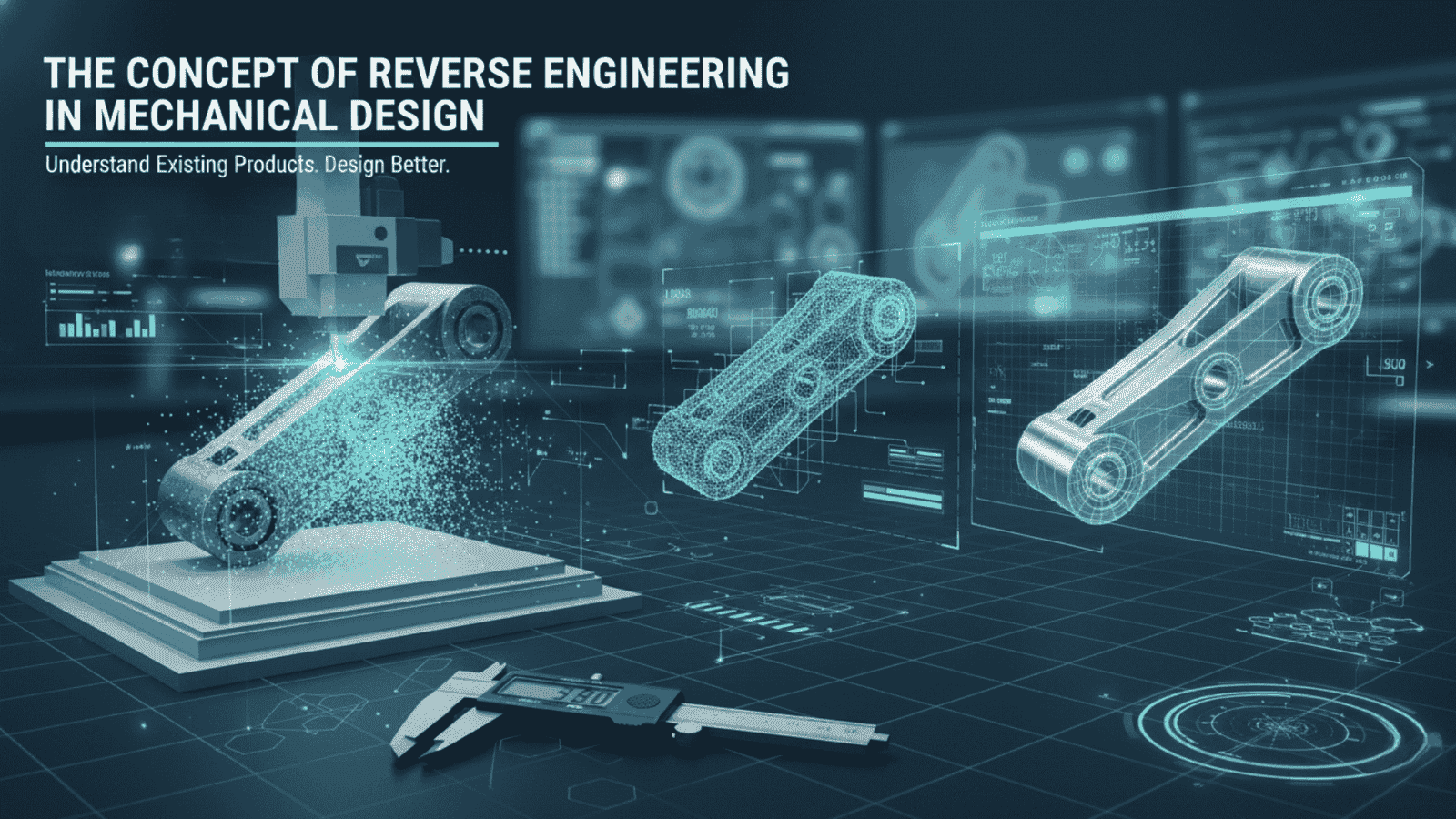
In mechanical engineering, design does not always start from a blank page. Many times, engineers begin with an existing physical product and work backward to understand how it was designed, how it works, and how it can be improved. This process is known as Reverse Engineering.
Reverse engineering plays a very important role in mechanical design, product development, cost reduction, and innovation. It is widely used in automotive, aerospace, manufacturing, tooling, and consumer product industries.
At 4Dimensions Infotech, we teach reverse engineering as a practical and industry-relevant skill that helps engineers think deeper, design smarter, and solve real-world problems. This article explains the concept of reverse engineering in a simple and clear way so that beginners can fully understand its importance and applications.
Reverse engineering is the process of analyzing an existing product or component to understand its design, structure, dimensions, materials, and working principles.
In simple terms:
Reverse Engineering = Taking a finished product and creating its design data again.
Instead of designing from scratch, engineers start with a physical part and convert it into:
CAD models
Engineering drawings
Material specifications
Assembly details
This helps in redesign, improvement, or reproduction of the product.
Reverse engineering is used when:
Original design data is missing
A product needs improvement
A part is discontinued but still required
Cost needs to be reduced
Performance needs to be improved
Compatibility with existing systems is required
It helps engineers learn from existing designs and apply that knowledge to new products.
Engineers analyze existing products to:
Improve performance
Reduce weight
Increase strength
Improve ergonomics
Reduce manufacturing cost
When drawings are not available, reverse engineering helps recreate parts accurately.
Companies study competitor products to understand design approach, materials, and features.
By reverse engineering failed parts, engineers identify design or material issues.
Existing products are modified to meet new requirements or customer needs.
The component is carefully inspected to understand:
Shape
Function
Assembly method
Wear patterns
Dimensions are captured using:
Vernier calipers
Micrometers
Height gauges
CMM (Coordinate Measuring Machine)
3D scanners
Material type is identified through:
Visual inspection
Weight and hardness tests
Chemical analysis (if needed)
Measured data is converted into 3D CAD models using software like CATIA, NX, Creo, SolidWorks, or AutoCAD.
Strength, fit, tolerance, and performance are checked using engineering knowledge and simulation tools.
Final drawings, BOM, and specifications are prepared for manufacturing.
Vernier caliper
Micrometer
Depth gauge
Profile projector
CMM
3D scanners
Laser scanners
Structured light scanners
CAD software (CATIA, NX, Creo, SolidWorks)
FEA tools for validation
Inspection software
These tools help convert physical parts into accurate digital designs.
| Aspect | Forward Engineering | Reverse Engineering |
|---|---|---|
| Starting Point | Idea or concept | Existing product |
| Data Source | Design requirements | Physical part |
| Goal | New product | Understand or recreate product |
| Common Use | Product development | Redesign, replacement, analysis |
Both approaches are important and often used together in industry.
✔ Saves development time
✔ Reduces cost
✔ Improves product understanding
✔ Helps in learning best design practices
✔ Enables product improvement
✔ Useful when original drawings are missing
Reverse engineering helps engineers learn by observation and analysis.
While useful, reverse engineering also has challenges:
❌ Inaccurate measurement
❌ Missing internal details
❌ Material identification errors
❌ Tolerance and fit issues
❌ Legal and intellectual property concerns
These challenges can be solved with proper tools, experience, and ethical practices.
Used for redesign, benchmarking, and component optimization.
Used for maintenance, repair, and replacement of legacy parts.
Used for jigs, fixtures, and machine parts with no drawings.
Used for custom implants and equipment redesign.
Used to improve usability, cost, and aesthetics.
Reverse engineering supports innovation, not copying.
Reverse engineering must always be done legally and ethically.
✔ Used for learning and improvement
✔ Used when ownership or permission exists
✔ Used for obsolete or discontinued products
❌ Not for copying patented designs
❌ Not for violating intellectual property laws
Professional engineers follow ethical guidelines and legal rules.
To become good at reverse engineering, an engineer must know:
✔ Engineering drawing reading
✔ CAD modeling
✔ GD&T and tolerances
✔ Manufacturing processes
✔ Material science
✔ Measurement techniques
✔ Analytical thinking
Reverse engineering sharpens design thinking and problem-solving skills.
Engineers skilled in reverse engineering:
Understand real products deeply
Learn practical design logic
Become better problem solvers
Handle redesign and improvement tasks confidently
Are valuable in maintenance, R&D, and design roles
It builds strong fundamentals and industry confidence.
At 4Dimensions Infotech, reverse engineering is taught as a hands-on practical skill, not just theory.
✔ Measurement techniques and best practices
✔ Converting physical parts into CAD models
✔ Applying GD&T and tolerance correctly
✔ Reverse modeling using CATIA, NX, Creo, SolidWorks
✔ Design validation and improvement
✔ Real industry-style reverse engineering projects
✔ Job-ready design mindset
We focus on making engineers capable of handling real-world design challenges.
Reverse engineering is a powerful tool in mechanical design. It allows engineers to understand existing products, learn from proven designs, solve problems, and innovate effectively. When used correctly and ethically, it strengthens design skills and speeds up product development.
If you want to become a confident mechanical design engineer who understands products inside-out, learning reverse engineering is essential.
Start your professional design journey with 4Dimensions Infotech and gain skills that industry truly values.
Understand. Analyze. Improve. Design Better.
© 2025 4Dimensions Infotech. All rights reserved. | Best Design Engineering Training Institute in Pune
Start your journey with the best design engineering training institute in Pune.