
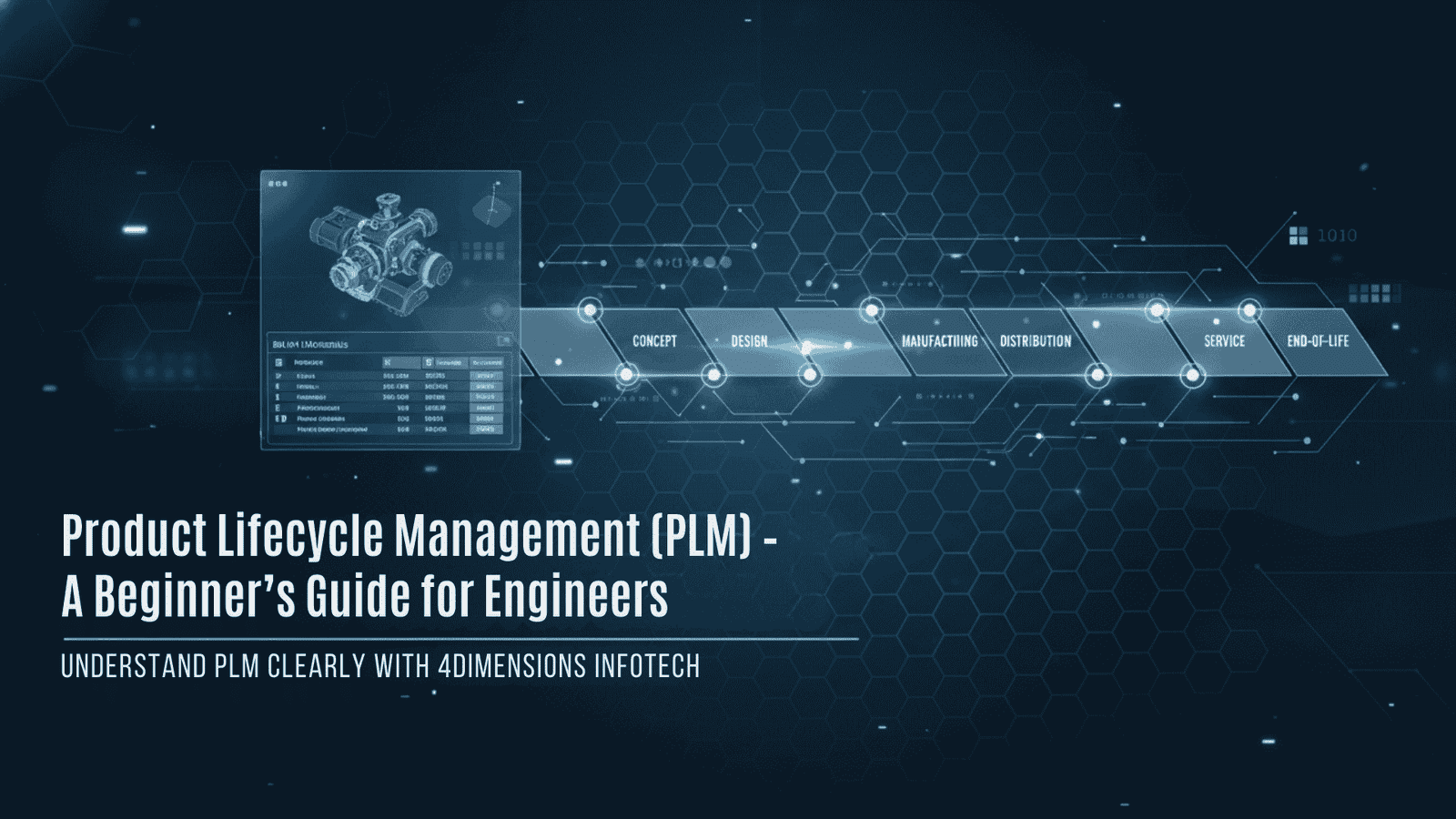
Every product around us — a car, a mobile phone, a gearbox, an aircraft part, or even a simple bolt — goes through a complete journey from idea to manufacturing and finally to disposal or recycling. This journey is known as the Product Lifecycle.
Managing this entire process in a structured, organized, and data-driven way is called Product Lifecycle Management (PLM).
PLM has now become one of the most important systems in engineering industries worldwide. It helps teams collaborate, maintain data, improve quality, reduce cost, and speed up product development.
For beginner engineers, learning PLM is as important as learning CAD and GD&T. This guide will explain PLM in the simplest way, step-by-step, so that even a fresher can understand how modern engineering companies work.
PLM is the central system that manages every stage of a product — from concept to design, manufacturing, service, and end-of-life.
A simpler definition:
PLM = The digital backbone of product development.
It stores everything related to a product:
✔ CAD models
✔ Drawings
✔ BOM (Bill of Materials)
✔ Revisions
✔ Change history
✔ Manufacturing data
✔ Reports, documents, workflows
PLM connects departments like design, production, purchase, quality, testing, and sales — allowing smooth collaboration.
Before PLM, data was handled through paper files, emails, and uncontrolled local storage.
Result = confusion, errors, duplicate models, slow development.
PLM solved all of this.
| Benefit | Result |
|---|---|
| One central data source | No confusion or data loss |
| Faster design changes | Quicker time-to-market |
| Controlled revision tracking | No outdated files |
| Team collaboration | All engineers work in sync |
| Cost reduction | Less rework & mistakes |
| Improved quality | Better product performance |
PLM ensures everyone works on the latest, correct version of the product — reducing mistakes dramatically.
A typical lifecycle includes the following major stages:
Idea generation
Market research
Requirement understanding
Feasibility study
CAD modelling
Material selection
GD&T, tolerances
Simulation & optimization
CAM programming
Production planning
Assembly instructions
Quality checks
Packaging logistics
Supplier management
Customer delivery
Spare part management
Performance monitoring
Warranty support
Material recovery
Redesign for sustainability
Final disposal
PLM tracks and controls everything across all stages.
Beginners often confuse PLM (Product Lifecycle Management) with PDM (Product Data Management).
| Feature | PDM | PLM |
|---|---|---|
| Scope | Only design data management | Complete lifecycle management |
| Who uses it? | Mainly design engineers | Design + Production + QA + Purchase + Service teams |
| Data stored | CAD files, drawings | CAD + BOM + revision + cost + workflows + service records |
| Application | Small to medium projects | Full-scale industrial product development |
PDM is a part of PLM, but PLM is much bigger, broader, and more powerful.
A PLM system usually includes:
Document Management → stores files
CAD Data & Version Control → avoids outdated models
Workflow Management → controls approvals and tasks
BOM Management → maintains part lists
Change Management (ECN/ECR) → controls modifications
Vendor & Supply Chain Management
Quality & Compliance Records
A beginner engineer who understands these will work more efficiently in a real company environment.
BOM stands for Bill of Materials — a list of every component used in assembly.
Example BOM for a motor:
| Item | Part Name | Material |
|---|---|---|
| 1 | Shaft | EN8 Steel |
| 2 | Housing | Aluminium |
| 3 | Bearing | Steel |
| 4 | Key | Mild Steel |
If BOM is wrong → product cost, assembly, and procurement fail.
PLM ensures BOM stays accurate and updated for everyone.
Imagine 5 engineers working on 5 versions of the same part. Chaos.
PLM controls revisions using version numbers (A, B, C, etc.), ensuring only approved models move to manufacturing.
✔ Eliminates confusion
✔ Reduces scrap and rework
✔ Ensures traceability
Revision control is one of the strongest features of PLM.
When a design needs improvement or correction, PLM uses change mechanisms:
ECR – Engineering Change Request
ECN – Engineering Change Notice/Number
This ensures changes are documented, approved, tracked — no unauthorized modifications.
Engineers who understand ECN/ECR are valued in industry.
| Software | Developed By |
|---|---|
| Teamcenter | Siemens |
| Windchill | PTC |
| Enovia | Dassault Systèmes |
| Autodesk Fusion PLM | Autodesk |
| Arena PLM | Arena Solutions |
Most companies working with CAD software also use PLM for control and security.
Knowing CAD is not enough for real-world projects — PLM completes the skill.
✔ Work like industry professionals
✔ Secure job faster with better skills
✔ Build cleaner drawings and BOMs
✔ Handle revisions and approvals smoothly
✔ Communicate with cross-functional teams
✔ Become valuable in design + manufacturing environments
PLM is now mandatory skill for top companies.
At 4Dimensions Infotech, we train engineers not only in CAD modelling, GD&T, drawing, tolerance and domain knowledge — but also in real-workflow skills like PLM and BOM management.
✔ CAD + PDM/PLM fundamentals
✔ Version control, workflow & document management
✔ BOM creation, change request, approval cycle
✔ Integration with CATIA, NX, Creo, SolidWorks
✔ Real-industry oriented project structure
✔ 100% Placement guarantee/assistance (as per course chosen)
We teach the skills industry ACTUALLY demands — not just software buttons.
PLM is more than just a software — it is the backbone of modern engineering organizations. It helps manage complete product data, reduces errors, speeds up workflows, saves cost, improves quality, and connects teams from design to manufacturing.
For engineers, understanding PLM means becoming smarter, faster, and more industry-ready.
If you want to master mechanical design the RIGHT way —
start learning PLM with 4Dimensions Infotech.
Design with clarity. Manage with intelligence. Grow with PLM.
© 2025 4Dimensions Infotech. All rights reserved. | Best Design Engineering Training Institute in Pune
Start your journey with the best design engineering training institute in Pune.