
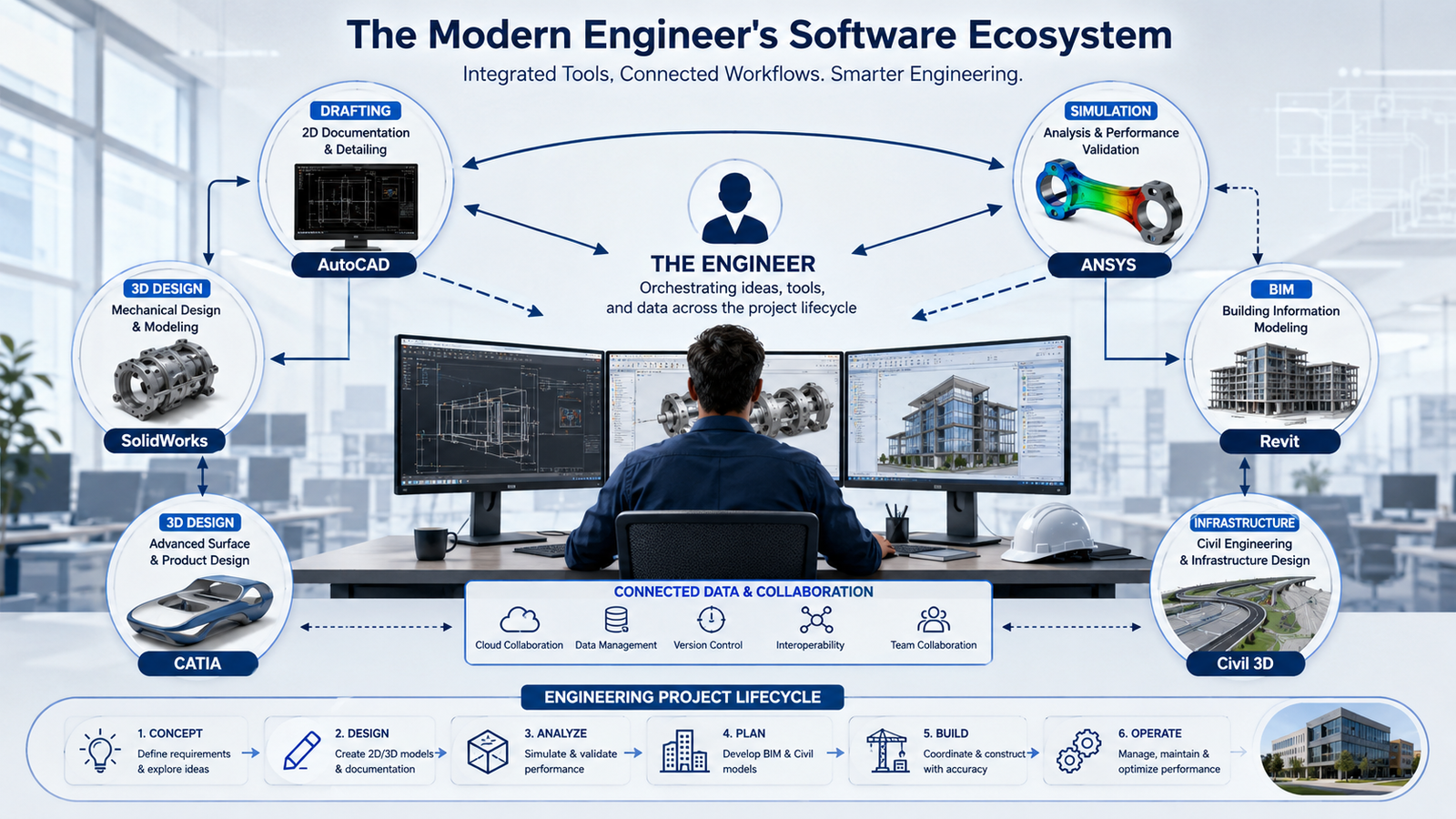
At 4Dimensions Infotech Pune, one of the biggest changes students notice when they start working on industry-level projects is that companies rarely use a single software tool.
Modern engineering projects involve multiple teams, multiple departments, and multiple workflows. Because of this, engineers are expected to work across different software platforms instead of relying on just one application.
Whether you are pursuing a career in mechanical design, product development, civil engineering, BIM coordination, automation, or manufacturing, understanding multiple software tools can significantly improve your career opportunities.
Today, employers are increasingly looking for engineers who can move seamlessly between drafting, 3D modeling, simulation, documentation, and project coordination.
As a result, multi-software skills for engineers have become one of the most valuable assets in the engineering industry.
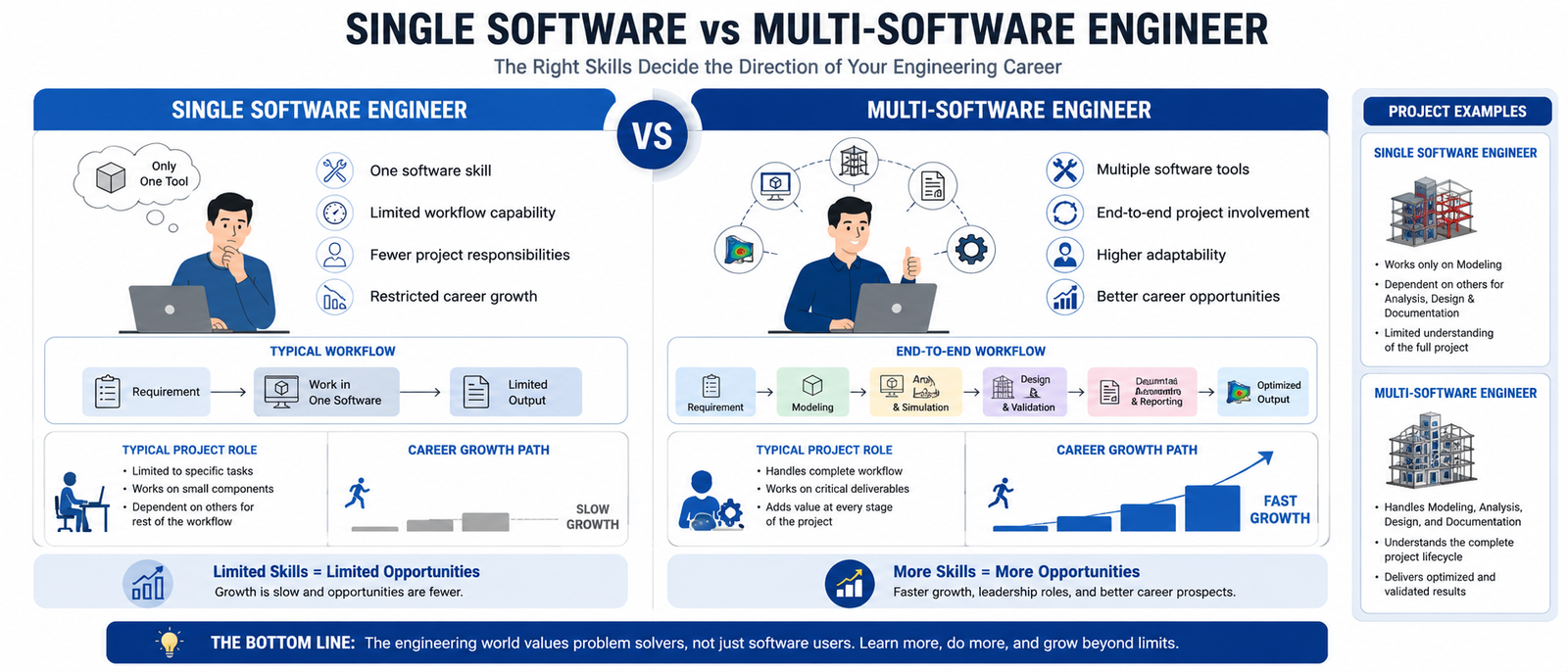
In the past, engineers could build successful careers by becoming experts in a single software platform.
For example, an engineer who knew AutoCAD well could handle most drafting tasks required by companies.
However, engineering workflows have evolved significantly. Modern projects require collaboration between design, simulation, manufacturing, analysis, and project management teams.
Because of this evolution, engineers who understand multiple software platforms often contribute more effectively to project development.
This transformation can be clearly seen in real industry CAD workflows, where multiple tools work together throughout the design process.
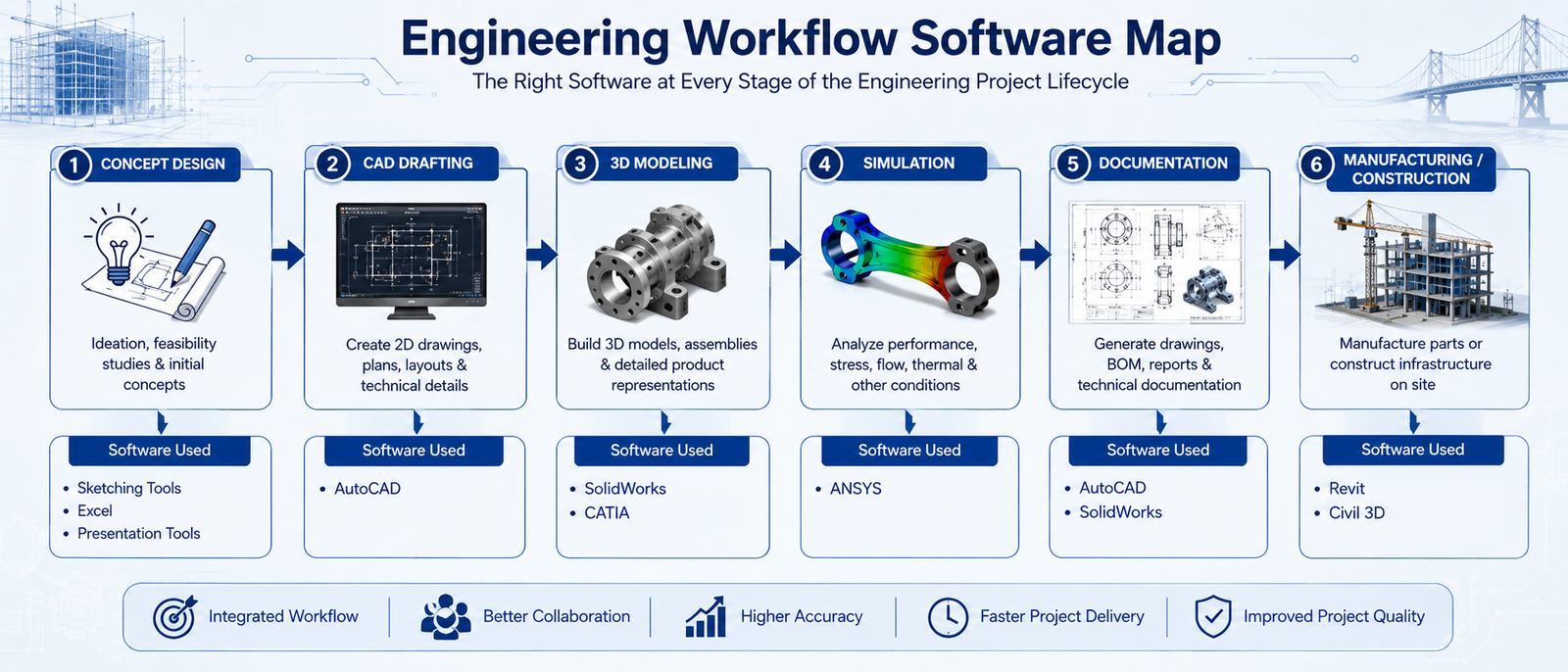
Engineering projects follow a structured workflow from concept development to production and implementation.
Each stage requires specialized software capabilities.
CAD tools help create technical drawings and models. Simulation software validates performance. BIM platforms coordinate construction projects. Manufacturing systems prepare products for production.
This integrated process is similar to the workflow explained in CAD to production engineering processes.
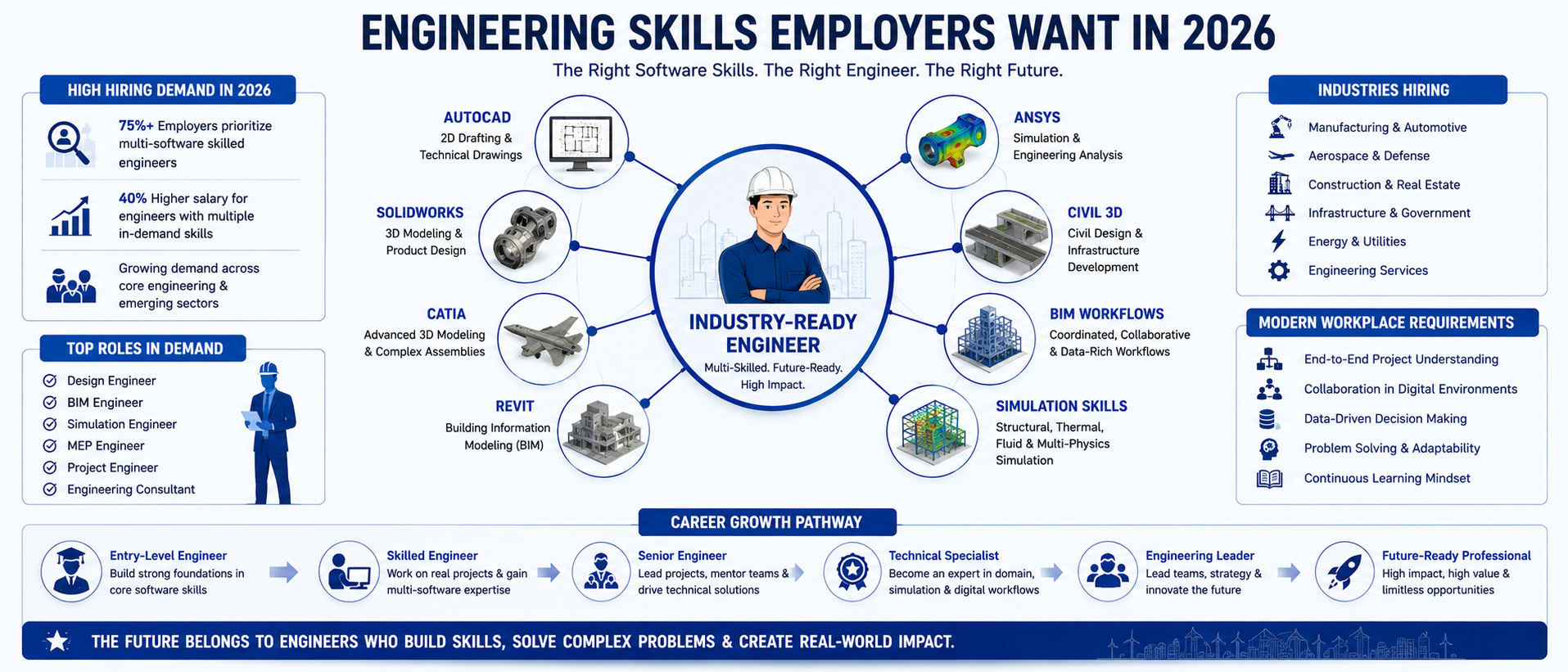
One of the biggest advantages of learning multiple engineering software tools is improved employability.
Companies prefer engineers who can perform a wider variety of tasks and contribute across different project stages.
An engineer who understands drafting, modeling, simulation, and documentation often becomes more valuable than someone with expertise in only one area.
This trend is especially visible in modern engineering job roles, where hybrid technical skills are increasingly in demand.
Learning different software tools exposes engineers to different design philosophies and problem-solving approaches.
As a result, they become better at selecting the right tool for the right task.
This flexibility helps engineers solve complex problems more efficiently and contribute more effectively to multidisciplinary teams.
The future of engineering is increasingly digital and interconnected.
Companies now expect engineers to understand multiple workflows rather than a single isolated tool.
By 2026 and beyond, engineers who combine CAD, simulation, BIM, and project coordination skills will continue to enjoy strong demand across industries.
Most engineering companies use a combination of software platforms instead of depending on a single tool.
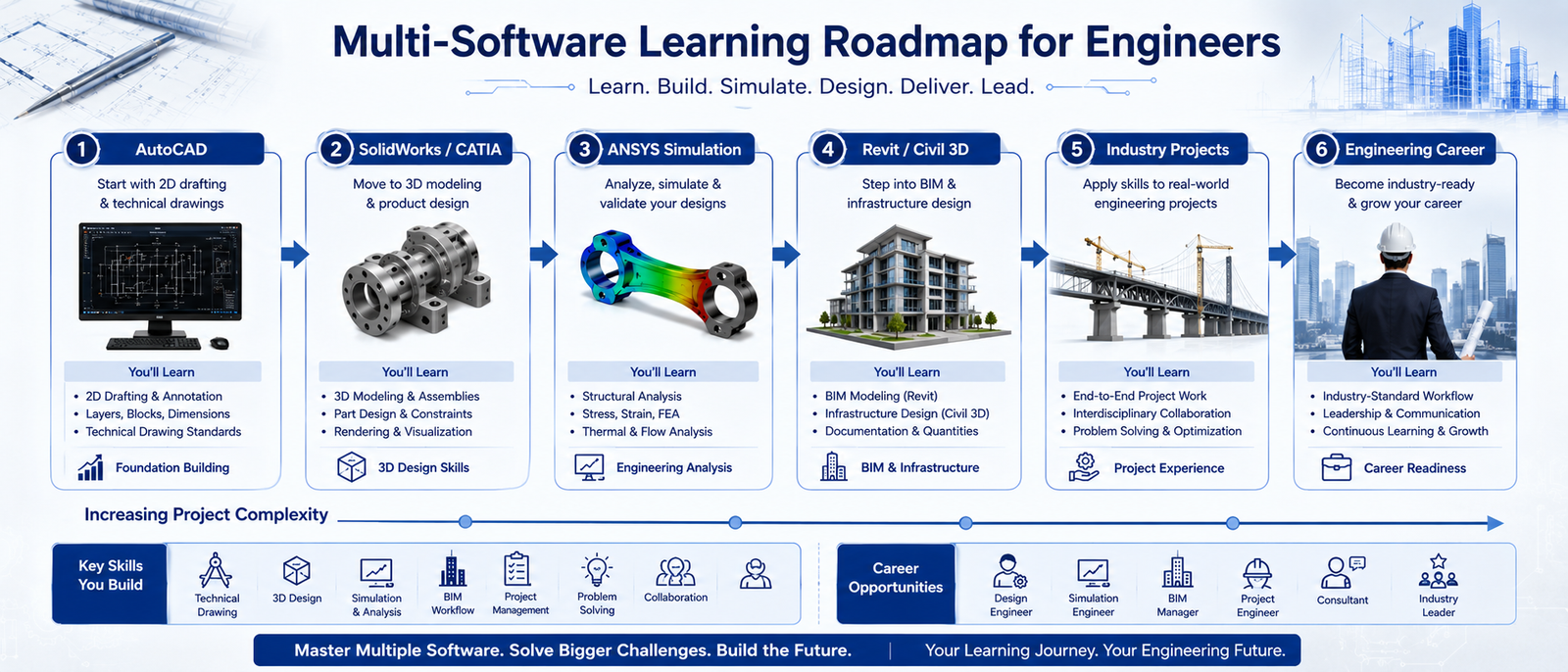
For example, a mechanical design engineer may use AutoCAD for drafting, SolidWorks or CATIA for 3D modeling, and ANSYS for simulation.
Similarly, civil engineering companies often combine AutoCAD, Civil 3D, Revit, and BIM workflows for infrastructure and construction projects.
This combination allows teams to create efficient, accurate, and collaborative engineering workflows.
Students should avoid trying to learn every software tool at the same time.
Instead, they should follow a structured progression.
Start with AutoCAD fundamentals, then move into 3D modeling software such as SolidWorks or CATIA. After that, explore simulation tools, BIM platforms, or specialized software depending on your career goals.
This step-by-step approach helps build confidence while developing practical industry-ready skills.
Multi-software knowledge is no longer optional for engineers who want to remain competitive in today’s industry.
Modern engineering projects depend on integrated workflows involving drafting, 3D modeling, simulation, BIM coordination, and documentation.
Engineers who understand multiple tools are better equipped to handle complex projects, adapt to industry changes, and pursue a wider range of career opportunities.
Developing skills across multiple software platforms is one of the smartest investments engineers can make for long-term career growth.
At 4Dimensions Infotech Pune, students gain hands-on experience with industry-standard software through real-world projects and structured training programs.
You can learn AutoCAD, SolidWorks, CATIA, Revit, Civil 3D, and other essential engineering tools while building practical project experience.
1. Why is multi-software knowledge important?
Because modern engineering projects require multiple tools for different tasks.
2. Do companies expect multi-software skills?
Yes, many companies prefer engineers who can work across multiple software platforms.
3. Which software should I learn first?
Most students begin with AutoCAD before moving into advanced design and analysis software.
4. Is learning multiple software difficult?
No. With structured training and practical projects, it becomes much easier.
5. Does multi-software knowledge improve career growth?
Yes, it improves employability, adaptability, and long-term career opportunities.
© 2025 4Dimensions Infotech. All rights reserved. | Best Design Engineering Training Institute in Pune
Start your journey with the best design engineering training institute in Pune.