
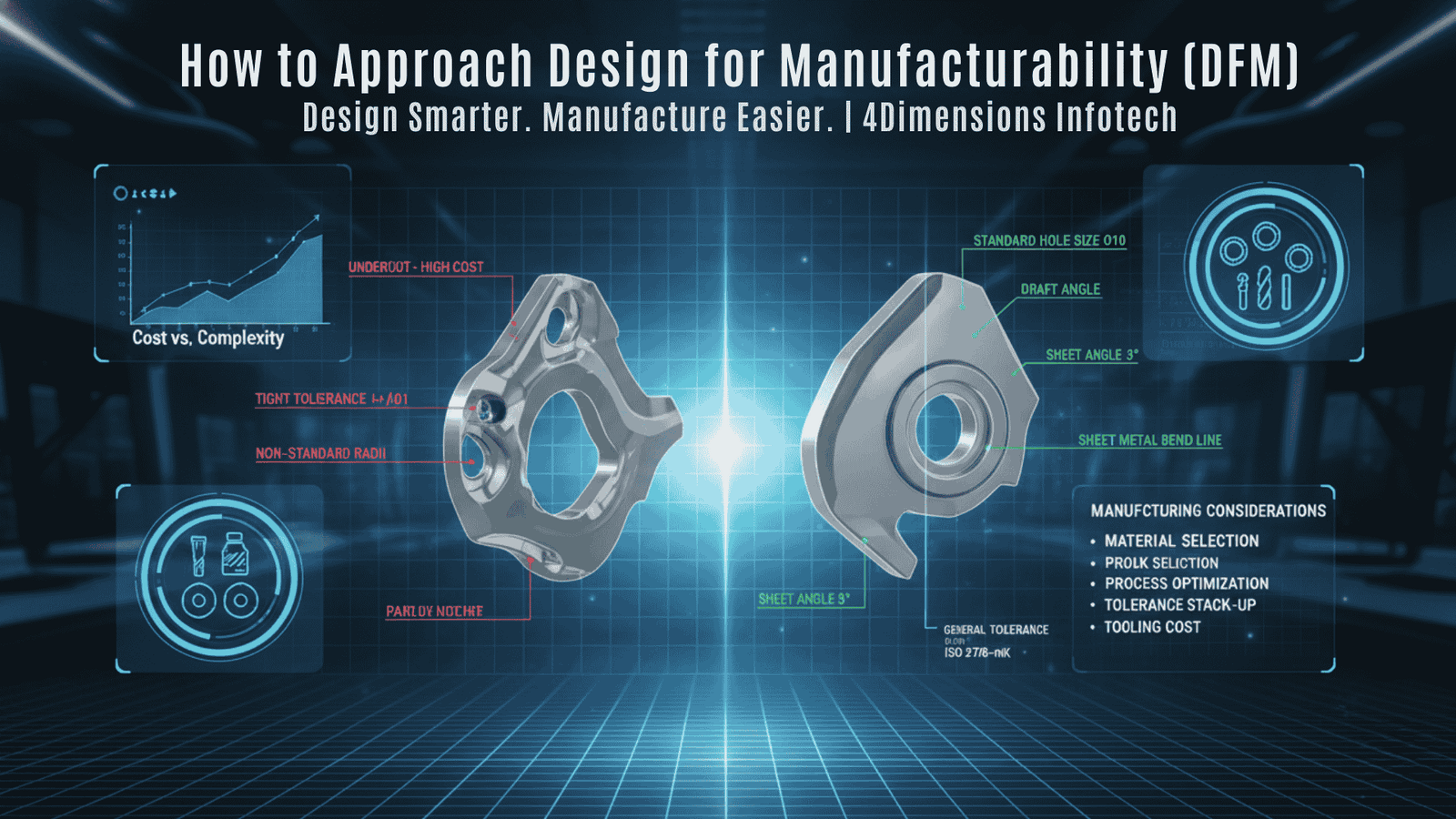
A great design is not just one that looks good in CAD — it is one that can be manufactured easily, reliably, at low cost, and with consistent quality. This is the main purpose of Design for Manufacturability (DFM).
DFM ensures that the product you design can be produced using existing manufacturing processes without unnecessary complexity, wastage, or cost. For any mechanical design engineer, DFM is one of the most essential skills because even a strong design becomes useless if it cannot be manufactured efficiently.
At 4Dimensions Infotech, we train engineers to think beyond 3D modeling — to think like real industry designers who understand how manufacturing works. This guide explains in simple language how to approach DFM step-by-step, what factors matter, and why every engineer must master it.
DFM means designing a product in such a way that manufacturing is simple, cost-effective, and error-free.
A simple definition:
DFM = Designing with manufacturing in mind.
The goal is to reduce:
✔ machining difficulty
✔ production time
✔ rework and scrap
✔ tooling cost
✔ assembly problems
✔ overall manufacturing cost
And to improve:
✔ quality
✔ repeatability
✔ efficiency
✔ safety
✔ reliability
When designers follow DFM, companies save money, time, and effort — and products perform better in real use.
Ignoring DFM leads to parts that cannot be produced using available machines or tools.
A simple design with fewer complex features lowers machining and tooling cost.
Well-designed parts are easier to manufacture consistently.
Simplified designs move faster from CAD to production.
DFM reduces changes and corrections during later stages.
Parts designed for the correct process and material have fewer failures.
DFM is not optional — it is mandatory for industry-ready design.
To design for manufacturability, you must understand how the part will be made.
Will the part be machined, cast, forged, sheet-metal, molded, or 3D printed?
Which tools and machines will be used?
What tolerances can the process naturally achieve?
What is the surface finish limit?
Are there cost limitations?
What is the production volume?
Example:
If the part will be made by casting, thin walls and sharp edges are difficult.
If it will be machined, deep pockets increase cutting time and tool wear.
Knowing the process guides design choices.
Complex shapes = complex manufacturing.
Use simple geometry when possible.
Good design focuses on:
✔ Minimal features
✔ Straight edges
✔ Fewer operations
✔ Easy tooling access
Material affects machinability, strength, corrosion, finishing, and cost.
Example:
SS304 is strong but harder to machine than MS or Aluminium.
Aluminium components reduce weight but may cost more.
Right material = right design + easier manufacturing.
Tight tolerances are expensive because they require precision machining.
Apply strict tolerances ONLY where function requires it.
Example:
A hole for a bolt may not need ±0.02 mm accuracy — simple clearance is enough.
Use standard drill sizes, thread sizes, and tool radii.
Examples:
✔ Hole diameters: Ø6, Ø8, Ø10 (avoid 7.35 mm unless needed)
✔ Threads: M6, M8, M10 (avoid non-standard)
✔ Sheet thickness: 1mm, 2mm, 3mm
Standardization reduces cost and time.
Tools must reach all surfaces easily.
Avoid:
❌ Deep narrow pockets
❌ Sharp internal corners
❌ Undercuts (unless absolutely needed)
❌ Features that need special tooling
Good accessibility = faster machining.
DFM includes DFA (Design for Assembly).
To improve assembly:
✔ Reduce number of fasteners
✔ Use symmetric parts
✔ Ensure parts align easily
✔ Avoid confusing orientation
✔ Provide proper chamfers & guides
Simpler assembly = faster production.
Low-volume parts → machining or 3D printing is best.
High-volume → casting, forging, injection molding.
DFM decisions depend on how many pieces will be produced.
Sharp corners cause stress and are difficult to machine.
Add fillets based on tool radius.
Example:
Internal corner radius of R3 works well with standard milling cutters.
Combining components reduces assembly, cost, and errors.
Example:
Instead of 3 welded parts → design as a single casting.
In casting, molding, sheet metal, and plastic parts — uniform thickness prevents:
❌ Shrinkage
❌ Warping
❌ Cracking
❌ Cooling issues
Ideal wall thickness = consistent + manufacturable.
✔ Avoid deep pockets
✔ Use standard hole sizes
✔ Avoid sharp corners
✔ Provide fillets
✔ Ensure clamping feasibility
✔ Maintain bend radii
✔ Ensure flat patterns are producible
✔ Provide relief cuts
✔ Avoid overly small features
✔ Follow K-factor and bend allowance
✔ Uniform wall thickness
✔ Provide draft angles
✔ Avoid sharp corners
✔ Consider shrinkage
✔ Design for easy mold flow
✔ Constant thickness
✔ Ribs for strength
✔ Draft angles
✔ Avoid thick solid blocks
✔ Consider gate location
✔ Provide good joint access
✔ Avoid unnecessary welds
✔ Ensure alignment features
✔ Minimize stress concentration
DFM must include correct tolerancing.
❌ High manufacturing cost
❌ Difficult inspection
❌ Increased rejection
❌ Poor fit
❌ Functional failure
Right GD&T = balanced function + manufacturability.
Key areas where DFM saves money:
✔ Less machining time
✔ Less tool wear
✔ Less scrap
✔ Fewer mistakes
✔ Standard parts
✔ Simplified assembly
✔ Optimized materials
Successful companies follow DFM strictly because it directly improves profit.
❌ Using tight tolerances everywhere
❌ Designing features that tools cannot reach
❌ Ignoring material machinability
❌ Complex shapes without functional need
❌ Over-engineering the product
❌ Designing only for appearance
❌ No communication with manufacturing team
Great designers combine engineering + manufacturing + usability.
At 4Dimensions Infotech, DFM is integrated into all CAD and design courses.
✔ Real-world DFM rules for machining, casting, sheet metal, plastics
✔ Selecting correct tolerances & GD&T
✔ Reducing cost through smarter design
✔ How manufacturers think & work
✔ Practical exercises with industry projects
✔ How to communicate with production teams
✔ Hands-on training in SolidWorks, CATIA, NX, Creo, AutoCAD
We make sure you don’t just model parts, you design manufacturable parts.
Design for Manufacturability (DFM) is one of the most important skills for a mechanical design engineer. It bridges the gap between CAD and the real world.
A design that is easy to manufacture is:
✔ cheaper
✔ faster
✔ safer
✔ more reliable
✔ more profitable
Mastering DFM makes you a valuable engineer in any industry.
Learn DFM the right way with 4Dimensions Infotech and become an engineer who designs smart, manufacturable, industry-ready products.
© 2025 4Dimensions Infotech. All rights reserved. | Best Design Engineering Training Institute in Pune
Start your journey with the best design engineering training institute in Pune.