
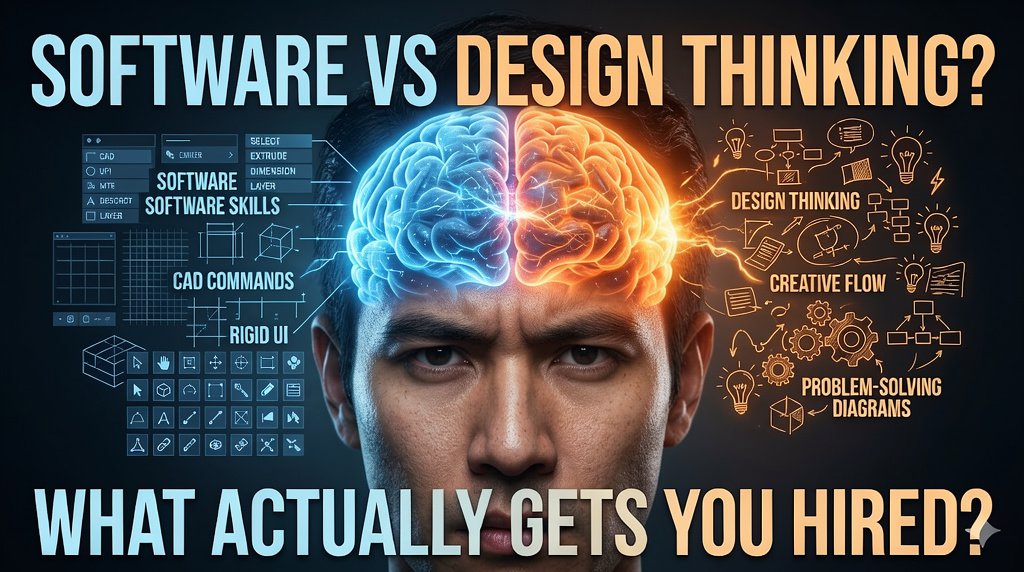
If you are planning a career in design, engineering, or product development, you have likely faced an important question: should you focus on learning software or understanding design?
Many students believe that mastering tools is enough. On the other hand, some think concepts matter more. However, the reality is more balanced, and understanding this difference can completely shape your career direction.
If you are exploring engineering design training in Pune or searching for the right career path, this guide will help you make a clear decision.
Software skills refer to your ability to use design tools such as AutoCAD, SolidWorks, Creo, CATIA, and Revit. These tools help you create, modify, and present designs efficiently in real-world projects.
For this reason, many students enroll in mechanical design courses or BIM training programs to build strong technical skills.
Design thinking focuses on how you approach problems and create solutions. It involves understanding requirements, planning designs, improving usability, and solving real-world challenges effectively.
In contrast to software skills, design thinking is not about tools. Instead, it is about how you think and make decisions.
As a result, engineers with strong design thinking can break down complex problems, make better design choices, and adapt to different tools easily.
Software skills help you execute designs, while design thinking helps you decide what to execute.
Without proper thinking, software usage becomes mechanical. Similarly, without software knowledge, design ideas remain theoretical.
There is a simple reason for this. Software provides quick and visible results.
Students can learn commands quickly, create models, and feel productive. However, this often creates a false sense of confidence.
As a result, many students who complete a 3D modeling course still struggle during interviews because they lack problem-solving ability.
Design thinking takes time to develop. It requires consistent practice, observation, and real-world exposure.
Unlike software skills, it does not provide instant visible results. Therefore, many students overlook its importance.
This is where things become clear. Recruiters do not look for candidates who only know software. Instead, they look for professionals who can understand requirements, solve design challenges, and suggest improvements.
In short, companies prefer thinkers, not just operators. This is especially true in industries such as product design, manufacturing, and construction.
Consider two candidates. The first candidate knows all commands and can follow tutorials, but lacks project understanding.
The second candidate understands design logic, has worked on real problems, and knows how to approach new challenges.
In most cases, companies choose the second candidate because of their practical thinking ability.
The best strategy is not choosing one over the other. Instead, you should combine both software skills and design thinking.
Start with a structured training program to understand software basics and build confidence.
Do not just create models. Instead, understand why the design exists, how it functions, and where it is used.
Real projects help you develop design thinking naturally. They improve your problem-solving ability and prepare you for real industry challenges.
If you focus only on software, you may struggle in interviews and depend heavily on instructions. As a result, your growth may slow down.
On the other hand, if you focus only on theory, you may not become job-ready because you lack execution skills.
However, when you combine both, you become more valuable, adapt faster, and grow more quickly in your career.
Many students believe that completing a course is enough to become job-ready. However, real readiness comes from understanding, practice, and application.
This is what separates average learners from industry-ready professionals.
A good training program does more than teach software. It helps you develop thinking skills through real-world exposure.
You should always look for programs that include practical assignments, design-based learning, industry exposure, and expert mentorship.
Software skills and design thinking are not competitors. Instead, they work together to build a strong career.
Software helps you get started, while design thinking helps you grow in the long run.
Upgrade your career with practical, job-oriented courses in Pune and become truly industry-ready.
Both are important. However, design thinking supports long-term growth, while software skills help you perform tasks efficiently.
You may get entry-level roles, but long-term growth depends on your problem-solving ability and design understanding.
You can improve by working on real projects, analyzing designs, and understanding how systems function in real life.
Yes, many companies ask scenario-based and problem-solving questions to evaluate your thinking ability.
You can join institutes that provide practical, project-based training along with real-world exposure and mentorship.
© 2025 4Dimensions Infotech. All rights reserved. | Best Design Engineering Training Institute in Pune
Start your journey with the best design engineering training institute in Pune.