
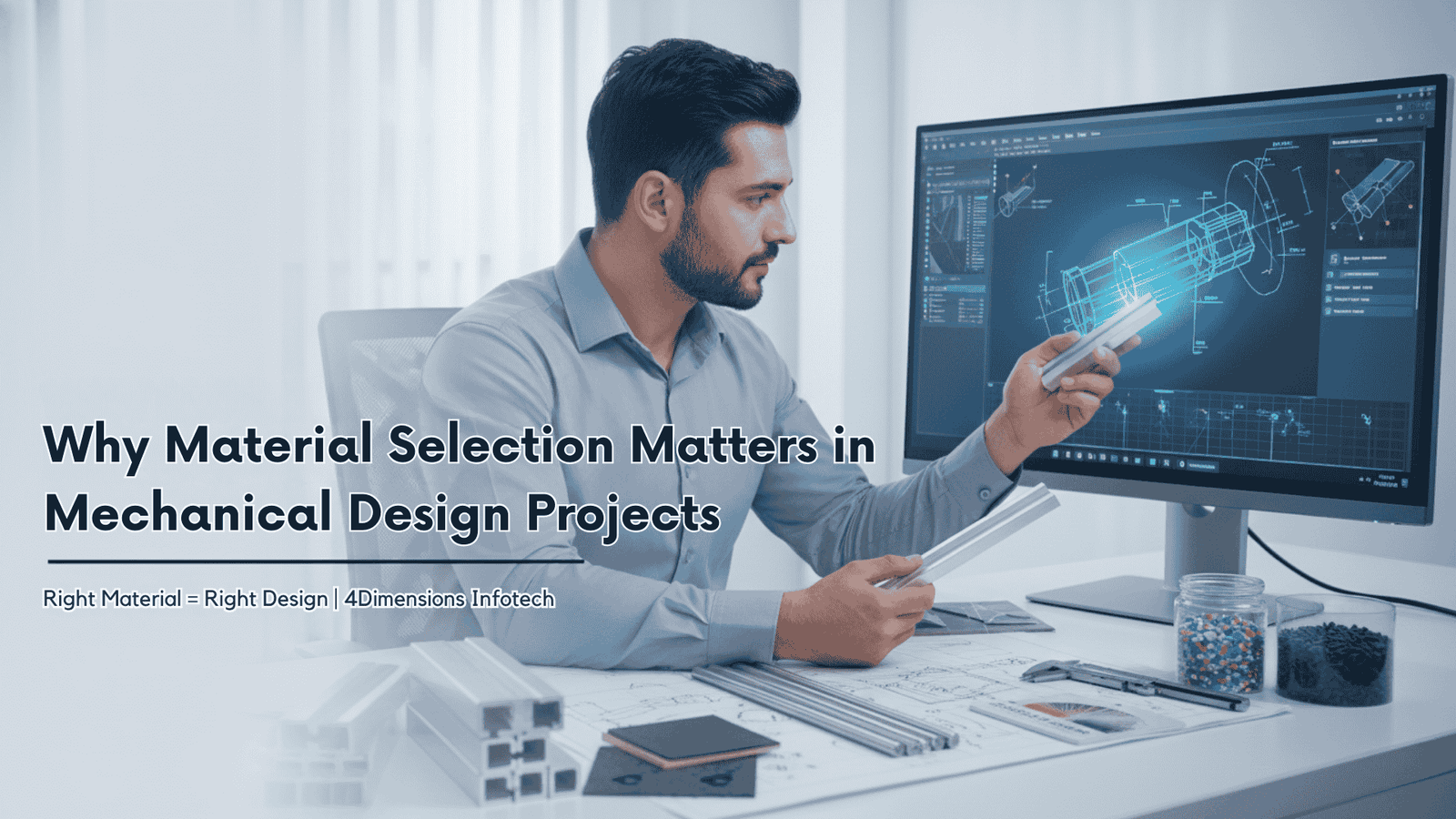
In mechanical design, the shape, dimensions, tolerance, and CAD model are important — but none of it matters if the material selection is wrong. A product may look perfect on software, but real-world performance depends largely on which material is used, how it behaves, and whether it suits the application.
Even the strongest design fails when the material is incapable of handling load, heat, wear, or environment. Therefore, material selection is one of the most critical decisions in mechanical engineering and should never be guessed — it must be evaluated scientifically.
This article explains in simple detail why material choice matters, what factors designers must consider, and how correct selection improves performance, cost, and lifespan of products.
Every mechanical component experiences force, friction, temperature, corrosion, vibration, and fatigue during operation. The right material ensures that the component:
✔ Performs its intended function
✔ Handles load and stress safely
✔ Resists wear and deformation
✔ Survives long-term working conditions
Example:
A shaft made of plastic will break under heavy torque.
A spring made of mild steel will lose elasticity quickly.
Correct material = correct performance.
The first requirement of any mechanical part is strength.
Different components require different strength levels:
| Component | Strength Requirement |
|---|---|
| Shafts, gears, crankshafts | High tensile strength |
| Frames, brackets, housings | Medium to high strength |
| Covers, casings | Moderate strength |
| Bushes, sliders | Wear resistance critical |
Using low-strength material for high-load parts leads to bending, cracking, or catastrophic failure.
Sometimes lightweight is more important than maximum strength — especially in automotive, aerospace and robotics.
Aluminium → lightweight, corrosion-resistant, moderate strength
Titanium → strong + lightweight, but costly
Steel → Strong but heavy
Composite materials → Lightweight, high stiffness
Material must align with project goals:
Strength where required, lightness where needed.
Many components operate at high temperatures — engines, turbines, brakes, power plants.
Wrong material + high temperature =
❗ Loss of hardness
❗ Creep failure
❗ Softening or expansion
❗ Fracture due to thermal shock
Heat-resistant materials like Inconel, Stainless Steel, Titanium are used where ordinary steel will fail.
If the environment contains moisture, salt, chemicals, or heat, corrosion becomes a major threat.
Examples:
✔ Marine equipment → Stainless Steel, Brass
✔ Chemical processing → Nickel alloys
✔ Outdoor structures → Coated or galvanized metals
✔ Food & medical → SS304 / SS316 for hygiene
Good material selection increases product life and reliability.
Movable and rotational components face friction and fatigue cycles.
Materials for such parts must have:
High hardness
Wear resistance
Good fatigue strength
Self-lubricating or coating compatibility
Example: Bearings often use Bronze, Hardened Steel or Polymer composites because they resist abrasion and fatigue.
Failure here = breakdown of complete mechanism.
A design is useless if it cannot be manufactured.
Material selection depends on fabrication method:
| Process | Suitable Material |
|---|---|
| CNC machining | Steel, Aluminium, Brass |
| Casting | Cast Iron, Aluminium, Bronze |
| Forging | High-strength steels |
| Sheet metal | Mild steel, SS, Aluminium |
| Injection molding | Plastics (ABS, Nylon, POM) |
Some materials are easy to machine, others difficult and expensive.
Right material = easy manufacturing + low cost.
Material must balance performance vs cost.
Example:
Titanium parts are excellent but too costly for mass production.
Mild steel is cheap but unsuitable for weight-sensitive applications.
For high-volume products → cost-effective materials preferred.
For specialized components → high-performance materials justified.
A good designer optimizes cost without compromising function.
Industries like aerospace, defense, medical and automotive have strict safety standards. Material must meet:
✔ International codes
✔ Safety certification
✔ Chemical composition standards
✔ Strength & fatigue requirements
A single failure in these industries can be fatal — material selection must be scientific and verified.
New materials unlock new design possibilities:
Carbon fiber = Ultra-light + ultra-strong → Racing, aerospace
Composites = Customizable strength → EV components
Shape Memory Alloys = Smart adaptive behavior
High-temperature alloys = Turbines & rockets
Technology advances → new materials rise → new designs born.
A designer with strong material knowledge becomes a high-value innovator.
| Reason | Benefit |
|---|---|
| Strength & durability | Failure resistance |
| Weight optimization | Improved efficiency |
| Heat and corrosion resistance | Longer life span |
| Manufacturability | Faster, cost-efficient production |
| Cost balance | Affordable design |
| Safety & reliability | Zero-risk operation |
| Innovation | New products & technology |
Material is the heart of mechanical design.
At 4Dimensions Infotech, we ensure students understand why materials matter — not just how to model parts.
✔ Material properties and selection strategies
✔ Heat treatment and hardness effects
✔ Manufacturing process compatibility
✔ Fitness-for-application evaluation
✔ CAD + GD&T + tolerance + fit combination
✔ Real industrial project applications
✔ Job-ready design mindset, not software-only learning
🚀 100% placement assistance / guarantee (as per course)
🧠 Practical hands-on learning
👨🏫 Mentorship from real industry experts
🎓 Online + offline batch flexibility
We don’t create just designers.
We create mechanical engineering thinkers.
Material selection is one of the most critical decisions in mechanical design.
It affects performance, cost, weight, safety, durability, and manufacturability. A skilled design engineer not only models parts — they choose the right material for the right function.
Master this skill and your designs will work flawlessly in real life.
If you want to learn design like industry professionals —
start with 4Dimensions Infotech today.
Better material knowledge = better design = better career.
© 2025 4Dimensions Infotech. All rights reserved. | Best Design Engineering Training Institute in Pune
Start your journey with the best design engineering training institute in Pune.