
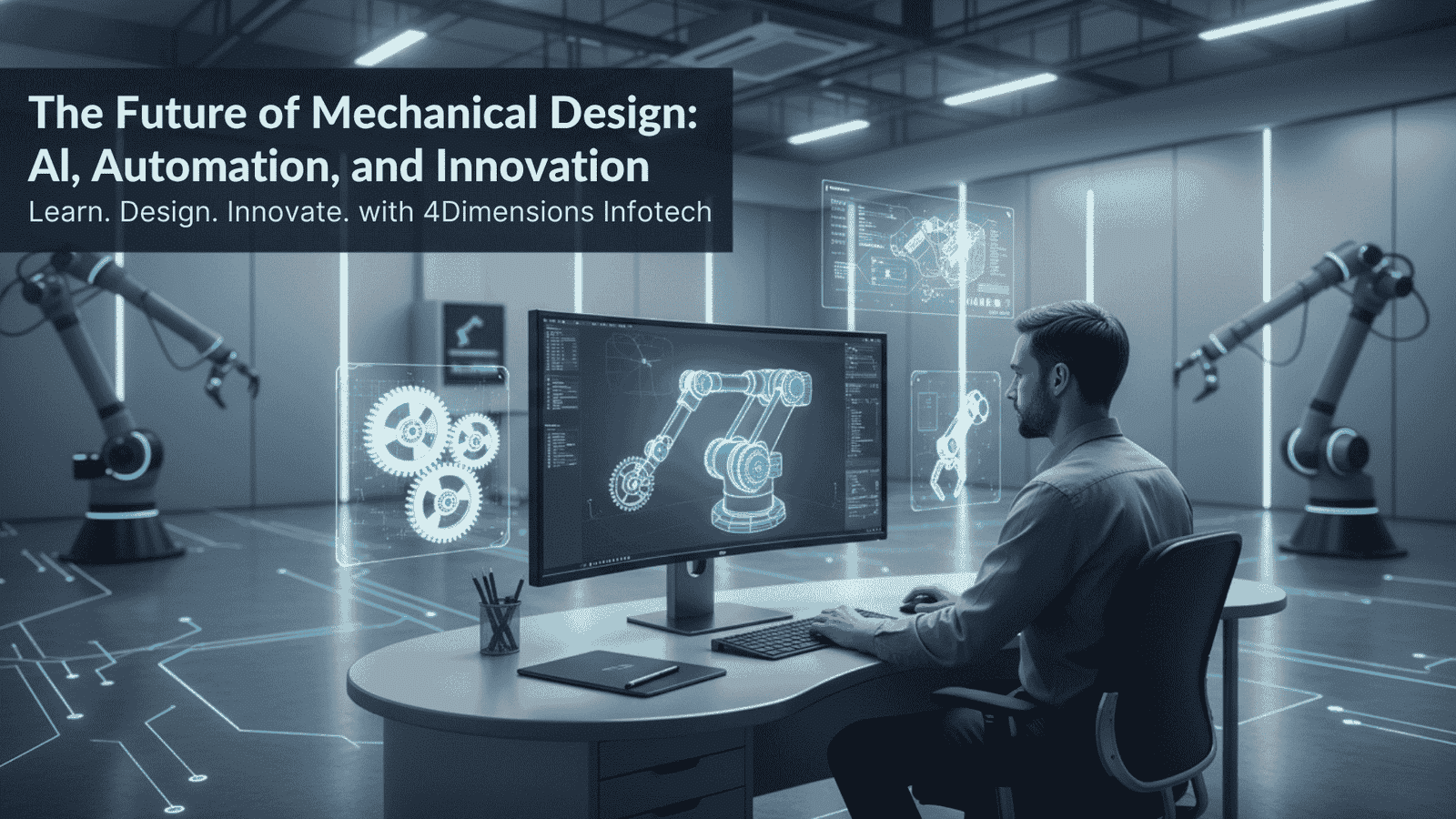
Mechanical design has always been the foundation of engineering innovation. From industrial machines to aerospace systems, every product begins with a design. But in recent years, the field of mechanical design is going through a massive transformation — powered by Artificial Intelligence (AI), automation, and advanced digital technologies.
At 4Dimensions Infotech, we prepare engineers to not only adapt to these changes but also lead them. This article explains in simple and clear language how AI and automation are changing mechanical design, what skills future engineers need, and how innovation is shaping the next generation of design professionals.
Mechanical design has come a long way from manual drafting to computer-aided design (CAD).
In the past, engineers designed on paper using rulers, protractors, and compasses. The process was slow, and even a small design change meant redrawing everything.
The introduction of CAD software such as AutoCAD, CATIA, and SolidWorks changed the industry forever. Engineers could now create accurate 3D models, simulate their designs, and make quick changes before production.
Now, we are entering a new era — where AI, automation, cloud computing, and IoT (Internet of Things) are reshaping the future of design. The focus is shifting from just designing to designing smart, connected, and efficient systems.
Artificial Intelligence is no longer a concept of the future — it is already changing how engineers work.
AI-based generative design allows software to automatically create hundreds of design variations based on given inputs like weight, materials, and strength.
Engineers simply set goals, and AI explores all possible solutions faster than a human could.
This helps create lightweight, efficient, and cost-effective designs in industries such as aerospace, automotive, and robotics.
AI can predict how a design will perform under different conditions without running physical prototypes. For example, AI-driven FEA (Finite Element Analysis) and CFD (Computational Fluid Dynamics) tools speed up simulation accuracy.
This saves time, reduces errors, and improves design reliability.
AI algorithms can automate routine tasks like part numbering, design standardization, and component reuse. Engineers can focus on creativity and problem-solving instead of repetitive modeling work.
AI connects design to manufacturing by analyzing production data. It helps detect defects, optimize machining paths, and ensure design for manufacturability (DFM).
In short, AI is becoming the co-designer of the future mechanical engineer.
Automation is transforming how products are designed and produced.
Modern CAD software includes automation features such as parametric design, design libraries, and macros. Engineers can automate entire processes like creating similar parts or updating assemblies.
Through Computer-Aided Manufacturing (CAM), designs are directly linked to CNC machines. Automated tool paths, simulation, and verification reduce production time and human errors.
Automation isn’t limited to manufacturing — robotic systems are now used for prototyping, 3D printing, and product testing. Robots can assemble, weld, and even inspect designs in real-time.
A digital twin is a virtual copy of a physical product. It allows engineers to test, analyze, and monitor designs before they are built. Automation tools connect digital twins with real data to improve performance continuously.
Automation makes mechanical design faster, smarter, and more reliable, opening opportunities for innovation.
Innovation in mechanical design is not just about new tools — it’s about a new way of thinking.
Modern engineers are focusing on eco-friendly materials, energy efficiency, and recyclable components.
Designing with sustainability in mind is now a global priority, as industries aim to reduce carbon emissions.
3D printing has revolutionized the design-to-manufacture process. It allows engineers to create complex geometries that were impossible with traditional methods.
Designers can now move from CAD models to physical prototypes in hours.
IoT connects mechanical systems with sensors and smart devices. Design engineers now create products that can monitor their own performance, collect data, and communicate with other systems.
AR and VR allow engineers to visualize and test designs in a virtual space. They can identify design flaws, improve ergonomics, and enhance collaboration across teams in different locations.
Innovation ensures that mechanical design stays creative, data-driven, and globally competitive.
To stay relevant, engineers must adapt to changing technologies. Here are the key skills that future mechanical designers must master:
Software like CATIA, SolidWorks, Siemens NX, Creo, and AutoCAD remain core to design. Engineers must go beyond 2D drawing and learn simulation, motion analysis, and product optimization.
Understanding how AI analyzes data and suggests improvements helps engineers make better design decisions.
Learning simple coding or scripting (e.g., Python, VBA, or macros) can help automate repetitive design tasks, improving productivity.
Knowing how to design for additive manufacturing (DfAM) will be crucial as 3D printing becomes mainstream.
Mechanical design engineers should focus on solving real-world problems — making designs more sustainable, user-friendly, and technologically advanced.
Technology never stops evolving. Future engineers must keep upgrading through courses, workshops, and certifications.
Mechanical design engineers will play a central role in shaping the future of industries.
Industries worldwide are looking for engineers who can design smart, automated systems. The demand for skilled design engineers in automotive, aerospace, robotics, and energy sectors is growing rapidly.
Companies are building fully digital ecosystems where design, simulation, and production happen seamlessly. Engineers who understand both design and manufacturing integration will lead the way.
Cloud-based CAD and AI-powered collaboration platforms allow engineers to work from anywhere. The future design office is virtual and connected.
The future is not “AI replacing engineers” — it’s AI assisting engineers.
Human creativity combined with AI’s computing power will define the next generation of design.
While the future looks bright, it also brings challenges:
Keeping up with fast technological changes.
Balancing automation with creativity.
Data security and intellectual property protection.
The need for continuous reskilling.
At 4Dimensions Infotech, our mission is to bridge this gap by offering industry-ready, future-oriented training that helps engineers thrive in the digital age.
At 4Dimensions Infotech, we understand that the future belongs to engineers who can combine design, innovation, and technology.
Industry-Oriented Training
Learn with real-world projects using CATIA, SolidWorks, NX, Creo, AutoCAD, and simulation tools.
Future-Ready Curriculum
Our courses cover topics like 3D printing, GD&T, product design, and manufacturing integration.
Placement Guarantee & Assistance
Get 100% placement support to start your professional journey with top design companies.
Expert Mentors
Our trainers are experienced industry professionals who teach practical, project-based learning.
Online & Offline Learning Options
Flexible learning for students and working professionals.
At 4Dimensions Infotech, we help you move beyond learning tools — we help you become a designer who can lead innovation.
The future of mechanical design is exciting, intelligent, and full of opportunities. With AI, automation, and innovation, engineers are no longer just creating products — they are shaping the future of how the world works.
Mechanical design engineers who adapt to these technologies will find themselves at the heart of tomorrow’s global industries.
If you want to build a future-proof career, start your journey with 4Dimensions Infotech — where creativity meets technology.
Design smarter. Design better. Design the future — with 4Dimensions Infotech.
© 2025 4Dimensions Infotech. All rights reserved. | Best Design Engineering Training Institute in Pune
Start your journey with the best design engineering training institute in Pune.