
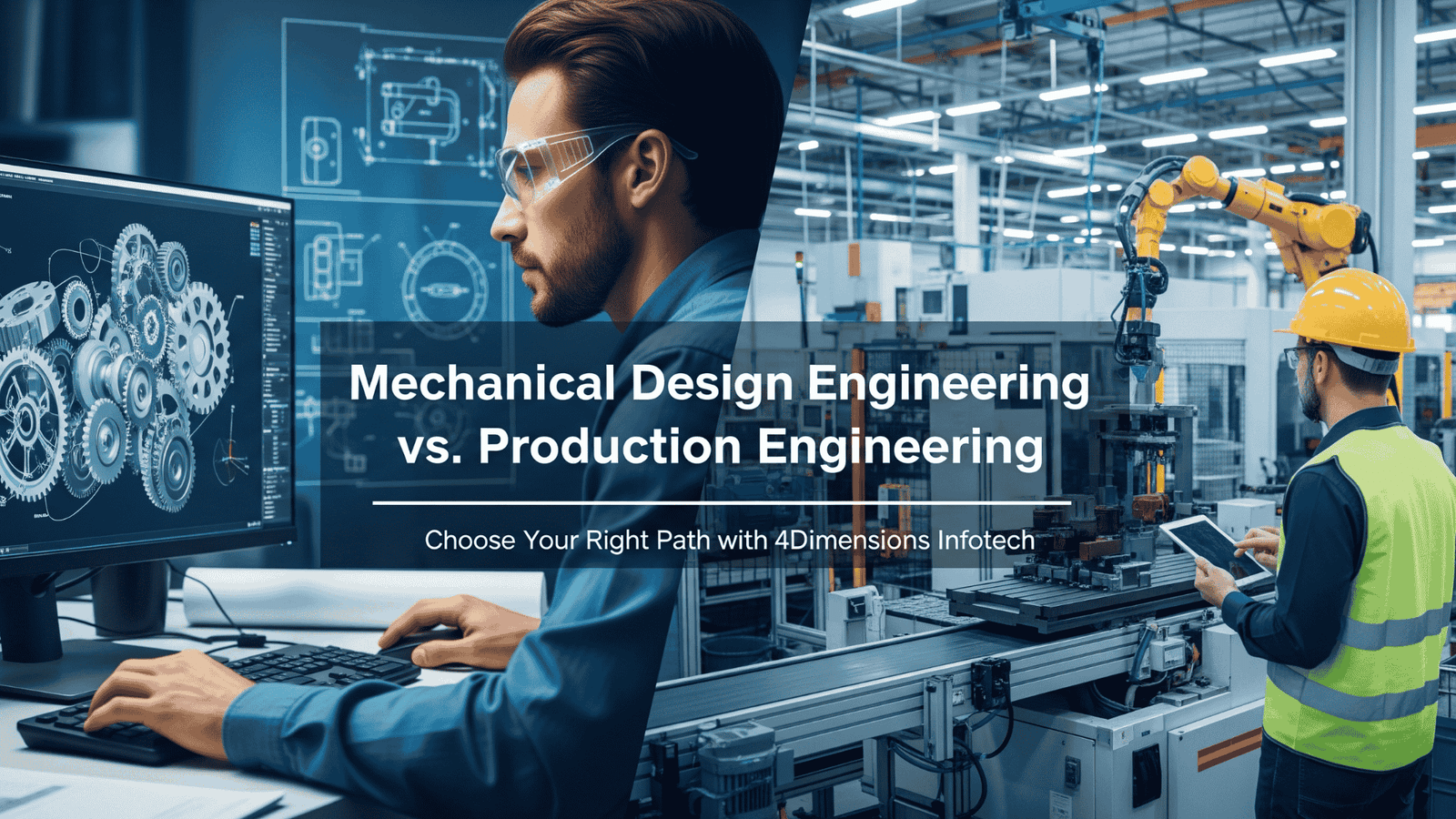
If you are a mechanical engineering student or a fresh engineer wondering whether to move into mechanical design engineering or production engineering, you are not alone. Both roles are important in industry, but they require different skills, mind-sets and career paths. At 4Dimensions Infotech, we believe it is important to understand each option in clear terms—so you can pick what fits you best and build a strong career ahead.
In this article you’ll get:
A clear definition of both fields.
What each job role typically involves.
Key differences in what you do, what skills you need, what growth looks like.
Which might be better for you, depending on your interests.
How you can prepare (and train) for either path.
Why 4Dimensions Infotech is the right training partner to help you succeed in either role.
Mechanical Design Engineering is the field where you create, model and develop mechanical parts, assemblies and systems. You use CAD (computer aided design) tools, engineering knowledge and simulation tools. According to one source: design engineers “create detailed plans and technical drawings for the manufacturing of mechanical devices and systems.” manufast.in+2Wikipedia+2
Conceptualise and sketch mechanical components and systems.
Use CAD/CAE tools (e.g., SolidWorks, CATIA, NX) to build 3D models, assemblies, drawings.
Perform simulation, analysis (stress, dynamics, thermal) to check if designs will work.
Select materials, set tolerances, ensure manufacturability and assembly.
Work with manufacturing, production and other teams to take the design to production.
Strong CAD/CAE skills.
Good understanding of mechanics, materials, dynamics, thermodynamics.
Creativity and problem-solving: designing something new or improving an existing system.
Attention to detail and design thinking: one small error and a design may fail in manufacturing.
Communication skills: you must explain your design decisions, work with manufacturing, quality etc.
Mechanical design engineers often start at junior designer or CAD operator roles. Later they may move to senior designer, design engineer, system engineer or design lead. The field offers scope in industries like automotive, aerospace, consumer products, energy etc. As stated: “Mechanical engineering is a field that offers a wide range of opportunities for those with the right skills and interests.”
Production Engineering (also called Manufacturing Engineering) is the field where you focus on the manufacturing process, the systems, machines, workflows, production lines and ensuring that parts/products are made in the best way. According to one source: “Manufacturing engineering or production engineering … focuses on transforming raw materials into finished products through efficient, effective, and economical methods.”
Plan and manage production processes: how many units, what machines, what workflow.
Ensure manufacturing equipment is reliable, efficient, safe.
Implement quality control, lean manufacturing, cost reduction, process improvement.
Work with supply chain, maintenance, operations, manufacturing teams to deliver products on time, at the right cost.
Monitor production output, equipment downtime, scrap, waste and take corrective actions.
Good understanding of production systems, manufacturing methods (casting, machining, forming, assembly).
Knowledge of process improvement, lean, Six Sigma, productivity metrics.
Strong operations mindset: output, efficiency, manufacturing cost, scheduling.
Good coordination, planning, problem-solving in a fast paced environment.
Communication and teamwork: you interact with production workers, engineers, planners, managers.
Production engineers start in roles like production engineer, process engineer or manufacturing engineer. Later they may move to manufacturing manager, operations manager, plant manager, or specialist roles in automation/lean manufacturing. According to comparison data between production engineers and mechanical engineers: production engineers often earn more (in some markets) and focus on operations and manufacturing rather than only design.
When choosing between design and production engineering, here are the major differences you should consider.
| Feature | Mechanical Design Engineering | Production Engineering |
|---|---|---|
| Focus | Designing new parts/systems, modelling, simulation, creativity | Manufacturing systems, processes, operations, output, cost, efficiency |
| Tools & software | CAD, CAE, 3D modelling, simulation | ERP/MRP systems, production planning tools, process improvement tools |
| Working environment | Often desk/office, modelling, design reviews, meetings | Often factory/plant floor exposure, production schedules, operations review |
| Skill emphasis | Design thinking, modelling, analysis, creativity | Process thinking, operations management, cost control, productivity |
| Career path | Designer → Senior Designer → System Engineer → Design Lead → Innovation/Research | Production Engineer → Process/Manufacturing Engineer → Plant/Operations Manager → Head Operations |
| Typical industries | Automotive, aerospace, consumer products, energy, R&D | Manufacturing plants, large scale production, heavy industry, operations heavy sectors |
| Job variability | High creativity, variable tasks, newer designs | High repetition, production driven, continuous improvement, large volumes |
| What may we consider “better”? | If you love designing new things, modelling, simulation | If you love production, operations, manufacturing, efficiency and hands-on processes |
There is no absolute answer to “which is better” — it depends on your interests, skills, and career goals. Here are guiding questions to help you decide.
Do you enjoy creating and modelling new things (parts, systems, assemblies) rather than only managing how things are made? If yes → design may suit you.
Do you prefer hands-on work, plant visits, manufacturing systems, process optimisation rather than sitting at a desk doing modelling? If yes → production might suit you.
Are you more comfortable with software modelling tools, simulations, CAD or with machines, manufacturing lines, production schedules?
What kind of industries do you want to work in? New product development and innovation fields favour design. Large scale manufacturing or operations heavy industries favour production.
In terms of long term growth: Do you see yourself as a design specialist or innovation lead, or as operations leader/plant head?
Where is your strength: creativity and design thinking, or process efficiency and management?
If you like mechanics, modelling, CAD, simulation, pick mechanical design engineering.
If you like production, manufacturing processes, optimisation, larger scale output, pick production engineering.
You can also combine: many industries require engineers who understand both design and manufacturing (Design for Manufacturing & Assembly, DFMA). Having both mind-sets gives you added advantage.
In India especially, manufacturing and operations are very important—so production engineering has strong demand. At the same time, design engineers are in demand in automotive, aerospace, EV, and high-technology industries. According to “Scope of Mechanical Engineering in India”, both design and production roles are widely available. gku.ac.in
No job is perfect. Understanding the difficulties helps you prepare better and avoid surprises.
You often face tight deadlines for new product development.
Design changes may come late, leading to re-work.
You must constantly keep up with new software tools, materials, manufacturing methods.
Your job might involve a lot of desk work and modelling; less “hands-on” manufacturing exposure (unless you make effort to get it).
If you don’t understand manufacturing constraints, your design may become expensive or unbuildable (which hurts your performance).
Working in a manufacturing environment often means shift work, plant floor exposure, possibly non-office hours.
You may handle large volumes of production with repetitive responsibilities.
Output, quality, cost, downtime are always on your shoulders—this can create pressure.
You must deal with maintenance, breakdowns, machine downtime, workforce issues.
Innovation work may be less than design roles; more focus on process improvement than creating entirely new products.
Since you work with 4Dimensions Infotech, here is how you can prepare for whichever path you choose.
Master CAD/CAE tools such as SolidWorks, CATIA, UG/NX, Creo.
Do projects: go from concept → CAD model → simulation → drawings → manufacturable product (even if in lab).
Learn materials, manufacturing methods, assembly, tolerancing.
Understand design for manufacturing (DFM) and design for assembly (DFA) so your designs can actually be manufactured.
Build a portfolio: downloadable parts, assemblies, simulation results, your design decisions documented.
Stay updated with trends: electric vehicles, lightweight materials, additive manufacturing.
Learn manufacturing methods: casting, machining, forming, welding, assembly.
Understand production planning, scheduling, ERP/MRP basics, process improvement tools (Lean, Six Sigma).
Get plant exposure/internship: visit factory floors, see production lines, machine operations.
Work on projects that improve process efficiency: reduce cycle time, reduce scrap, improve quality.
Learn about automation, robotics, manufacturing systems, IoT in manufacturing.
Develop soft skills: coordination, leadership, conflict management, process monitoring.
At 4Dimensions Infotech, we offer both streams of training, so you can prepare for whichever path suits you or even combine both skill-sets. Our courses include CAD/CAM, mechanical design software, production/manufacturing engineering modules, hands-on projects and placement support.
Let’s compare opportunities, growth, salary aspects — keeping in mind regional market (India) and global trends.
Mechanical design engineering: strong demand in industries like automotive (EVs), aerospace, consumer products, heavy machinery.
Production engineering: strong demand in manufacturing, operations, large scale plants, especially in India due to “Make in India”, manufacturing growth.
Because manufacturing is a large part of Indian industry, production engineers have stable opportunities; but for design engineers too the scope is widening with advanced manufacturing, digital twins, simulation and global design centres.
A comparison in one source (U.S. market) shows production engineers had higher average salary than mechanical engineers. Zippia
In India, salary depends on industry, company, skills, project complexity and experience. Design engineers in advanced industries (automotive, aerospace) can earn high. Production engineers with strong process improvement skills and ability to deliver cost savings are also highly valued.
Growth wise: Both paths can lead to leadership roles—Design Lead/Chief Designer or Plant/Operations Manager. Which one is “better” salary-wise depends on the company, demands, skillset.
Because both design and production are critical to industry, neither is definitively “better”.
For staying future-proof: combining both skill sets (design + manufacturing awareness) gives advantage.
Also, fields like additive manufacturing, simulation, Industry 4.0 are closing gap between design and production, making hybrid engineers more valuable.
Here is what I recommend based on your interests:
If you love designing mechanical systems, you enjoy CAD/CAE, creating new parts and assemblies, working on simulations, you should pick Mechanical Design Engineering.
If you prefer working on the production floor, managing manufacturing systems, optimizing process, achieving higher output and cost control, you should pick Production Engineering.
If you are not fully sure yet, at 4Dimensions Infotech you can start with a basic CAD/design course (gives you design exposure) and simultaneously take modules in manufacturing/production so you keep your options open.
Also industry demands: In Pune, Maharashtra (and nearby industrial belts) there are opportunities both in design (especially automotive) and production/manufacturing. So choose what excites you and where you can excel.
At 4Dimensions Infotech, we specialise in training engineers for both mechanical design and production/manufacturing engineering roles. Here’s how we help you build the right skill-set and career path:
Comprehensive CAD/CAM training: We teach industry-standard tools like CATIA, SolidWorks, UG/NX, Creo (for design) as well as manufacturing modules (jigs & fixtures, BIW design, material handling equipment).
Hands-on, project-based learning: You don’t just learn theory—at 4Dimensions Infotech you apply what you learn on real projects, simulations and manufacturing case-studies.
Dual path support: Whether you aim to be a design engineer or production/manufacturing engineer—or a hybrid—you get the training and modules for both.
Placement guarantee & industry connections: We have placement focus and industry tie-ups so you can step into the job market with confidence.
Flexible learning formats: Day-time/weekend batches, online + offline modes to suit working professionals and full-time students alike.
Choosing between mechanical design engineering and production engineering is not about one being better than the other in general—it’s about which is better for you. Both have strong roles in industry, both need specific skills, both offer growth and good opportunities. What matters most is that you align your skills, interests and career goals.
At 4Dimensions Infotech, we understand this path. We help you decide, train you for the role you pick, and support you to step into your career with confidence. Whether you pick design, production or a blend of both—we’ve got you covered.
Ready to build your career in mechanical engineering? Join 4Dimensions Infotech today and let’s design your future together.
© 2025 4Dimensions Infotech. All rights reserved. | Best Design Engineering Training Institute in Pune
Start your journey with the best design engineering training institute in Pune.