
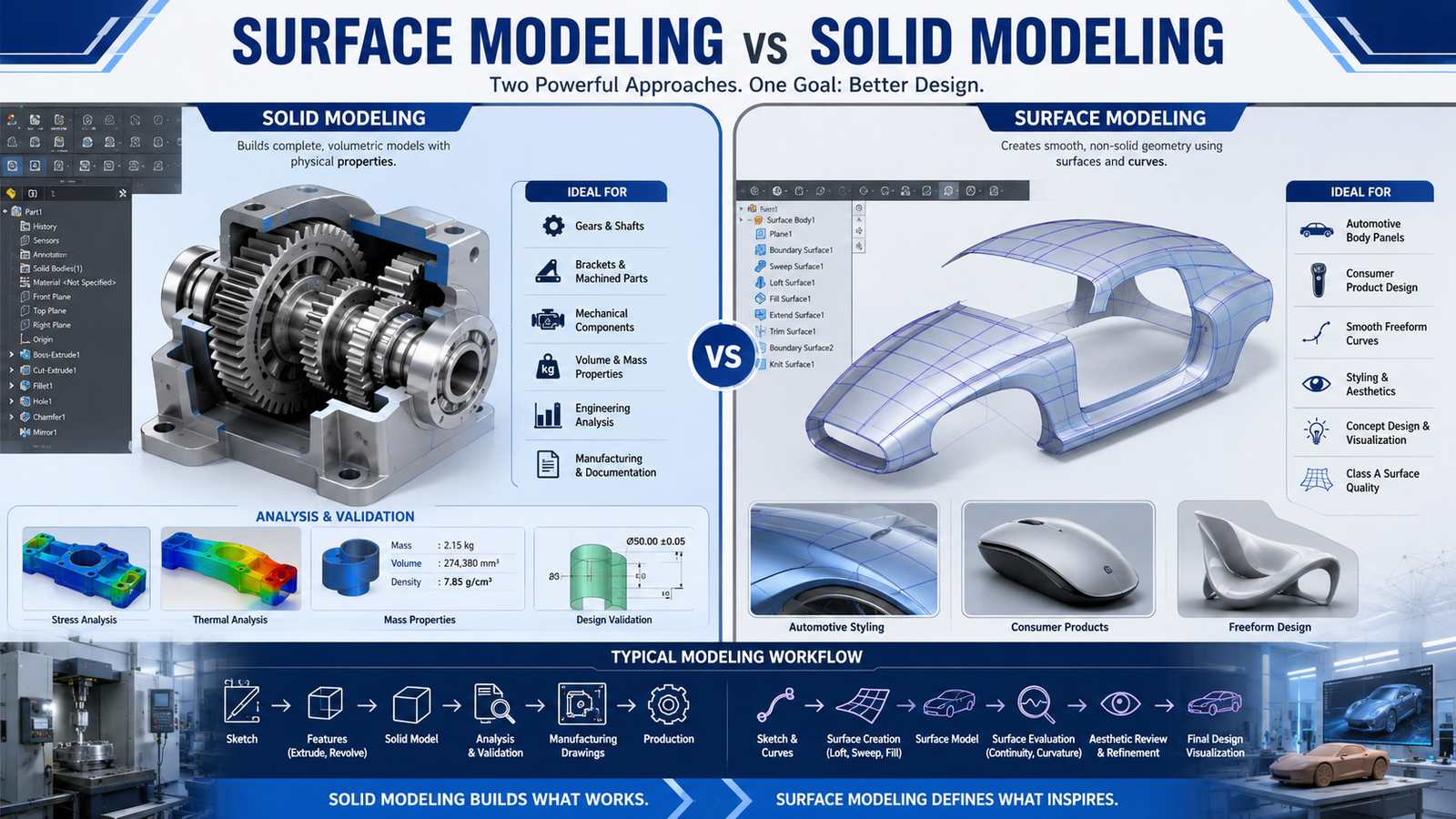
At 4Dimensions Infotech Pune, students enrolled in a CAD Design Course, SolidWorks Course, or CATIA Course quickly discover that modern product development depends heavily on advanced 3D CAD modeling techniques.
Among the most important methods used in engineering design are Surface Modeling and Solid Modeling. Understanding Surface Modeling vs Solid Modeling is essential for mechanical engineers, product designers, automotive engineers, and anyone working in modern manufacturing industries.
Although both techniques are used in 3D CAD modeling, they serve completely different purposes. One focuses on creating visually appealing and complex shapes, while the other focuses on creating functional engineering components that can be manufactured and analyzed.
Modern companies rarely rely on a single modeling approach. Instead, they combine both techniques within the same product development cycle. This workflow is commonly used in industries such as automotive, aerospace, consumer electronics, industrial machinery, and product design.
Engineers working in companies often use workflows explained in real industry CAD workflows, where both Surface Modeling and Solid Modeling play an important role in turning ideas into real products.
Therefore, understanding the difference between Surface Modeling vs Solid Modeling is no longer optional. It has become a fundamental skill for every design engineer.
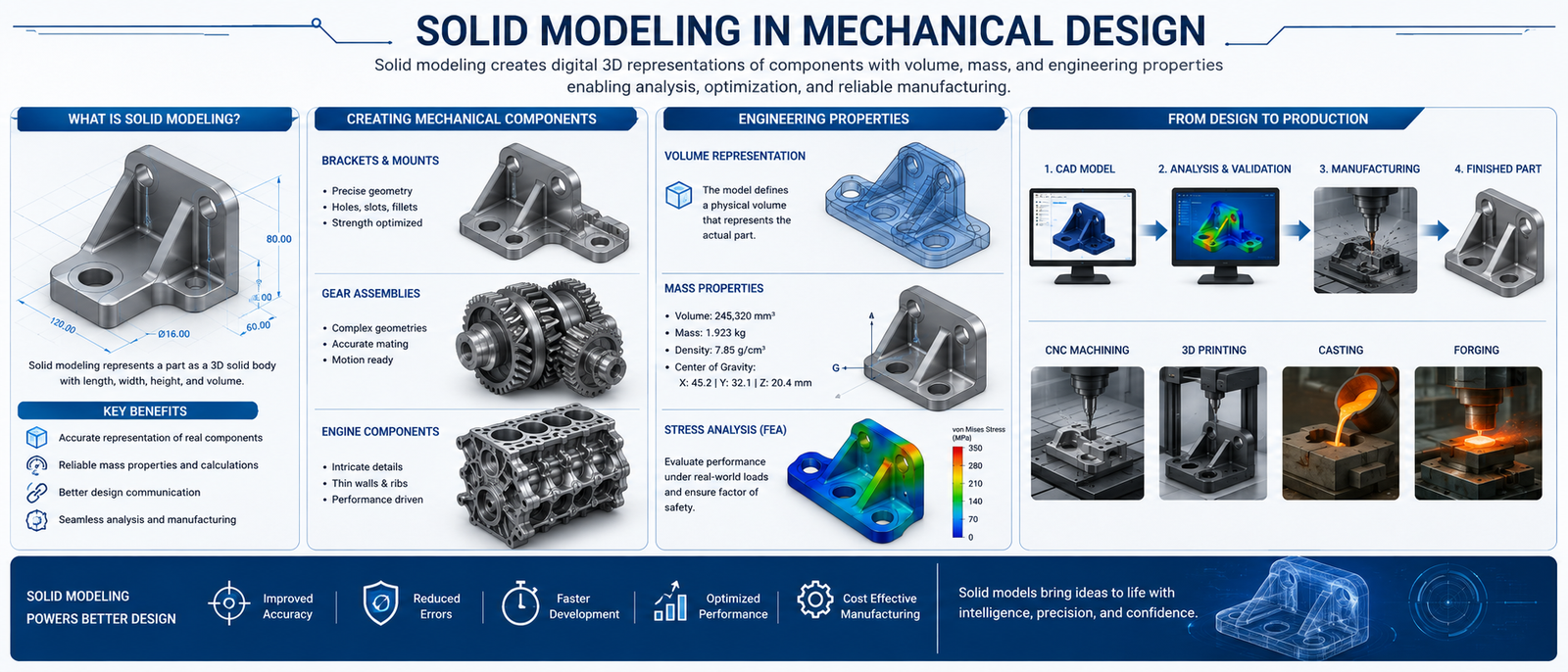
Solid Modeling is a CAD technique used to create complete 3D objects that contain volume, mass, and physical properties. Unlike simple visual representations, a solid model behaves like a real engineering component.
Because the model contains material information, engineers can calculate weight, center of gravity, volume, and structural properties. This makes Solid Modeling extremely useful in mechanical engineering and manufacturing applications.
For example, machine components such as gears, shafts, brackets, housings, and industrial assemblies are usually created using Solid Modeling techniques.
One of the biggest advantages of Solid Modeling is that it supports engineering analysis. Engineers can perform stress analysis, thermal analysis, motion studies, and manufacturing validation directly on the model.
This approach directly supports concepts explained in Design for Manufacturing (DFM), where engineers ensure that products can be manufactured efficiently and economically.
Modern software such as SolidWorks, CATIA, Creo, and NX provide powerful Solid Modeling tools that are widely used throughout the engineering industry.
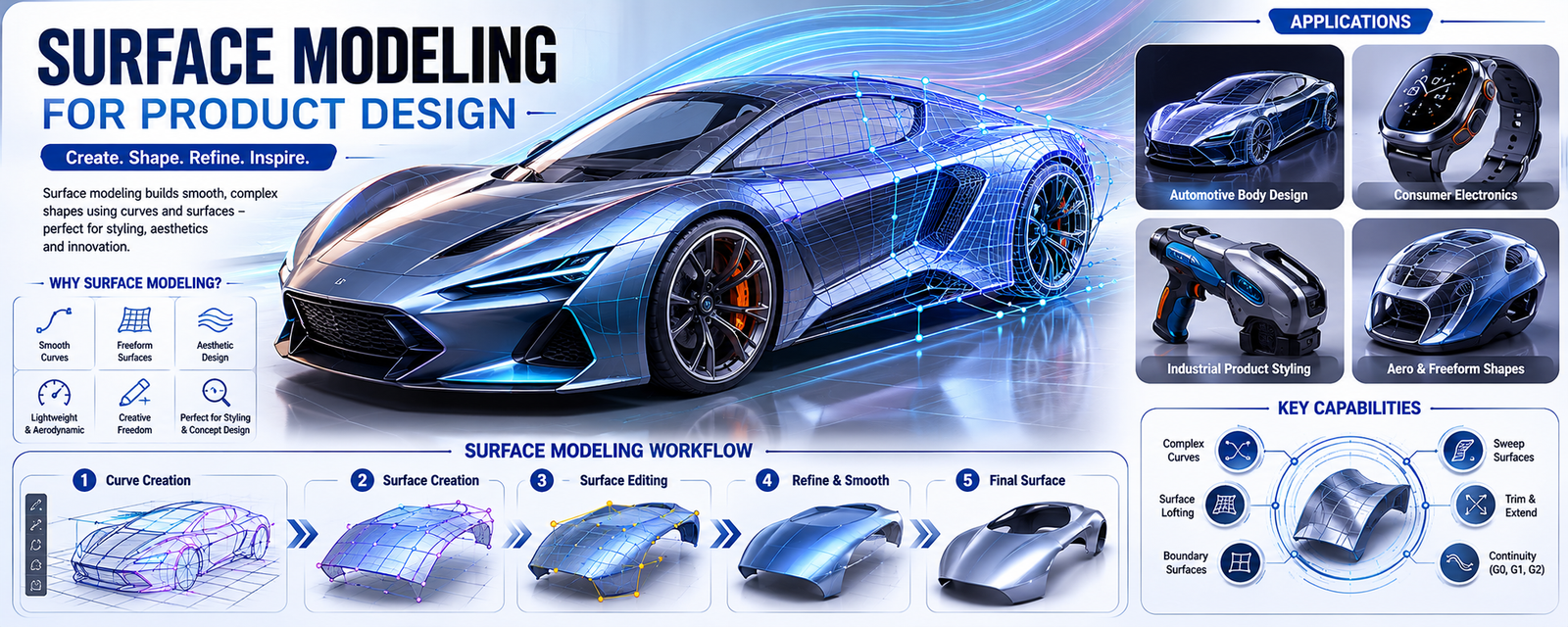
Surface Modeling focuses on creating complex external shapes and freeform geometries. Unlike Solid Modeling, surface models do not necessarily contain volume or mass properties.
Instead, Surface Modeling is used to create visually appealing designs with smooth curves, organic shapes, and aerodynamic surfaces.
This makes Surface Modeling extremely popular in automotive design, aerospace design, consumer electronics, medical products, and industrial product styling.
For example, the outer body of a car, smartphone casing, aircraft exterior panels, and modern consumer products are often developed using Surface Modeling techniques.
The importance of aesthetics in engineering is explained in Functional vs Aesthetic Design Engineering, where engineers balance appearance with functionality.
Software such as CATIA is particularly known for its advanced Surface Modeling capabilities, which is one reason it is heavily used in automotive and aerospace industries.
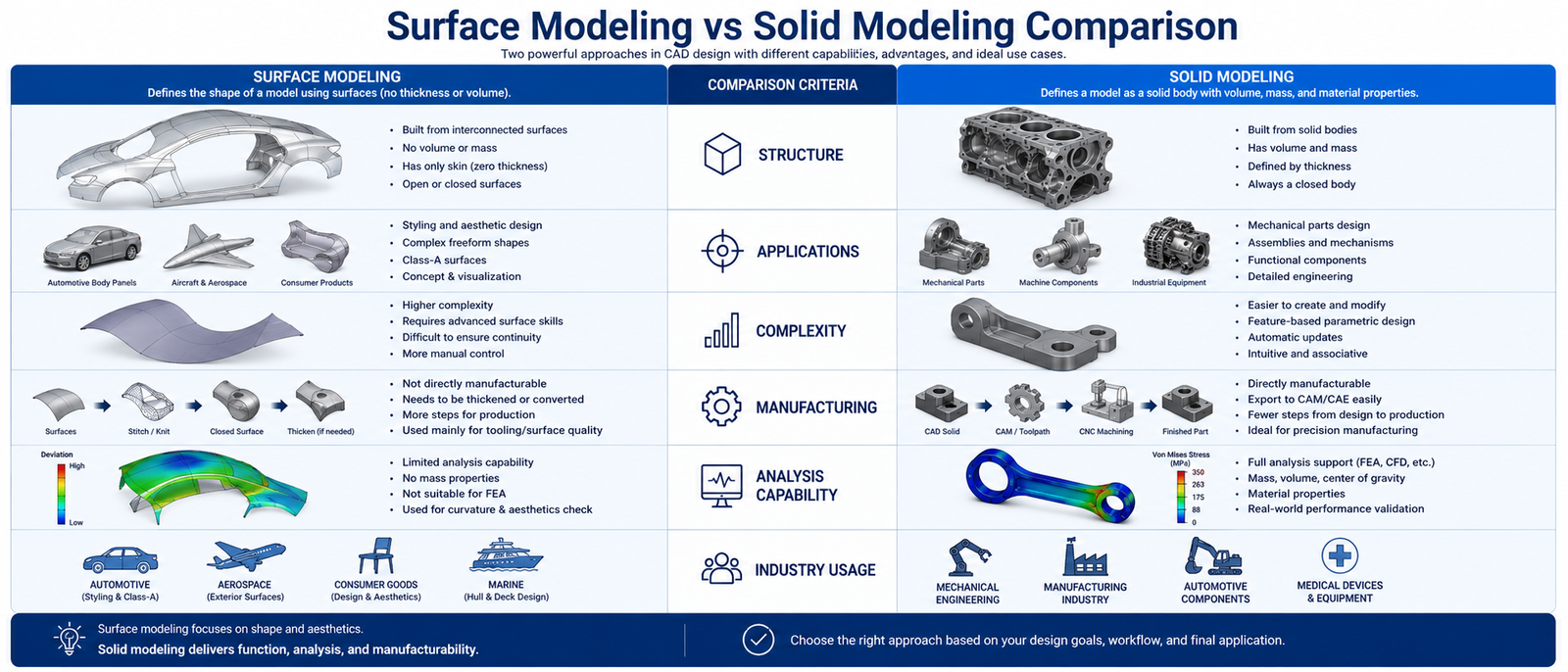
When comparing Surface Modeling vs Solid Modeling, the biggest difference lies in how the model is represented and used.
Solid Modeling focuses on engineering functionality, manufacturing, and analysis. Engineers use it when designing mechanical components that require simulation, manufacturing validation, and physical properties.
Surface Modeling focuses on visual appearance, styling, and complex geometry creation. It allows designers to create smooth and sophisticated shapes that would be difficult to create using traditional solid modeling methods.
Another major difference is industry application. Mechanical engineering companies primarily rely on Solid Modeling, while automotive and product design industries often rely heavily on Surface Modeling.
However, modern engineering projects rarely use only one technique. Most companies combine both methods to achieve the best results.
This hybrid workflow is commonly used in real industry CAD workflows, where aesthetics and functionality must work together.
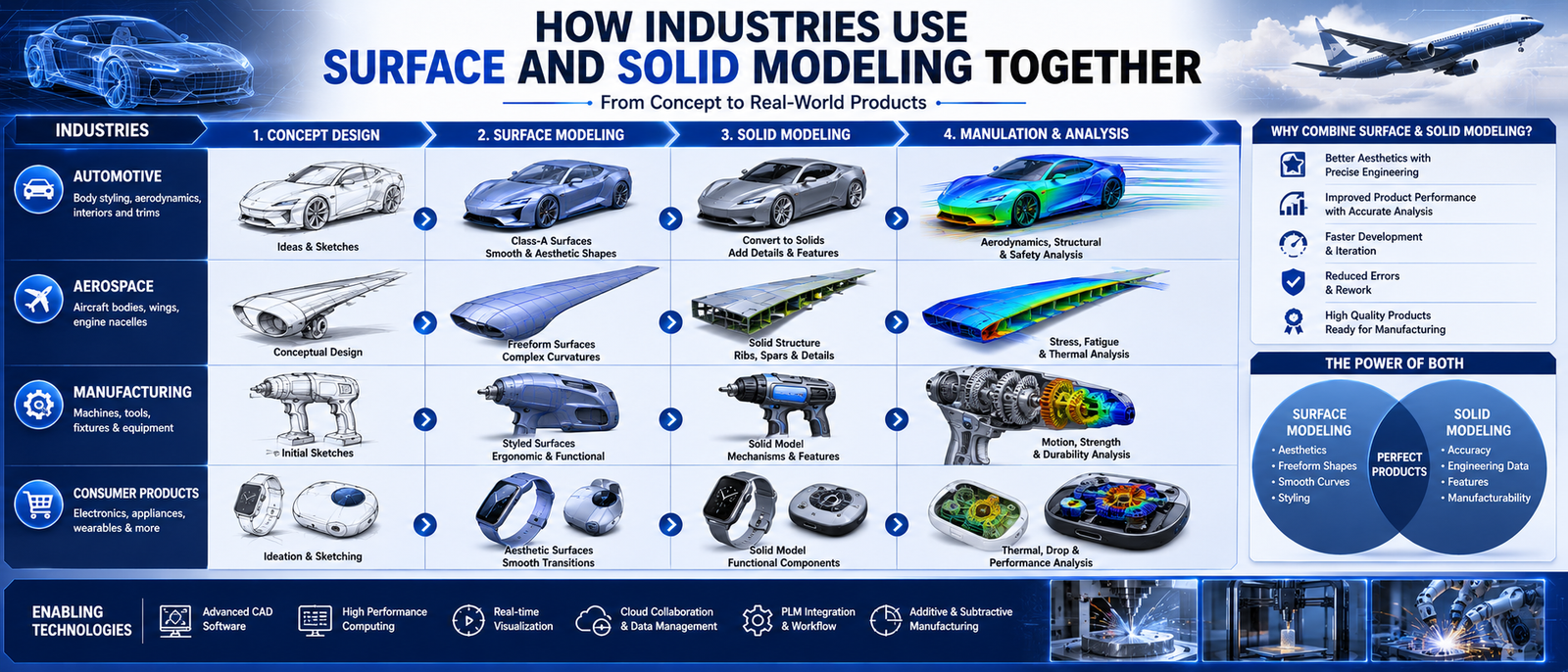
In real-world engineering projects, companies rarely choose between Surface Modeling and Solid Modeling. Instead, they use both techniques together.
First, designers create complex shapes using Surface Modeling. Once the external appearance is finalized, engineers convert these surfaces into solid models for structural analysis, manufacturing, and simulation.
This approach allows companies to create products that are both visually appealing and mechanically reliable.
Students pursuing a CAD Design Course in Pune, SolidWorks Course in Pune, or CATIA Course in Pune should focus on learning both techniques because employers increasingly expect engineers to understand complete product development workflows.
Understanding Surface Modeling vs Solid Modeling is essential for modern engineers. While Surface Modeling focuses on shape, aesthetics, and freeform geometry, Solid Modeling focuses on functionality, analysis, and manufacturing.
Together, these techniques form the foundation of modern CAD design and product development.
At 4Dimensions Infotech Pune, students gain practical experience using industry-standard software such as SolidWorks, CATIA, AutoCAD, and Creo.
Through real-world projects, students learn Surface Modeling, Solid Modeling, simulation workflows, and manufacturing-focused design techniques that companies actively look for when hiring engineers.
1. What is Surface Modeling?
Surface Modeling is used to create complex and smooth external shapes without volume information.
2. What is Solid Modeling?
Solid Modeling creates 3D objects with volume, mass, and engineering properties.
3. Which is better, Surface Modeling or Solid Modeling?
Both are useful depending on the design requirements and industry application.
4. Where is Surface Modeling used?
It is commonly used in automotive design, aerospace design, and consumer product development.
5. Can Surface Modeling and Solid Modeling be used together?
Yes. Most real-world engineering projects combine both techniques to achieve optimal results.
© 2025 4Dimensions Infotech. All rights reserved. | Best Design Engineering Training Institute in Pune
Start your journey with the best design engineering training institute in Pune.