
At 4Dimensions Infotech, one pattern becomes clear very quickly.
Students who only learn software often struggle, while those who understand how design impacts manufacturing move ahead faster.
That difference defines modern design engineers.
Many people assume innovation comes from machines, automation, or new technology.
However, real innovation begins much earlier at the design stage.
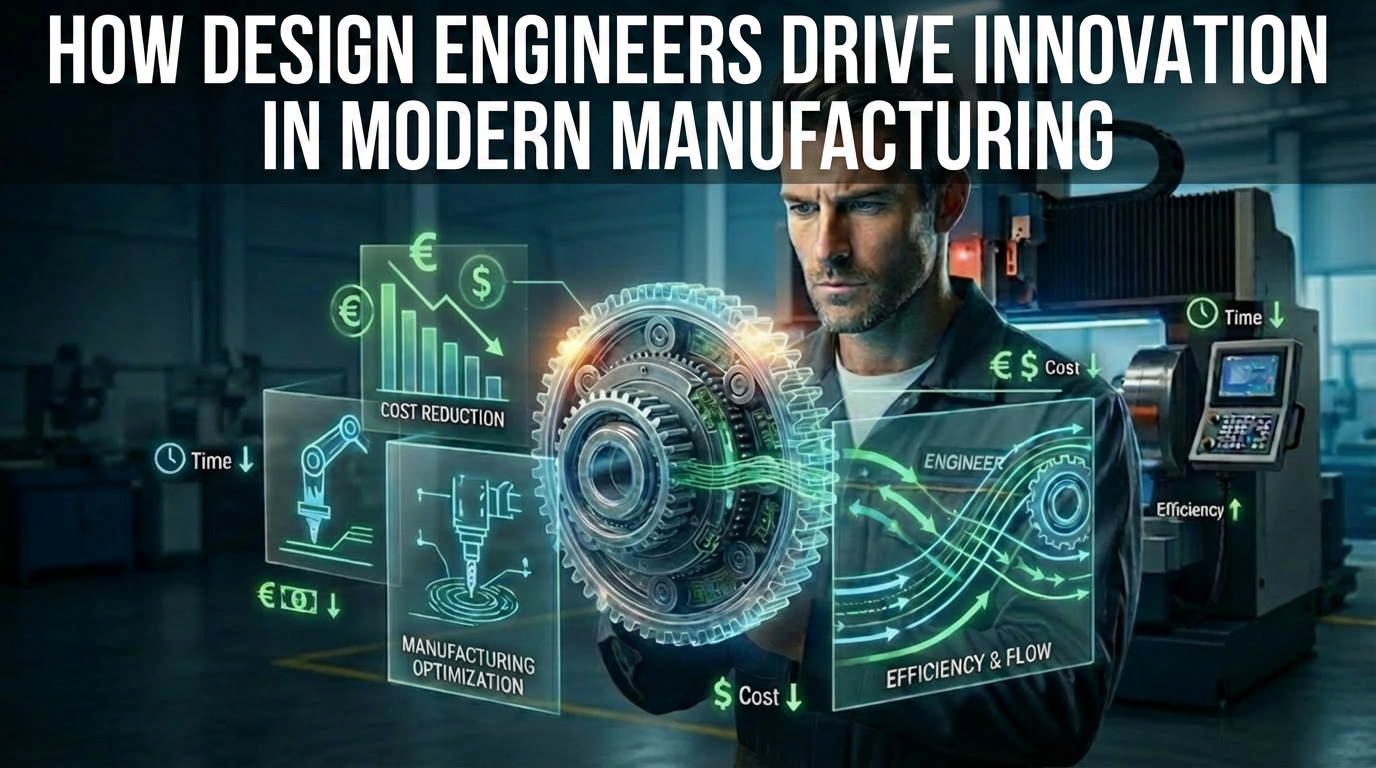
Even a small design change can reduce manufacturing time, lower production cost, and improve product performance.
As a result, modern manufacturing solves problems before they appear on the shop floor.
This is exactly where design engineers create value.
The role of a design engineer has evolved.
Today, engineers do much more than create drawings.
They actively contribute to product development, design optimization, material selection, manufacturing planning, and cost reduction.
Therefore, they influence the entire lifecycle of a product not just its design.
This is where ideas take shape.
Using skills from a CAD course or design training, engineers create efficient geometries, reduce complexity, and improve functionality.
Even minor design improvements can lead to major gains in production efficiency.
At this stage, design connects with production.
Engineers who understand manufacturing through CAD CAM courses or practical training can design parts that are easier to machine and faster to produce.
As a result, they reduce tool wear, improve speed, and increase efficiency.
This is where real industry value is created.
At a higher level, design integrates with automation and smart manufacturing.
Engineers begin to think about how products interact with machines and how workflows can be optimized.
This is where Industry 4.0 thinking becomes important.
In today’s competitive environment, companies must reduce costs, improve quality, and deliver faster.
Because of this, they need engineers who can think ahead not just follow instructions.
Students trained in tools like SolidWorks, CATIA, and Creo combined with practical knowledge are highly valued in the industry.
A single design decision can save hours of machining time, reduce material usage, and eliminate production errors.
When applied across large-scale production, these improvements create significant impact.
That is innovation at scale.
Innovation appears differently across industries.
In mechanical design, the focus is on improving product performance and manufacturability.
In contrast, civil engineering focuses on improving planning, coordination, and execution.
Tools like Revit and Civil 3D help civil engineers bring innovation into infrastructure projects.
Pune is one of India’s leading manufacturing hubs.
With strong industries in automotive, engineering, and production, the demand for skilled design engineers continues to grow.
As a result, interest in CAD training, practical learning, and industry-focused courses is increasing rapidly.
Most students learn software.
However, very few learn how to apply it effectively in real-world scenarios.
This creates two types of engineers:
Innovation belongs to the second group.
To stand out, you need more than just software knowledge.
Start by learning design fundamentals.
Then, understand manufacturing processes and focus on efficiency, cost, and real-world applications.
Most importantly, work on practical projects that build problem-solving ability.
Machines do not innovate.
Software does not innovate.
Engineers do.
Design engineers sit at the center of this transformation.
If you think beyond drawing and connect design with real-world impact, you won’t just be part of manufacturing—you will shape its future.
👉 Start your journey with CAD courses in Pune and become a design engineer who drives innovation.
Design engineers improve product design, optimize manufacturing processes, and reduce costs before production begins.
CAD tools allow engineers to create, test, and refine designs digitally, making it easier to identify improvements early.
CAD CAM training connects design with manufacturing, helping engineers create practical and production-ready designs.
Design fundamentals, software skills, manufacturing knowledge, and problem-solving ability are essential.
Yes, design engineering remains a strong career with growing demand in manufacturing, automation, and product development.
© 2025 4Dimensions Infotech. All rights reserved. | Best Design Engineering Training Institute in Pune
Start your journey with the best design engineering training institute in Pune.