
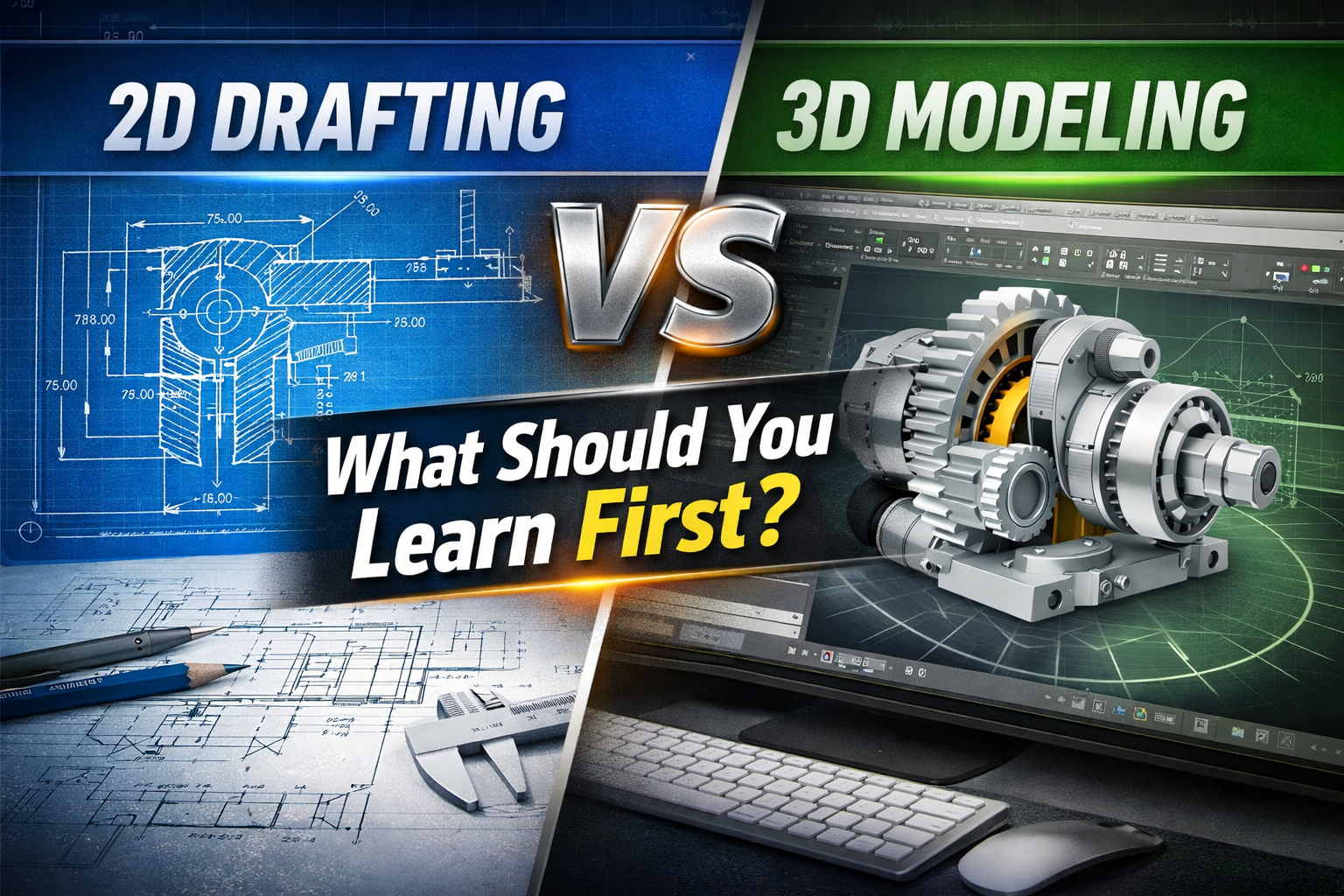
If you’re planning a career in design engineering, one of the most common questions is: 2D drafting vs 3D modeling – what should you learn first?
For students exploring CAD courses in Pune, this confusion is very common. At 4Dimensions Infotech, students follow a structured learning path starting from fundamentals and progressing to advanced design tools.
2D drafting is the process of creating flat technical drawings using software like AutoCAD. It is the foundation of any design career and helps you understand how engineering drawings are created and interpreted.
Most CAD training programs begin with 2D drafting because it builds a strong base for learning advanced tools.
3D modelling involves creating realistic digital representations of components and products. It allows engineers to visualize, test, and improve designs before production.
Tools like SolidWorks, CATIA, and Creo are widely used for 3D design and product development.
Through 3D modelling, you learn product design, assemblies, simulations, and complete system visualization, which are essential in modern industries.
When comparing 2D drafting vs 3D modelling, the main difference lies in how designs are created and visualized.
2D drafting focuses on flat drawings that represent different views of a design, while 3D modeling allows you to build a complete, realistic model that can be rotated, tested, and analyzed.
While 2D drafting is simpler and forms the foundation, 3D modeling is more advanced and widely used in real-world product development. Most industries expect engineers to understand both.
Beginners should always start with 2D drafting. Learning AutoCAD first helps you understand design basics, dimensions, and layouts, making it easier to move to advanced tools later.
That’s why most CAD training programs in Pune start with AutoCAD before introducing 3D software.
Once you are comfortable with 2D drafting, you can move to 3D modeling tools. This step allows you to apply your fundamentals to real-world design projects.
Software like SolidWorks, CATIA, and Creo helps you develop advanced design skills required in industries such as automotive and manufacturing.
To expand your career opportunities, you can explore additional courses that complement your core CAD skills.
If you’re searching for CAD courses in Pune, 4Dimensions Infotech offers a structured learning approach that helps students become job-ready.
After mastering both 2D drafting and 3D modeling, you can explore roles such as CAD Designer, Mechanical Design Engineer, and Product Design Engineer.
Students with practical experience have strong job opportunities across industries.
Freshers can start with ₹2.5 – ₹4 LPA. With experience and strong 3D modeling skills, salaries can grow to ₹4 – ₹8 LPA and beyond.
To summarize, the right approach is simple—start with 2D drafting to build a strong foundation, then move to 3D modeling for advanced design skills.
This structured learning path helps you grow faster and become job-ready in the design industry.
👉 Join 4Dimensions Infotech and build a strong foundation in design engineering.
You should start with 2D drafting to build a strong foundation, then move to 3D modeling for advanced skills.
Yes, AutoCAD helps you understand design basics, which makes learning 3D tools easier.
Both are important, but 3D modeling offers more advanced career opportunities. However, 2D drafting is essential as a starting point.
It is possible, but not recommended. Starting with 2D drafting makes the learning process smoother.
Courses that include AutoCAD, SolidWorks, and CATIA with practical training and placement support are considered the best.
© 2025 4Dimensions Infotech. All rights reserved. | Best Design Engineering Training Institute in Pune
Start your journey with the best design engineering training institute in Pune.